Industry-Verified Manufacturing Data (2026)

Communication Transceiver

Based on aggregated insights from multiple verified factory profiles within the CNFX directory, the standard Communication Transceiver used in the Motor Vehicle Manufacturing sector typically supports operational capacities ranging from standard industrial configurations to heavy-duty production requirements.

Technical Definition & Core Assembly

A canonical Communication Transceiver is characterized by the integration of Microcontroller Interface and Transmitter Circuit. In industrial production environments, manufacturers listed on CNFX commonly emphasize Silicon (for integrated circuits) construction to support stable, high-cycle operation across diverse manufacturing scenarios.

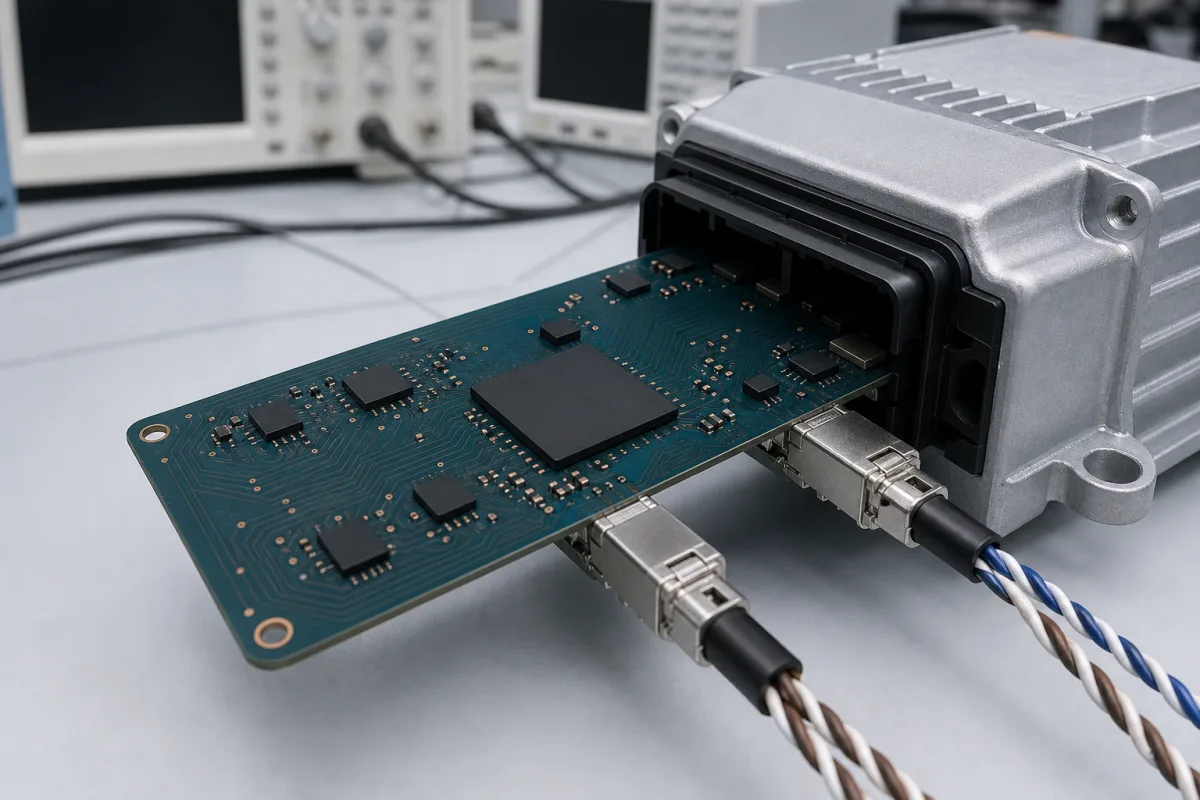
Electronic component within the Battery Control Unit (BCU) responsible for bidirectional data communication between the BCU and external systems.
Product Specifications

Technical details and manufacturing context for Communication Transceiver

Definition
A communication transceiver in the Battery Control Unit (BCU) is a critical electronic module that enables the transmission and reception of data signals. It facilitates real-time communication between the BCU and external entities such as vehicle control units, charging stations, or diagnostic tools, allowing for monitoring battery status, sending control commands, and receiving configuration updates.
Working Principle
The transceiver converts digital data from the BCU's microcontroller into electrical signals suitable for transmission over communication buses (e.g., CAN, LIN, Ethernet). It simultaneously receives incoming signals, demodulates them, and converts them back into digital data for the BCU to process. This involves modulation/demodulation techniques, signal conditioning, and protocol handling specific to the automotive communication standard employed.
Common Materials
Silicon (for integrated circuits), Copper (for connectors and traces), Epoxy resin (for encapsulation)
Technical Parameters
  • Data transmission rate, e.g., 500 kbps for CAN bus (bps) Per Request
Components / BOM
  • Microcontroller Interface
    Connects to the BCU's main microcontroller for data exchange
    Material: Silicon, Copper
  • Transmitter Circuit
    Converts digital signals to modulated electrical signals for transmission
    Material: Silicon, Copper
  • Receiver Circuit
    Receives and demodulates incoming signals for digital processing
    Material: Silicon, Copper
  • Bus Interface Connector
    Physical connection point to the communication bus
    Material: Copper, Plastic
Engineering Reasoning
3.0-5.5 VDC, -40 to +85°C
2.7 VDC supply voltage, 125°C junction temperature
Design Rationale: Semiconductor junction breakdown due to thermal runaway beyond 125°C, logic state corruption below 2.7V CMOS threshold
Risk Mitigation (FMEA)
Trigger Electrostatic discharge (ESD) event exceeding 8 kV HBM
Mode: Gate oxide rupture in CMOS transistors
Strategy: Integrated ESD protection diodes with 15 kV IEC 61000-4-2 rating
Trigger Electromagnetic interference (EMI) at 2.4 GHz exceeding 10 V/m
Mode: Bit error rate degradation beyond 10^-6 BER
Strategy: Shielded CAN-FD transceiver with 30 dB RF attenuation at 2.4 GHz

Industry Taxonomies & Aliases

Commonly used trade names and technical identifiers for Communication Transceiver.

Applied To / Applications

This component is essential for the following industrial systems and equipment:

Industrial Ecosystem & Supply Chain DNA

Complementary Systems
Downstream Applications
Specialized Tooling

Application Fit & Sizing Matrix

Operational Limits
pressure: Atmospheric to 1.5 bar absolute
other spec: Operating voltage: 9-36 VDC, Data rate: 10-1000 kbps
temperature: -40°C to +85°C
Media Compatibility
✓ Automotive-grade enclosures ✓ Printed circuit board assemblies ✓ Battery management system interfaces
Unsuitable: High-voltage arc environments
Sizing Data Required
  • Communication protocol (CAN, LIN, Ethernet)
  • Required data throughput (kbps)
  • Power supply constraints (VDC, current draw)

Reliability & Engineering Risk Analysis

Failure Mode & Root Cause
Signal Degradation
Cause: Component aging (e.g., oscillator drift, amplifier gain reduction) due to thermal cycling, voltage fluctuations, or prolonged operation beyond design limits, leading to reduced signal integrity and increased bit error rate.
Hardware Failure
Cause: Environmental stress (e.g., moisture ingress, dust accumulation, vibration) or electrical issues (e.g., power surges, electrostatic discharge) damaging internal circuits, connectors, or antennas, resulting in complete loss of communication.
Maintenance Indicators
  • Intermittent or complete loss of signal transmission/reception despite verified external network integrity
  • Unusual audible noise (e.g., buzzing, static) from the transceiver unit or abnormal visual indicators (e.g., flickering LEDs, overheating signs)
Engineering Tips
  • Implement regular preventive maintenance: Clean air vents and connectors to prevent dust buildup, verify secure mounting to minimize vibration, and monitor operating temperatures to avoid thermal stress.
  • Use surge protection and uninterruptible power supplies (UPS) to stabilize input voltage, and perform periodic signal quality tests (e.g., bit error rate checks) to detect early degradation before failure.

Compliance & Manufacturing Standards

Reference Standards
ISO/IEC 11801: Information technology - Generic cabling for customer premises ANSI/TIA-568.2-D: Balanced Twisted-Pair Telecommunications Cabling and Components Standards CE Marking: Directive 2014/53/EU (Radio Equipment Directive)
Manufacturing Precision
  • Frequency Stability: +/- 0.5 ppm
  • Output Power Variation: +/- 1.0 dB
Quality Inspection
  • Bit Error Rate (BER) Test
  • Electromagnetic Compatibility (EMC) Test

Factories Producing Communication Transceiver

Verified manufacturers with capability to produce this product in China

✓ 94% Supplier Capability Match Found

T Technical Director from United Arab Emirates Jan 22, 2026
★★★★★
"Standard OEM quality for Motor Vehicle Manufacturing applications. The Communication Transceiver arrived with full certification."
Technical Specifications Verified
P Project Engineer from Australia Jan 19, 2026
★★★★☆
"Great transparency on the Communication Transceiver components. Essential for our Motor Vehicle Manufacturing supply chain. (Delivery took slightly longer than expected, but technical support was excellent.)"
Technical Specifications Verified
S Sourcing Manager from Singapore Jan 16, 2026
★★★★★
"The Communication Transceiver we sourced perfectly fits our Motor Vehicle Manufacturing production line requirements."
Technical Specifications Verified
Verification Protocol

“Feedback is collected from verified sourcing managers during RFQ (Request for Quote) and factory evaluation processes on CNFX. These reports represent historical performance data and technical audit summaries from our B2B manufacturing network.”

19 sourcing managers are analyzing this specification now. Last inquiry for Communication Transceiver from Mexico (46m ago).

Supply Chain Compatible Machinery & Devices

Automotive Solid-State Battery Pack

High-energy-density solid-state battery system for electric vehicles

Explore Specs →
Automotive Active Grille Shutter System

Aerodynamic system with motorized shutters for vehicle thermal and efficiency management.

Explore Specs →
Automotive Active Suspension Damping System

Electronically controlled suspension system for vehicle stability and comfort.

Explore Specs →
Ground Assembly Unit

A foundational structural component that provides stable mounting and alignment for equipment within an industrial system.

Explore Specs →

Frequently Asked Questions

What is the primary function of this communication transceiver in motor vehicle manufacturing?

This transceiver enables bidirectional data communication between the Battery Control Unit (BCU) and external vehicle systems, facilitating real-time battery monitoring, control, and integration with the vehicle's network.

How does this transceiver ensure reliable communication in automotive environments?

Built with silicon-based integrated circuits, copper connectors, and epoxy resin encapsulation, it withstands automotive temperature ranges, vibrations, and electromagnetic interference while maintaining stable data transmission.

What vehicle systems typically interface with this BCU transceiver?

It commonly connects to vehicle CAN bus networks, telematics systems, charging infrastructure, diagnostic tools, and other control units to exchange battery status, performance data, and control commands.

Can I contact factories directly on CNFX?

CNFX is an open directory, not a transaction platform. Each factory profile provides direct contact information and production details to help you initiate direct inquiries with Chinese suppliers.

Get Quote for Communication Transceiver

Request technical pricing, lead times, or customized specifications for Communication Transceiver directly from verified manufacturing units.

Your business information is encrypted and only shared with verified Communication Transceiver suppliers.

Thank you! Your message has been sent. We'll respond within 1–3 business days.

Need to Manufacture Communication Transceiver?

Connect with verified factories specializing in this product category

Add Your Factory Contact Us
Previous Product
Communication Interface (e.g., CAN, Ethernet)
Next Product
Component Presentation System