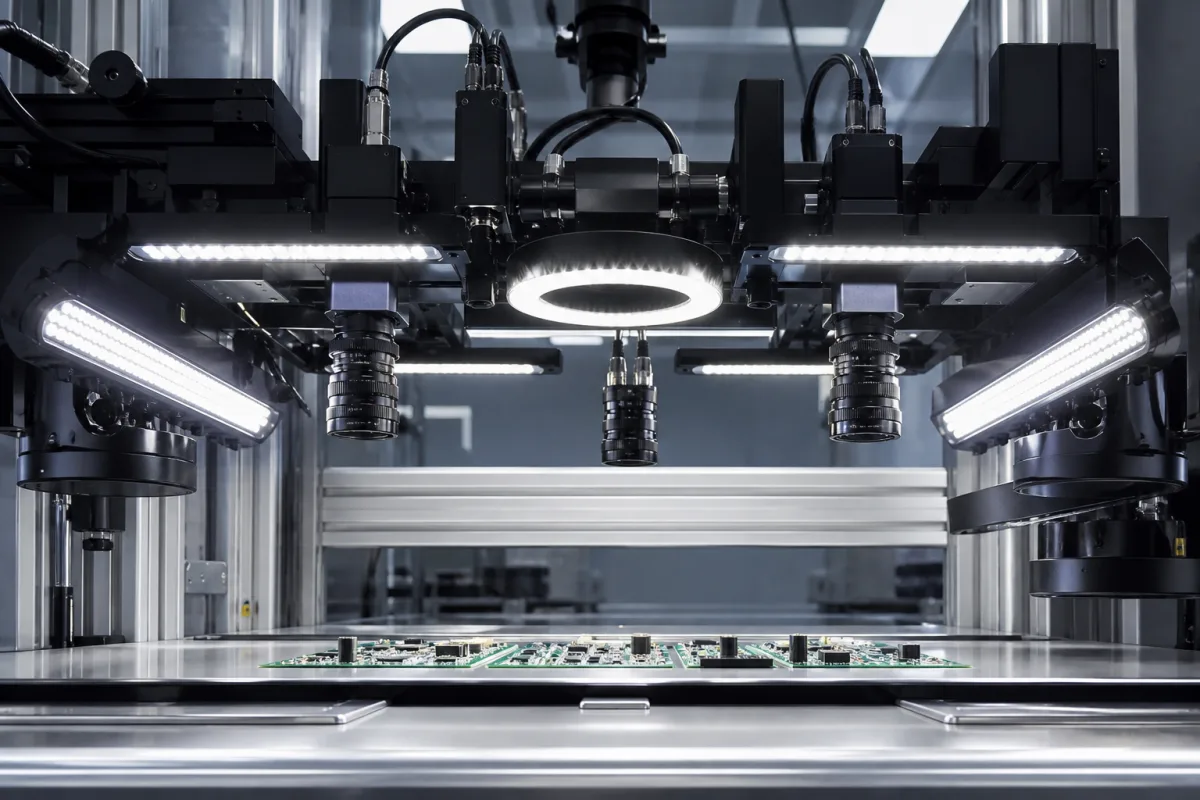
LED illumination array for machine vision: bar and linear LED lights set at angles around the part
LED bar and linear light arrays for machine vision · Lens and beam angle, working distance, OverDrive versus continuous drive, wavelength choice, daisy-chaining and angled bar setups
This page covers LED bar and linear lights used as illumination arrays in machine vision: rows of LEDs behind a lens or diffuser, mounted singly or in pairs and sets at chosen angles to the part. Ask three things first: which lens, wavelength and working distance give the contrast you need, whether the light runs continuously or is strobed in OverDrive with the camera, and how lights are triggered, dimmed and chained.
LED bar lights and linear lights for machine vision inspection, alignment and code reading, used singly or in angled multi-bar arrangements. Machine vision lighting as a whole, including ring, dome, coaxial and backlights with their controllers, is covered on the Illumination unit page. General area lighting, LED panel lights and line-scan lights are outside this page.
CNFX editorial research · Sources checked October 12, 2026 · 3 sources
CCS describes its LDL2 bar lights as emitting surfaces with LEDs arranged in straight lines radiating direct light, with 297 models combining emitting-surface size and width, directional characteristics and colour; a narrow type uses a lens in front of the LEDs for convergent light in a narrow space and a wide type (-WD) illuminates a wide space, and the illuminating direction and angle can be adjusted to the workpiece. In one CCS example, an LDL2-74X30RD set at a proposed angle and direction picked out only the damage on hairline-finished aluminium sheet. [3]
Smart Vision Lights lists its L300G2 linear light with narrow 10° (standard), line (10° width with a 50° fan angle) or wide 30° lenses, bright-field, dark-field and direct lighting, a 300–2,000 mm working distance, IP50 and wavelengths of white, 365 and 395 nm UV, 470, 505, 530 and 625 nm visible, 850 and 940 nm IR and SWIR from 1,050 to 1,650 nm, with an optional factory-fitted linear polarizer. [1] Its configurable LSR300 linear light uses user-changeable OptiCards and optic windows to set beam angle, diffusion and polarisation on site, with 200–2,000 mm working distance and lengths of 150–900 mm. [2]
Editorial note: CCS notes that its directional and irradiance data are reference values; ask each supplier for irradiance at your working distance and lens, measured the same way, before comparing bars. [3]
Give the supplier the feature to inspect, part material and finish, field of view, working distance, camera and exposure time, ambient light, wash-down or dust conditions and the mounting space for each bar.
02
Choose drive mode, triggering and control
Smart Vision Lights states that the L300G2's integrated Multi-Drive driver can produce up to 390,000 lux and runs in either OverDrive or continuous mode under NPN or PNP trigger control, with intensity set by a 1–10 VDC analogue line, built-in status indicators, and up to six lights daisy-chained in series with a standard 5-pin M12 jumper cable. [1] The LSR300 also uses Multi-Drive for OverDrive and continuous operation. [2]
CCS lists separate strobe overdrive control units, digital and analogue control units and PoE controllers alongside its bar lights, so the drive may sit in the light or in a separate controller. [3]
Editorial note: ask for the output, maximum pulse width and duty cycle in OverDrive and the output in continuous mode, measured at your working distance, before choosing exposure times.
03
Smart Vision Lights L300G2 and LSR300 against CCS LDL2 bar lights
Data below come from two makers' pages; ask other suppliers for the same items.
Send the inspection task and station limits together
Paste it into your enquiry below or into an email to a maker, then replace every bracket.
Task: [feature; part material and finish]
Geometry: [field of view; working distance; mounting angles]
Camera: [exposure; trigger]
Light: [wavelength; lens; polarizer]
Drive: [continuous or OverDrive; controller]
Environment: [IP; ambient light]
6 companies list this product among what they make. Company figures are quoted from each
company's own website; every card states where the relationship came from.
Explore company information and manufacturing capabilities, then discuss the scope of your project with a relevant supplier.
Share this page
Compiled and source-reviewed by the CNFX editorial team.
Each manufacturer above links to the page on that company's own website where the product is listed, with the date we checked it. How we source and review
· Page last updated 13 October 2026
Buyer questions
How bright can a machine vision linear light be?
Smart Vision Lights lists up to 390,000 lux for its L300G2 with its integrated Multi-Drive driver. [1]
What lens options do bar lights have?
The L300G2 offers narrow 10°, a line lens of 10° width with 50° fan, and wide 30°; CCS offers narrow and wide (-WD) LDL2 types. [1][3]
Can linear lights be connected in series?
Smart Vision Lights states that up to six L300G2 lights can be daisy-chained with a standard 5-pin M12 jumper cable. [1]
Sources and what still needs a direct check
Sources checked 2026-10-12. Smart Vision Lights and CCS describe their own lights; CCS states its directional and irradiance data are reference values.