Lighting power · Output mode, efficiency and lifetime
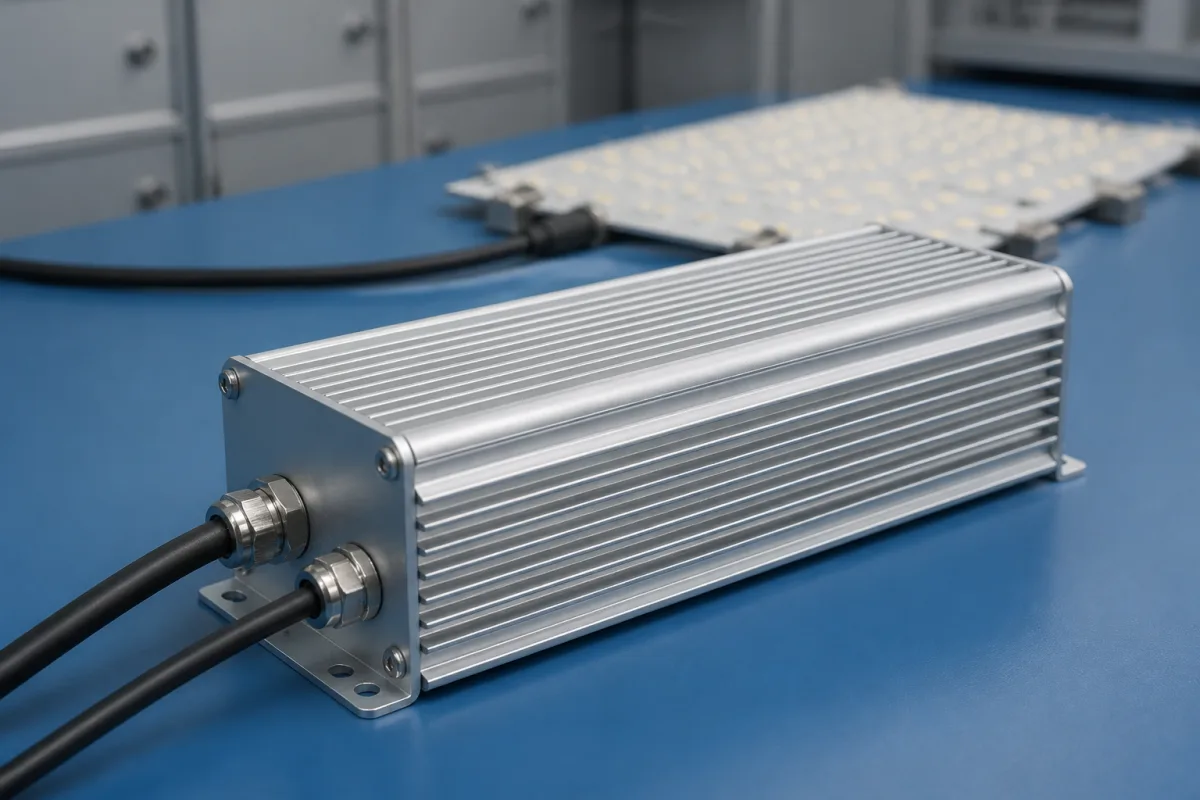
US DOE says that "the driver is the weak link for some currently available LED products". Choose the output mode the LEDs need, check the driver's constant-current window against your string voltage at temperature, meet the efficiency and standby rules of your market, and keep the driver cool, because its electrolytic capacitors age with heat.
Separate AC-DC LED drivers (control gear) for luminaires, LED strips and modules: constant-current, constant-voltage and dimmable types, indoor and outdoor. Driver ICs and complete luminaires are outside this page.
CNFX editorial research · Sources checked October 12, 2026 · 6 sources
Choose constant current or constant voltage and match the string
Mean Well, an LED driver maker, explains that LEDs are driven by forward current but have a nonlinear voltage-current curve, wide forward-voltage tolerance and voltage that shifts with temperature, so drivers are either constant voltage or constant current. Driving LEDs from constant voltage alone gives uneven brightness, reliability and lifetime, which is why constant current is preferred for high-power LEDs. [1]
Constant-voltage supplies are used with LED loads that include their own current control, such as resistors or driver ICs on LED strips. Constant-current supplies hold a fixed current only inside a stated constant-current voltage range, for example 70–100% of rated output voltage in some series; below it the driver may enter a hiccup mode and fail to drive the LEDs. [1]
As an editorial calculation example only: a driver rated 54 V with a constant-current range of 70–100% covers strings from about 37.8 V to 54 V. Check the string's forward voltage at both cold and hot operating temperatures against that window.
Give the supplier the LED module or strip data: current, forward-voltage range over temperature, number of series LEDs and parallel strings, and whether the load has its own current control.
02
Meet the efficiency, standby and flicker rules
EU Regulation 2019/2020 treats a driver sold separately as separate control gear. For LED control gear it sets minimum efficiency η ≥ Pcg^0.81 ÷ (1.09 × Pcg^0.81 + 2.10), where Pcg is declared output power, and limits no-load, standby and networked standby power to 0.5 W each where applicable. [2]
As an editorial calculation example only, using that formula: a 100 W driver must be at least about 87.7% efficient and a 20 W driver about 78.4%.
The Regulation measures flicker with Pst LM, where 1 means a 50% chance that an average observer notices it, and stroboscopic effect with SVM; for LED mains light sources it sets Pst LM ≤ 1.0 and SVM ≤ 0.4 at full load from 1 September 2021. Ask driver suppliers for flicker and SVM data with your LED load, including when dimmed. [2]
This page used the original 2019 text; later amendments were not read. Other markets set their own rules.
03
Keep the driver cool to make it last
The US Department of Energy notes that, given long LED package lifetimes, the driver is the weak link for some LED products: its useful life depends on internal components such as electrolytic capacitors and is strongly dependent on operating temperature. [3]
Ask the supplier for the driver's rated life at a stated case temperature, the case-temperature measuring point, and the derating curve for your ambient. Mount the driver where it can shed heat, and check that the luminaire's thermal design keeps the case within its rating.
04
Outdoor, DALI, junction-box and multi-channel drivers on supplier pages
Inventronics lists outdoor LED drivers for high-mast, sports, UV and horticulture lighting and DALI drivers; Qinx lists constant-voltage, junction-box and multi-channel LED drivers; Cincon lists LED power supplies alongside AC-DC and DC-DC converters. [4][5][6]
05
Rectifier, converter, capacitors and housing inside an LED driver
The capacitor and housing rows carry the DOE point that heat sets driver life; the input-stage and isolation rows have no reviewed source, so their values must come from the supplier.
Part
Role
Fix in the order
Input rectifier and PFC
Draws current from the mains; affects power factor and harmonics.
Driver ratings to check against your LED string and mains
Output voltage range decides whether the driver can run your string at all; the efficiency and dimming rows draw on the EU Regulation, while power factor, THD and isolation need the supplier's test data.
Field
What it means and published values
Ask the supplier for
Input voltage range (V AC)
Mains supply range.
Input range and surge rating.
Output power (W)
Sets EU minimum efficiency for separate control gear. [2]
Send the LED load, supply and environment data together
Paste it into your enquiry below or into an email to a maker, then replace every bracket.
Load: [LED current; forward-voltage range over temperature; series and parallel layout; CC or CV]
Supply: [mains voltage and frequency; surge level]
Market: [efficiency and standby rules; flicker requirements; certifications]
Dimming: [DALI, 0–10 V or other; range]
Environment: [ambient temperature; case-temperature limit; IP rating; mounting]
Documents: [efficiency curve; PF/THD; lifetime at case temperature; flicker and SVM data]
Explore company information and manufacturing capabilities, then discuss the scope of your project with a relevant supplier.
Share this page
Compiled and source-reviewed by the CNFX editorial team.
Each manufacturer above links to the page on that company's own website where the product is listed, with the date we checked it. How we source and review
· Page last updated 13 October 2026
Buyer questions
Constant current or constant voltage LED driver?
Mean Well notes that LEDs are current-driven and that constant voltage alone gives uneven brightness and lifetime, so constant current is preferred for high-power LEDs; constant voltage suits loads with their own current control, such as LED strips. [1]
What efficiency must an LED driver meet in the EU?
Regulation 2019/2020 sets η ≥ Pcg^0.81/(1.09·Pcg^0.81 + 2.10) for separate LED control gear, about 87.7% at 100 W by editorial calculation, and 0.5 W limits for no-load and standby power. [2]
Why do LED drivers fail before the LEDs?
DOE notes driver life depends on components such as electrolytic capacitors and is strongly dependent on temperature, making the driver the weak link in some products. [3]
Sources and what still needs a direct check
Sources checked 2026-10-12. The EU Regulation is binding in the EU only; its original 2019 text was read. The DOE fact sheet is a US government source. Mean Well is an LED driver manufacturer. Supplier pages describe their own offers. IEC 61347 and IEC 62384 were not read for this page.