Energy storage · Cell chemistry, configuration, C-rate, life and shipping
A battery pack is cells in series for voltage and in parallel for capacity, plus the protection electronics that keep each cell inside its limits. Choose the chemistry for energy, power and life; size it from voltage, capacity and current; and make sure it can be shipped legally.
Rechargeable lithium-ion and lithium iron phosphate (LFP) battery packs for portable devices, power tools, mobile machines and energy storage, from single-cell packs with a protection board to multi-cell packs with a battery management system. Cells alone, chargers and lead-acid batteries are outside this page.
CNFX editorial research · Sources checked October 12, 2026 · 8 sources
Battery University describes lithium cobalt oxide (LCO) as high in specific energy but limited in life, thermal stability and load capability, used in phones and laptops at 3.60 V nominal; lithium iron phosphate (LFP) as offering high current rating, long cycle life, good thermal stability and abuse tolerance, at a lower 3.2 V per cell and lower specific energy, with higher self-discharge that makes cell quality and balancing more important. [1]
Battery University adds that LFP manufacturing must be clean and dry; moisture can cut life drastically. Ask which cell maker and grade the pack uses. [1]
Give the supplier the device or machine, required voltage window, average and peak current, runtime, operating and charging temperatures, space and weight limits. Chemistry and configuration follow from these.
02
Set voltage, capacity and current with series-parallel configuration
Battery University explains that cells in series add voltage and cells in parallel add capacity; a laptop pack of four 3.6 V cells in series and two in parallel (4s2p) gives 14.4 V and 4,800 mAh from 2,400 mAh cells. Cells must be the same type, voltage and capacity and matched, because the weakest cell in a series string limits the pack. [2]
IATA defines a battery's watt-hour rating as rated capacity in ampere-hours multiplied by nominal voltage. Editorial calculation for the 4s2p example: 14.4 V × 4.8 Ah ≈ 69 Wh. [5][2]
C-rate expresses current relative to capacity: 1C discharges a battery in about one hour, 2C in 30 minutes, 0.5C in two hours; faster discharge yields somewhat less capacity because of internal losses. Battery University notes that “the protection circuit prevents the Li-ion Energy Cell from discharging above 1C”, while power cells with nickel, manganese or phosphate chemistry can tolerate up to 10C. [3]
03
Plan cycle life around depth of discharge, charge voltage and temperature
Battery University estimates cycles to 70% capacity at different depths of discharge: about 300 for NMC and 600 for LFP at 100% DoD, rising to about 1,000 and 3,000 at 40% DoD. It gives 4.20 V/cell as a Li-ion charge voltage, and states that each 0.10 V reduction in peak charge voltage is said to double cycle life while storing less energy. [4]
It treats dwelling above 30 °C and above 4.10 V per cell as stressful, and estimates that Li-ion stored a year at 40 °C keeps about 85% of capacity at 40% charge but about 65% at full charge. These are general trends for cobalt-based Li-ion; LFP voltages differ. [4]
Ask the supplier for a cycle-life figure stated with its DoD, charge voltage, current and temperature, and to what end-of-life capacity.
04
Make sure the pack can be shipped
IATA's 2026 guidance treats battery packs, modules and assemblies as batteries, requires lithium cell and battery types to pass the tests in UN Manual of Tests and Criteria sub-section 38.3, and requires manufacturers and distributors to make the 38.3 test summary available, for example on a website with a QR code or URL. [5]
Lithium-ion batteries shipped by themselves by air (Packing Instruction 965) must be at no more than 30% state of charge unless approved, and cannot travel on passenger aircraft without approval. Ask for the test summary for the exact pack design before ordering. [5]
05
Tool, forklift, golf-cart and solar-storage packs from listed makers
Topband lists tool and home battery packs and energy storage; HIITIO lists LFP batteries for forklifts, AGVs, golf carts and aerial work platforms and packs for light electric vehicles; MECC lists Li-ion battery packs within PV and storage systems; Jimitech lists battery packs for solar banks. Ask each for cell source, BMS functions and the UN 38.3 summary. [6][7][8]
06
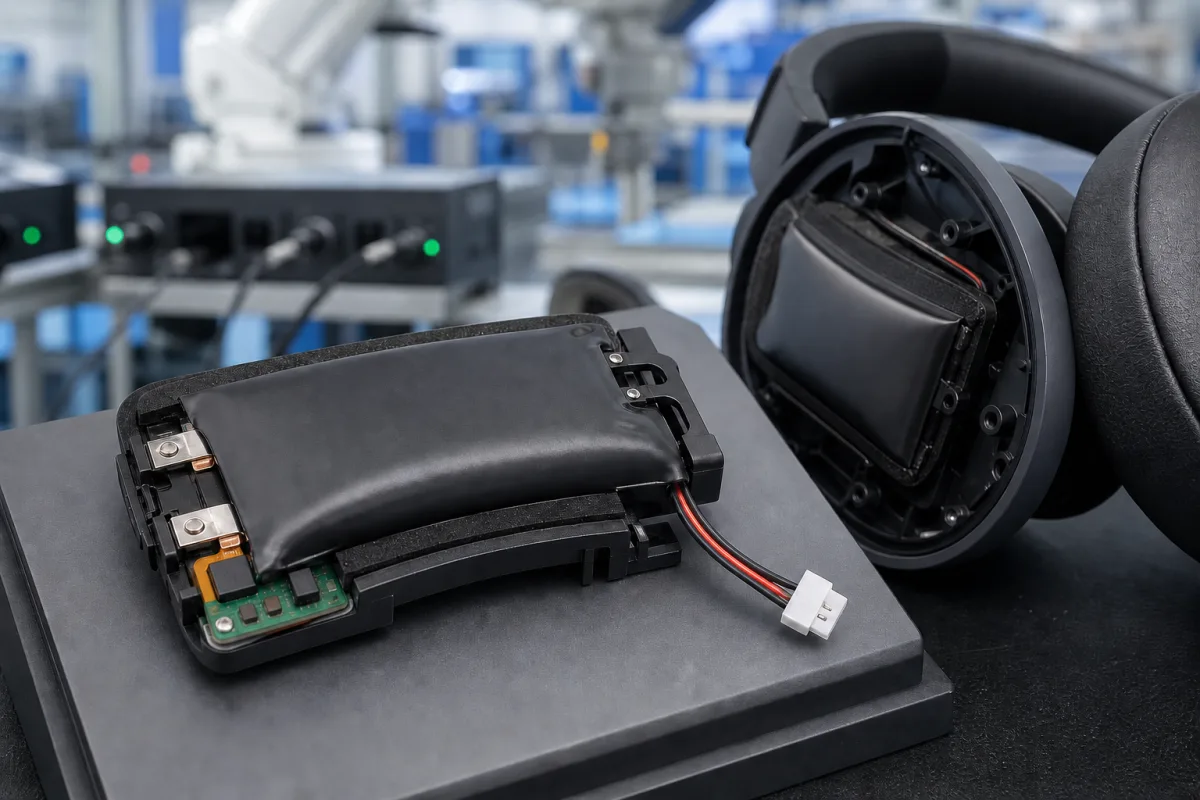
Cells, interconnects, BMS and case in a lithium pack
The connector and wiring row has no source on this page, so its current rating has to come from the supplier's drawing.
Voltage, capacity and current limits your device sets for the pack
Read the charge-voltage and cycle-life rows together: Battery University links lower peak charge voltage to longer cycle life, so ask for cycle figures at the charge voltage your charger will use.
Field
What it means and published values
Ask the supplier for
Nominal voltage (V)
Cells in series × cell voltage; LFP 3.2 V, LCO 3.6 V per cell. [2][1]
Configuration and nominal voltage.
Capacity (mAh)
Cells in parallel × cell capacity; depends on C-rate. [2][3]
Capacity and the C-rate it is rated at.
Charge voltage (V)
4.20 V/cell, a Li-ion charge voltage given by Battery University; lower extends life. [4]
Charge voltage and charger.
Discharge cut-off voltage (V)
End of discharge, e.g. 3.0 V/cell for Li-ion in testing. [3]
Send the device, electrical and shipping data together
Paste it into your enquiry below or into an email to a maker, then replace every bracket.
Device: [product; space; weight limit; operating environment]
Electrical: [voltage window; average and peak current; runtime; charge time]
Chemistry: [Li-ion or LFP; cell maker and model if specified]
Configuration: [series-parallel arrangement; nominal voltage; capacity; Wh]
Protection: [protection board or BMS; balancing; communication; temperature sensing]
Life: [cycles required at what DoD, charge voltage and temperature]
Compliance: [UN 38.3 test summary; other safety tests required; markings]
Documents: [datasheet; drawing; cell datasheet; test reports]
Explore company information and manufacturing capabilities, then discuss the scope of your project with a relevant supplier.
Share this page
Compiled and source-reviewed by the CNFX editorial team.
Each manufacturer above links to the page on that company's own website where the product is listed, with the date we checked it. How we source and review
· Page last updated 13 October 2026
Buyer questions
How do I work out a battery pack's watt-hours?
Multiply rated capacity in ampere-hours by nominal voltage; a 4s2p pack of 3.6 V 2.4 Ah cells is 14.4 V × 4.8 Ah ≈ 69 Wh. [5][2]
How can I make a lithium pack last longer?
Use partial depth of discharge, a lower charge voltage and avoid heat; Battery University estimates each 0.1 V lower charge voltage roughly doubles cycle life. [4]
What is a UN 38.3 test summary?
A summary of the transport tests in UN Manual sub-section 38.3 that manufacturers and distributors must make available for lithium cells and batteries. [5]
Sources and what still needs a direct check
Sources checked 2026-10-12. Battery University (Cadex Electronics) publishes educational articles on battery chemistry, configuration and ageing; its figures are general estimates. IATA's 2026 guidance explains lithium battery transport rules. Supplier pages describe their own offers.