Industry-Verified Manufacturing Data (2026)

Robotic Handling Arm

Based on aggregated insights from multiple verified factory profiles within the CNFX directory, the standard Robotic Handling Arm used in the Computer, Electronic and Optical Product Manufacturing sector typically supports operational capacities ranging from standard industrial configurations to heavy-duty production requirements.

Technical Definition & Core Assembly

A canonical Robotic Handling Arm is characterized by the integration of End-effector and Servo motors. In industrial production environments, manufacturers listed on CNFX commonly emphasize Aluminum alloy construction to support stable, high-cycle operation across diverse manufacturing scenarios.

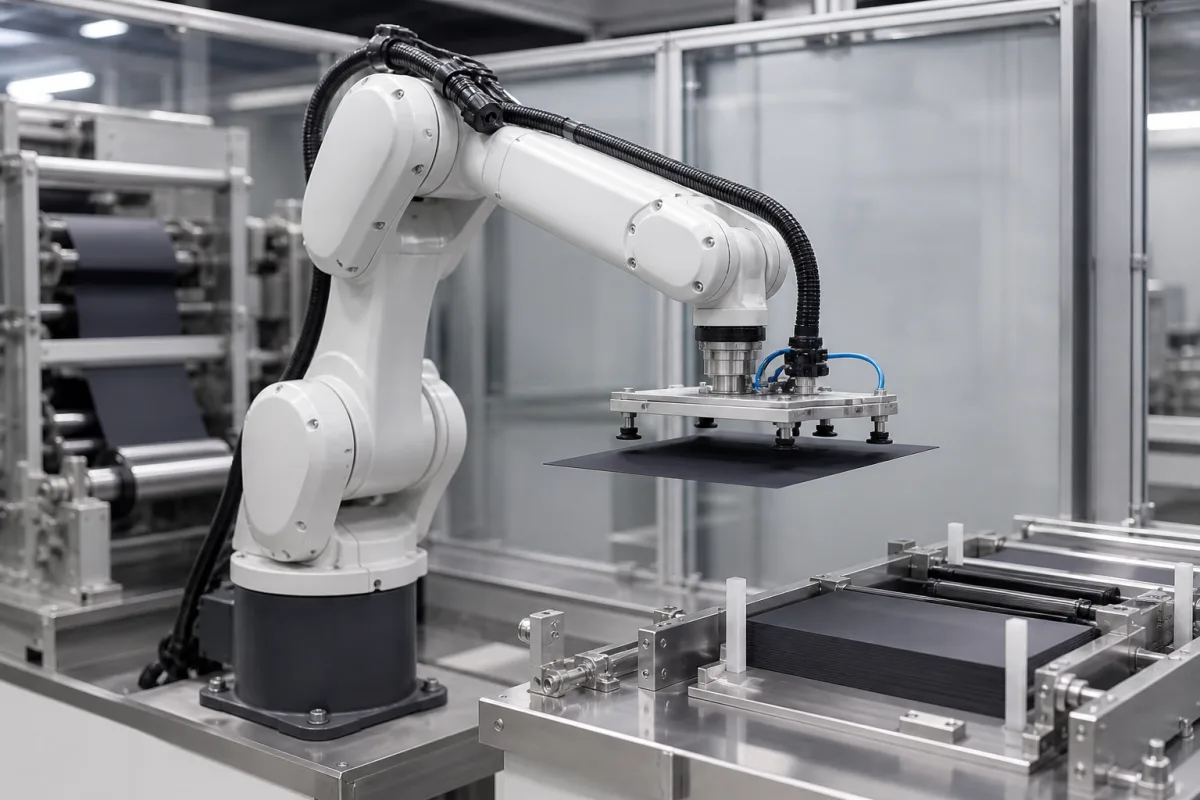
A robotic arm component within an electrode stacking module that precisely handles and positions electrode materials during battery manufacturing processes.
Product Specifications

Technical details and manufacturing context for Robotic Handling Arm

Definition
The robotic handling arm is a critical component of the electrode stacking module in battery production lines. It is responsible for the automated, high-precision picking, transferring, and placement of electrode sheets (anodes and cathodes) and separators during the stacking process. This component ensures accurate alignment and consistent layer formation, which is essential for battery performance, safety, and manufacturing efficiency.
Working Principle
The robotic handling arm operates through a combination of servo motors, precision gears, and sensors. It receives positioning and movement commands from the module's control system. Using vacuum grippers, mechanical clamps, or specialized end-effectors, it picks up individual electrode sheets or separators from feeding systems. Guided by vision systems and positional feedback, it then moves along programmed trajectories to precisely place each layer onto the stacking platform, ensuring proper alignment and orientation before releasing the material.
Common Materials
Aluminum alloy, Stainless steel, Engineering plastics, Carbon fiber composites
Technical Parameters
  • Positioning accuracy for precise electrode placement (mm) Per Request
Components / BOM
  • End-effector
    Specialized tool for gripping and releasing electrode materials
    Material: Aluminum alloy with silicone or polyurethane contact surfaces
  • Servo motors
    Provide precise rotational movement for joint articulation
    Material: Steel, copper, rare-earth magnets
  • Reduction gears
    Increase torque and improve positioning accuracy
    Material: Hardened steel or planetary gear systems
  • Position sensors
    Provide feedback on arm position and orientation
    Material: Electronic components with protective housing
  • Structural arm segments
    Provide rigid framework for movement and load bearing
    Material: Aluminum alloy or carbon fiber composite
Engineering Reasoning
0.1-1.5 m/s linear velocity, ±0.05 mm positioning accuracy, 2-15 kg payload capacity
Exceeding 2.0 m/s velocity causes harmonic resonance, payload >18 kg induces permanent joint deformation, positioning error >0.2 mm triggers cascading misalignment
Design Rationale: Resonant frequency excitation at 15-25 Hz range due to structural harmonics, yielding stress exceeding 250 MPa in aluminum 6061-T6 joints, cumulative positioning error from servo motor backlash >0.15°
Risk Mitigation (FMEA)
Trigger Servo motor encoder signal loss for >100 ms
Mode: Uncontrolled arm oscillation at 8-12 Hz frequency
Strategy: Dual redundant absolute encoders with 0.001° resolution and watchdog timer circuit
Trigger Gripper surface contamination exceeding 5 mg/cm² particulate accumulation
Mode: Electrode slippage with 0.3-0.8 mm positional drift per cycle
Strategy: Integrated laser cleaning system operating at 1064 nm wavelength with 10 W power

Industry Taxonomies & Aliases

Commonly used trade names and technical identifiers for Robotic Handling Arm.

Applied To / Applications

This component is essential for the following industrial systems and equipment:

Industrial Ecosystem & Supply Chain DNA

Complementary Systems
Downstream Applications
Specialized Tooling

Application Fit & Sizing Matrix

Operational Limits
pressure: Atmospheric (no pressure rating required)
other spec: Positioning accuracy: ±0.1mm, Max payload: 5kg, Slurry concentration: 30-60% solids by weight
temperature: 15-35°C (operating), 5-45°C (storage)
Media Compatibility
✓ Lithium-ion electrode slurry (NMC/NCA) ✓ Graphite anode slurry ✓ Dry electrode sheets
Unsuitable: Corrosive chemical baths (e.g., acid/alkaline etching solutions)
Sizing Data Required
  • Maximum electrode sheet dimensions (LxW)
  • Required cycle time (sheets/hour)
  • Workspace envelope constraints

Reliability & Engineering Risk Analysis

Failure Mode & Root Cause
Gearbox backlash and wear
Cause: Inadequate lubrication, misalignment, or excessive cyclic loading leading to pitting, spalling, and increased clearance in reduction gears.
Encoder or resolver failure
Cause: Contamination (dust, oil ingress), electrical noise, or mechanical shock disrupting position feedback, causing loss of accuracy or erratic movement.
Maintenance Indicators
  • Unusual grinding or clicking noises during motion, indicating gear wear or bearing failure.
  • Erratic or jerky arm movement, especially at low speeds, suggesting encoder issues or drive instability.
Engineering Tips
  • Implement predictive maintenance via vibration analysis and thermal imaging on joints and gearboxes to detect early wear.
  • Use precision alignment tools during installation and re-alignment to minimize parasitic loads on bearings and gears.

Compliance & Manufacturing Standards

Reference Standards
ISO 9283:1998 - Manipulating industrial robots - Performance criteria and related test methods ANSI/RIA R15.06 - Industrial Robots and Robot Systems - Safety Requirements CE Marking - Machinery Directive 2006/42/EC
Manufacturing Precision
  • Positioning repeatability: +/-0.05 mm
  • Maximum payload deviation: +/-1.0% of rated capacity
Quality Inspection
  • Laser interferometer accuracy verification
  • Load capacity and endurance cycle testing

Factories Producing Robotic Handling Arm

Verified manufacturers with capability to produce this product in China

✓ 97% Supplier Capability Match Found

P Procurement Specialist from Canada Jan 07, 2026
★★★★★
"Found 23+ suppliers for Robotic Handling Arm on CNFX, but this spec remains the most cost-effective."
Technical Specifications Verified
T Technical Director from United States Jan 04, 2026
★★★★★
"The technical documentation for this Robotic Handling Arm is very thorough, especially regarding technical reliability."
Technical Specifications Verified
P Project Engineer from United Arab Emirates Jan 01, 2026
★★★★★
"Reliable performance in harsh Computer, Electronic and Optical Product Manufacturing environments. No issues with the Robotic Handling Arm so far."
Technical Specifications Verified
Verification Protocol

“Feedback is collected from verified sourcing managers during RFQ (Request for Quote) and factory evaluation processes on CNFX. These reports represent historical performance data and technical audit summaries from our B2B manufacturing network.”

19 sourcing managers are analyzing this specification now. Last inquiry for Robotic Handling Arm from UAE (1h ago).

Supply Chain Compatible Machinery & Devices

Industrial Smart Camera Module

Embedded vision system for industrial automation and quality inspection.

Explore Specs →
Industrial Wireless Power Transfer Module

Wireless power transfer module for industrial equipment applications

Explore Specs →
Industrial Smart Sensor Module

Modular industrial sensor with embedded processing and wireless connectivity

Explore Specs →
Surface Mount Resistor

Passive electronic component for current limiting and voltage division in circuits

Explore Specs →

Frequently Asked Questions

What materials are used in this robotic handling arm?

The robotic handling arm is constructed from high-performance materials including aluminum alloy, stainless steel, engineering plastics, and carbon fiber composites for optimal strength, precision, and durability in battery manufacturing environments.

How does this robotic arm improve electrode stacking accuracy?

The arm utilizes precision servo motors, reduction gears, and position sensors to achieve micron-level accuracy in handling and positioning electrode materials, ensuring consistent stacking quality and reducing material waste in battery production.

What components are included in the BOM for this robotic handling arm?

The bill of materials includes end-effector, servo motors, reduction gears, position sensors, and structural arm segments, all designed for seamless integration into electrode stacking modules for computer, electronic, and optical product manufacturing.

Can I contact factories directly on CNFX?

CNFX is an open directory, not a transaction platform. Each factory profile provides direct contact information and production details to help you initiate direct inquiries with Chinese suppliers.

Get Quote for Robotic Handling Arm

Request technical pricing, lead times, or customized specifications for Robotic Handling Arm directly from verified manufacturing units.

Your business information is encrypted and only shared with verified Robotic Handling Arm suppliers.

Thank you! Your message has been sent. We'll respond within 1–3 business days.

Need to Manufacture Robotic Handling Arm?

Connect with verified factories specializing in this product category

Add Your Factory Contact Us
Previous Product
Robotic Arm/Actuator
Next Product
Robotic Welding Unit