Industry-Verified Manufacturing Data (2026)

End Effector

Based on aggregated insights from multiple verified factory profiles within the CNFX directory, the standard End Effector used in the Machinery and Equipment Manufacturing sector typically supports operational capacities ranging from standard industrial configurations to heavy-duty production requirements.

Technical Definition & Core Assembly

A canonical End Effector is characterized by the integration of Mounting Flange and Actuation Mechanism. In industrial production environments, manufacturers listed on CNFX commonly emphasize Aluminum alloy construction to support stable, high-cycle operation across diverse manufacturing scenarios.

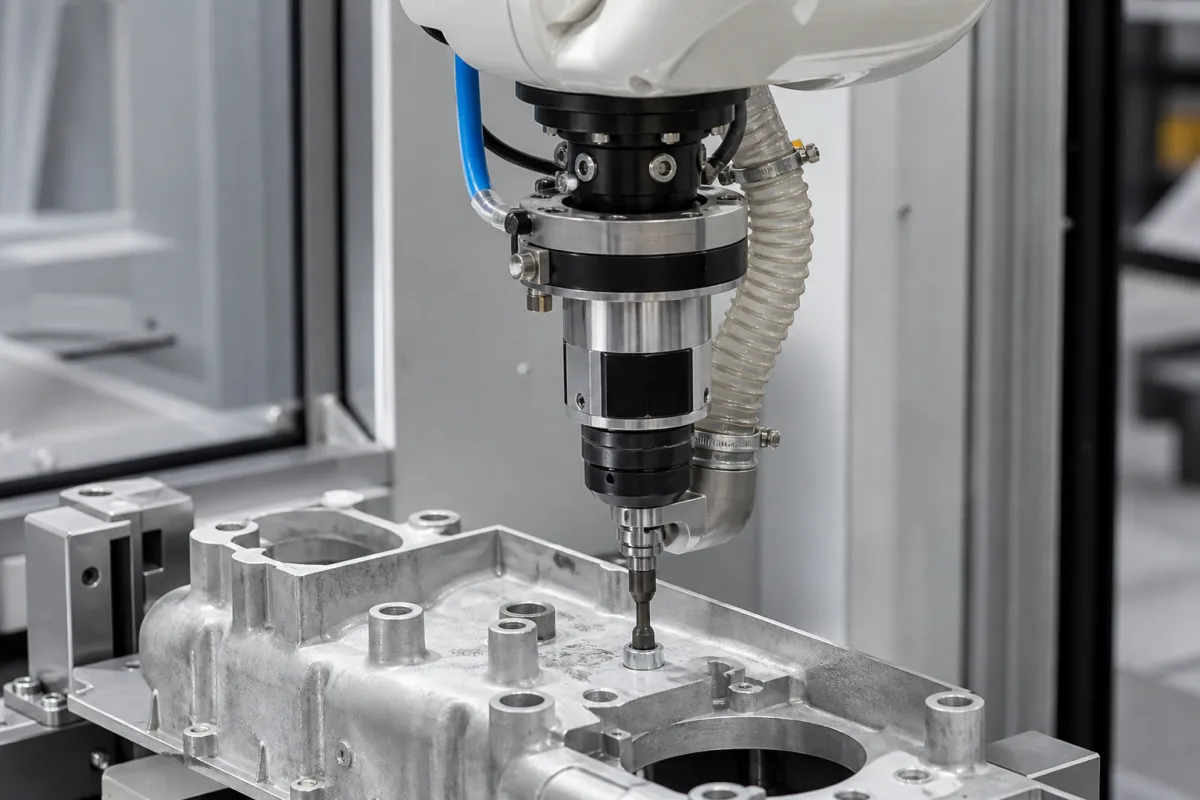
The interface component at the end of a robotic arm that directly interacts with workpieces or tools during assembly operations.
Product Specifications

Technical details and manufacturing context for End Effector

Definition
An end effector is the specialized device mounted at the terminal link of an assembly robot's manipulator, designed to perform specific tasks such as gripping, welding, fastening, or placing components. It serves as the robot's 'hand' or 'tool' that enables precise interaction with assembly parts, directly affecting the robot's functionality and application scope in manufacturing processes.
Working Principle
End effectors operate by receiving control signals from the robot's controller to execute specific actions. Gripping types use pneumatic, hydraulic, or electric actuation to open/close jaws or fingers. Tool-based types (like screwdrivers or welders) activate their respective functions. They often incorporate sensors (force, vision, proximity) to provide feedback for adaptive control and precision during assembly tasks.
Common Materials
Aluminum alloy, Steel, Engineering plastics
Technical Parameters
  • Mounting interface dimensions for compatibility with robot wrist flange (mm) Customizable
Components / BOM
  • Mounting Flange
    Interface connecting the end effector to the robot wrist, ensuring mechanical and electrical compatibility
    Material: Steel
  • Actuation Mechanism
    System (pneumatic, hydraulic, or electric) that provides motion for gripping or tool operation
    Material: Aluminum alloy
  • Gripper Jaws/Tool Head
    Contact surfaces or working elements that directly interact with workpieces or perform assembly operations
    Material: Hardened steel or specialized tool material
Engineering Reasoning
0.1-150 N gripping force, 0.01-0.5 mm positioning accuracy, -20°C to 80°C ambient temperature
Gripping force exceeds 180 N causing permanent deformation, positioning error exceeds 1.0 mm causing misalignment, temperature exceeds 100°C causing polymer degradation
Design Rationale: Yield strength of aluminum alloy (6061-T6: 276 MPa) exceeded during overloading, thermal expansion coefficient mismatch (aluminum: 23.1 μm/m·K vs steel: 12 μm/m·K) causing binding, polymer fatigue at 10⁶ cycles under 120 N load
Risk Mitigation (FMEA)
Trigger Electromagnetic interference from nearby welding equipment inducing 50 V spikes in control signals
Mode: Servo motor position feedback corruption causing 2.5 mm overshoot
Strategy: Shielded twisted-pair cabling with ferrite cores and optical isolation in feedback circuits
Trigger Abrasive particulate contamination (ISO 4406 18/16/13) in pneumatic lines
Mode: Cylinder seal wear causing 15% pressure drop below 0.4 MPa minimum
Strategy: 5 μm absolute filtration with differential pressure monitoring and automatic bypass

Industry Taxonomies & Aliases

Commonly used trade names and technical identifiers for End Effector.

Applied To / Applications

This component is essential for the following industrial systems and equipment:

Industrial Ecosystem & Supply Chain DNA

Complementary Systems
Downstream Applications
Specialized Tooling

Application Fit & Sizing Matrix

Operational Limits
pressure: 0 to 10 bar
temperature: -20°C to 120°C
repeatability: ±0.05 mm
payload capacity: 1 to 50 kg
Media Compatibility
✓ metallic components ✓ plastic assemblies ✓ electronic circuit boards
Unsuitable: highly corrosive chemical environments
Sizing Data Required
  • workpiece weight
  • required precision tolerance
  • gripping force requirement

Reliability & Engineering Risk Analysis

Failure Mode & Root Cause
Mechanical wear and misalignment
Cause: Repeated cyclic loading, impact forces, and improper installation leading to bearing degradation, gear backlash, or structural fatigue in joints and linkages.
Electrical or pneumatic component failure
Cause: Contamination ingress (dust, moisture, oils), overheating due to excessive duty cycles, or voltage/pressure spikes damaging sensors, solenoids, or actuators.
Maintenance Indicators
  • Unusual vibrations, grinding noises, or increased play during operation indicating mechanical wear or looseness
  • Erratic movement, loss of precision, or failure to complete cycles signaling sensor drift, actuator issues, or control system faults
Engineering Tips
  • Implement regular alignment checks and torque verification on fasteners and couplings to prevent progressive misalignment and uneven loading
  • Use filtered air supplies, protective covers, and environmental controls to minimize contamination and thermal stress on sensitive components

Compliance & Manufacturing Standards

Reference Standards
ISO 9283:1998 - Performance criteria and testing methods for manipulating industrial robots ANSI/RIA R15.06 - Safety requirements for industrial robots and robot systems DIN EN ISO 10218-2:2011 - Robots and robotic devices - Safety requirements for industrial robots - Part 2: Robot systems and integration
Manufacturing Precision
  • Mounting interface flatness: 0.05mm
  • Tool center point repeatability: +/-0.02mm
Quality Inspection
  • Static load capacity test
  • Functional safety test (including emergency stop verification)

Factories Producing End Effector

Verified manufacturers with capability to produce this product in China

✓ 93% Supplier Capability Match Found

T Technical Director from Germany Feb 23, 2026
★★★★★
"As a professional in the Machinery and Equipment Manufacturing sector, I confirm this End Effector meets all ISO standards."
Technical Specifications Verified
P Project Engineer from Brazil Feb 20, 2026
★★★★☆
"Standard OEM quality for Machinery and Equipment Manufacturing applications. The End Effector arrived with full certification. (Delivery took slightly longer than expected, but technical support was excellent.)"
Technical Specifications Verified
S Sourcing Manager from Canada Feb 17, 2026
★★★★★
"Great transparency on the End Effector components. Essential for our Machinery and Equipment Manufacturing supply chain."
Technical Specifications Verified
Verification Protocol

“Feedback is collected from verified sourcing managers during RFQ (Request for Quote) and factory evaluation processes on CNFX. These reports represent historical performance data and technical audit summaries from our B2B manufacturing network.”

17 sourcing managers are analyzing this specification now. Last inquiry for End Effector from Vietnam (16m ago).

Supply Chain Compatible Machinery & Devices

Hydraulic Press

Industrial machine using hydraulic pressure to compress, form, or assemble materials

Explore Specs →
Heavy-Duty CNC Plasma Cutting Machine

Industrial machine for precision metal cutting using plasma arc technology

Explore Specs →
Automated Assembly Line System

Integrated production system for sequential component assembly operations

Explore Specs →
Automated Powder Coating System

Integrated industrial system for applying dry powder coatings to metal substrates.

Explore Specs →

Frequently Asked Questions

What materials are used in this end effector for durability?

Our end effectors are constructed from aluminum alloy for lightweight strength, steel for high-stress components, and engineering plastics for wear resistance and precision.

How does the end effector interface with different robotic arms?

The mounting flange is designed to standard robotic arm interfaces, ensuring compatibility with most industrial robots while the actuation mechanism can be customized for specific applications.

What types of assembly operations can this end effector perform?

This end effector handles various assembly tasks including part placement, component joining, tool manipulation, and workpiece positioning through interchangeable gripper jaws and tool heads.

Can I contact factories directly on CNFX?

CNFX is an open directory, not a transaction platform. Each factory profile provides direct contact information and production details to help you initiate direct inquiries with Chinese suppliers.

Get Quote for End Effector

Request technical pricing, lead times, or customized specifications for End Effector directly from verified manufacturing units.

Your business information is encrypted and only shared with verified End Effector suppliers.

Thank you! Your message has been sent. We'll respond within 1–3 business days.

Need to Manufacture End Effector?

Connect with verified factories specializing in this product category

Add Your Factory Contact Us
Previous Product
End Carriages
Next Product
End Effector (Gripper/Clamp)