Industry-Verified Manufacturing Data (2026)

Insulated Chamber Housing

Based on aggregated insights from multiple verified factory profiles within the CNFX directory, the standard Insulated Chamber Housing used in the Machinery and Equipment Manufacturing sector typically supports operational capacities ranging from standard industrial configurations to heavy-duty production requirements.

Technical Definition & Core Assembly

A canonical Insulated Chamber Housing is characterized by the integration of Inner Shell and Outer Shell. In industrial production environments, manufacturers listed on CNFX commonly emphasize Stainless Steel (e.g., 304, 316) construction to support stable, high-cycle operation across diverse manufacturing scenarios.

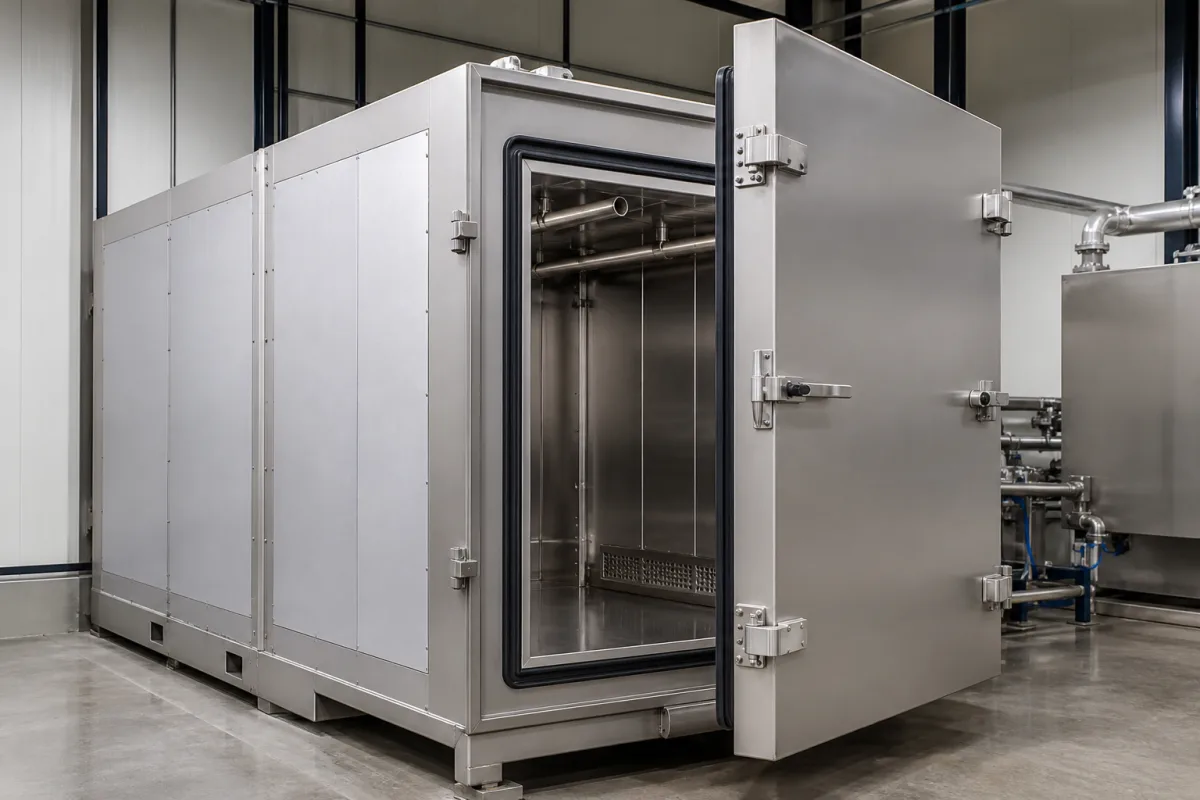
The structural enclosure that forms the insulated chamber within a high-temperature rinse system.
Product Specifications

Technical details and manufacturing context for Insulated Chamber Housing

Definition
A specialized housing component that creates and maintains an insulated environment within a High-Temp Rinse Chamber. It serves as the primary structural barrier, containing the high-temperature rinse process while minimizing thermal energy loss to the surrounding machinery and environment. Its design is critical for maintaining process temperature stability, operator safety, and overall system energy efficiency.
Working Principle
The housing acts as a thermal barrier. Its insulated construction (e.g., double-walled with an air gap or filled with insulating material) reduces heat transfer via conduction, convection, and radiation. It contains the heated rinse medium (often water or cleaning solution) and the components being processed, ensuring the internal chamber reaches and maintains the required high temperature for effective rinsing or sterilization.
Common Materials
Stainless Steel (e.g., 304, 316), Insulation Material (e.g., Mineral Wool, Ceramic Fiber)
Technical Parameters
  • Overall external dimensions (Length x Width x Height) and internal chamber dimensions. (mm) Customizable
Components / BOM
  • Inner Shell
    Forms the primary containment surface exposed to the high-temperature rinse medium; must be corrosion-resistant.
    Material: Stainless Steel
  • Outer Shell
    Provides structural rigidity and protects the insulation layer from physical damage and environmental exposure.
    Material: Stainless Steel or Powder-Coated Mild Steel
  • Insulation Core
    Fills the cavity between shells to drastically reduce heat transfer, maintaining internal temperature and improving energy efficiency.
    Material: Mineral Wool, Ceramic Fiber Blanket, or Foamed Insulation
  • Access Door / Seal
    Provides a sealed opening for loading/unloading parts; includes a high-temperature gasket or seal to prevent heat and fluid leakage.
    Material: Stainless Steel with Silicone/PTFE Gasket
Engineering Reasoning
0-150°C with thermal gradient ≤20°C/cm across chamber walls
Structural deformation occurs at 180°C differential between inner/outer surfaces, leading to seal failure at 0.5mm displacement
Design Rationale: Thermal stress-induced creep deformation in 316L stainless steel at sustained temperatures above 160°C, following Larson-Miller parameter P = T(20 + log t) × 10⁻³ where P > 35 causes permanent deformation
Risk Mitigation (FMEA)
Trigger Thermal cycling between 20-150°C at >5 cycles/hour
Mode: Weld seam fatigue cracking at stress concentration points
Strategy: Implement continuous fiber laser welding with 0.1mm precision and post-weld stress relief annealing at 400°C for 2 hours
Trigger Insulation degradation reducing thermal resistance by 40%
Mode: External surface temperature exceeds 60°C, violating safety standards
Strategy: Embed fiber optic distributed temperature sensing with 0.1°C resolution and automated insulation density monitoring

Industry Taxonomies & Aliases

Commonly used trade names and technical identifiers for Insulated Chamber Housing.

Applied To / Applications

This component is essential for the following industrial systems and equipment:

Industrial Ecosystem & Supply Chain DNA

Complementary Systems
Downstream Applications
Specialized Tooling

Application Fit & Sizing Matrix

Operational Limits
pressure: Atmospheric to 2 bar (29 psi) internal, vacuum to -0.8 bar (-11.6 psi)
flow rate: Up to 100 L/min (26.4 GPM) per chamber
temperature: Ambient to 200°C (392°F) continuous, with peak excursions to 250°C (482°F)
slurry concentration: Up to 30% solids by weight, particle size <100 μm
Media Compatibility
✓ Deionized water with additives (e.g., SC1, SC2 chemistries) ✓ Hot DI water rinse (up to 85°C) ✓ Low-concentration acidic/alkaline cleaning solutions (pH 2-12)
Unsuitable: Hydrofluoric acid (HF) or concentrated halide solutions due to material degradation risks
Sizing Data Required
  • Required chamber volume (L) based on part dimensions and throughput
  • Maximum operating temperature and thermal cycling profile
  • System pressure differential and vacuum requirements

Reliability & Engineering Risk Analysis

Failure Mode & Root Cause
Thermal degradation of insulation
Cause: Continuous exposure to high temperatures beyond design limits, leading to breakdown of insulating materials and loss of thermal efficiency.
Structural fatigue and cracking
Cause: Thermal cycling and mechanical stress from operational vibrations causing material fatigue, leading to cracks and compromised chamber integrity.
Maintenance Indicators
  • Visible condensation or frost on external surfaces indicating insulation failure
  • Audible hissing or whistling sounds suggesting air leaks or pressure loss
Engineering Tips
  • Implement regular thermal imaging inspections to detect hot spots and insulation degradation before failure occurs
  • Install vibration monitoring sensors and maintain proper alignment of connected equipment to minimize mechanical stress on the chamber structure

Compliance & Manufacturing Standards

Reference Standards
ISO 9001:2015 - Quality Management Systems ASTM C177 - Standard Test Method for Steady-State Heat Flux Measurements and Thermal Transmission Properties by Means of the Guarded-Hot-Plate Apparatus CE Marking - EU Directive 2014/35/EU for Electrical Equipment
Manufacturing Precision
  • Wall Thickness Uniformity: +/-0.5mm
  • Surface Flatness: 0.2mm per 300mm length
Quality Inspection
  • Thermal Conductivity Test (ASTM C518)
  • Leak Integrity Test (Pressure Decay Method)

Factories Producing Insulated Chamber Housing

Verified manufacturers with capability to produce this product in China

✓ 92% Supplier Capability Match Found

P Procurement Specialist from United States Jan 15, 2026
★★★★★
"Reliable performance in harsh Machinery and Equipment Manufacturing environments. No issues with the Insulated Chamber Housing so far."
Technical Specifications Verified
T Technical Director from United Arab Emirates Jan 12, 2026
★★★★★
"Testing the Insulated Chamber Housing now; the technical reliability results are within 1% of the laboratory datasheet."
Technical Specifications Verified
P Project Engineer from Australia Jan 09, 2026
★★★★★
"Impressive build quality. Especially the technical reliability is very stable during long-term operation."
Technical Specifications Verified
Verification Protocol

“Feedback is collected from verified sourcing managers during RFQ (Request for Quote) and factory evaluation processes on CNFX. These reports represent historical performance data and technical audit summaries from our B2B manufacturing network.”

8 sourcing managers are analyzing this specification now. Last inquiry for Insulated Chamber Housing from Brazil (1h ago).

Supply Chain Compatible Machinery & Devices

Hydraulic Press

Industrial machine using hydraulic pressure to compress, form, or assemble materials

Explore Specs →
Heavy-Duty CNC Plasma Cutting Machine

Industrial machine for precision metal cutting using plasma arc technology

Explore Specs →
Automated Assembly Line System

Integrated production system for sequential component assembly operations

Explore Specs →
Automated Powder Coating System

Integrated industrial system for applying dry powder coatings to metal substrates.

Explore Specs →

Frequently Asked Questions

What are the benefits of using stainless steel for insulated chamber housing?

Stainless steel (grades 304 or 316) provides excellent corrosion resistance, durability in high-temperature environments, and easy cleaning for industrial rinse systems, ensuring long-term reliability and hygiene.

How does the insulation core improve performance in high-temperature rinse systems?

The insulation core (mineral wool or ceramic fiber) minimizes heat loss, maintains consistent chamber temperatures, reduces energy consumption, and protects external components from excessive heat exposure.

What maintenance is required for insulated chamber housing?

Regular inspection of seals and door mechanisms, checking for insulation integrity, and cleaning stainless steel surfaces to prevent corrosion. Proper maintenance ensures optimal thermal performance and system longevity.

Can I contact factories directly on CNFX?

CNFX is an open directory, not a transaction platform. Each factory profile provides direct contact information and production details to help you initiate direct inquiries with Chinese suppliers.

Get Quote for Insulated Chamber Housing

Request technical pricing, lead times, or customized specifications for Insulated Chamber Housing directly from verified manufacturing units.

Your business information is encrypted and only shared with verified Insulated Chamber Housing suppliers.

Thank you! Your message has been sent. We'll respond within 1–3 business days.

Need to Manufacture Insulated Chamber Housing?

Connect with verified factories specializing in this product category

Add Your Factory Contact Us
Previous Product
Insulated Chamber Door
Next Product
Insulated Enclosure