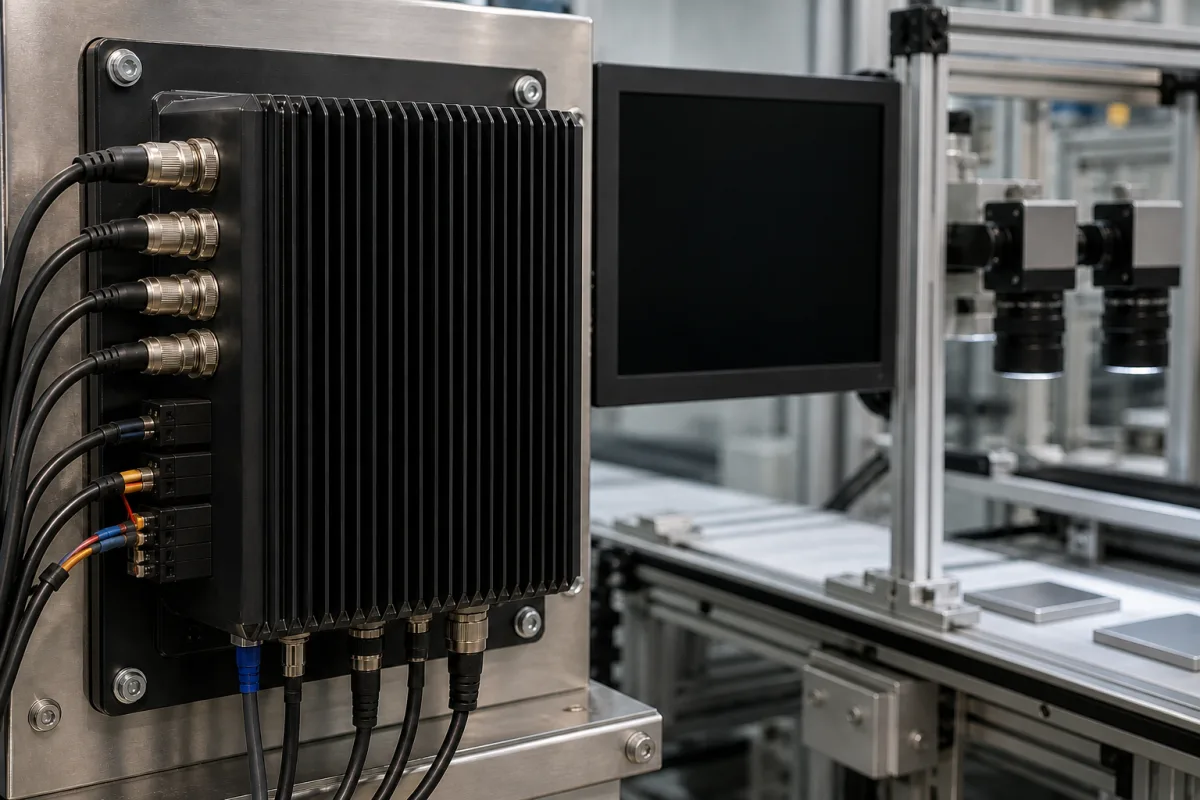
AI vision controller: a Jetson AGX Orin box that runs deep-learning inspection models next to PoE cameras
Deep-learning vision controllers built on an NVIDIA Jetson AGX Orin module · AI throughput by module, temperature rating and airflow, PoE camera ports and their bandwidth and power
An AI vision controller is an industrial embedded computer that runs deep-learning models (classification, detection, segmentation) on camera images at the line, instead of rule-based vision tools alone. The versions reviewed here are built round NVIDIA's Jetson AGX Orin module, an ARM processor with an Ampere GPU and tensor cores in a finned aluminium housing, with Gigabit Ethernet ports that also power the cameras. Three things decide whether one fits: the AI throughput and memory of the module inside, the temperature it is rated for and the airflow that rating assumes, and how many cameras its ports can feed and power.
Embedded vision controllers built on GPU system-on-module platforms such as NVIDIA Jetson AGX Orin for deep-learning inspection, with PoE GigE camera ports, isolated I/O and wide-range DC input. Multi-camera vision controllers selected by camera port bandwidth and line protocols are covered on the Vision processing unit page; complete inspection systems with cameras, lenses and lighting are covered on the Machine vision system for inspection page.
CNFX editorial research · Sources checked October 12, 2026 · 3 sources
Choose the Jetson AGX Orin module by TOPS, memory and temperature grade
JWIPC's EVC-6200 vision controller offers two module options: 64 GB with 275 TOPS, 2,048 CUDA cores and 64 tensor cores, or 32 GB with 200 TOPS, 1,792 CUDA cores and 56 tensor cores, with up to a 12-core ARM Cortex-A78AE CPU at 2.2 GHz, running Ubuntu 20.04 with JetPack 5.1.2 or Ubuntu 22.04 with JetPack 6.0. [1]
NVIDIA states the Jetson Orin family offers up to 275 TOPS and quotes the figures as sparse INT8 operations, so they are peak AI throughput for 8-bit inference rather than a measure of a given inspection model's speed. [2] Editorial calculation: the 32 GB option has about 73% of the 64 GB option's rated TOPS (200 / 275).
NVIDIA also sells an industrial grade of the AGX Orin module. Its table gives the commercial module −25 to 80 °C and the industrial module −40 to 85 °C, both measured at the thermal transfer plate surface, and operating lifetimes of 5 and 10 years respectively. [2]
Jetson AGX Orin commercial
Jetson AGX Orin Industrial
Temperature at thermal transfer plate
−25 to 80 °C
−40 to 85 °C
Operating lifetime
5 years
10 years
Ask which module grade and memory size are fitted, which JetPack version the inspection software is validated on, and the inference rate measured with your own model at the required image size.
02
Read the −25 to 60 °C rating together with the 0.7 m/s airflow it assumes
JWIPC rates the EVC-6200 for −25 to 60 °C operation with 0.7 m/s airflow, −40 to 85 °C storage and 10–85% non-condensing humidity; with an SSD fitted it is tested to 15 G shock (IEC 60068-2-27, half sine, 11 ms) and 2 Grms random vibration from 5 to 500 Hz (IEC 60068-2-64, 1 h per axis). [1]
The unit takes 9 to 36 V DC with over-current and over-voltage protection, measures 230 × 165 × 91.5 mm in an extruded aluminium housing, and mounts on a desk, wall or DIN rail. [1] Editorial calculation: with the commercial module limited to 80 °C at its thermal transfer plate and the box rated to 60 °C ambient, the heat path from plate to air has about 20 K to work with, which is why the rating is tied to an airflow figure; in a closed cabinet without that airflow the ambient limit should be confirmed with the maker.
State the cabinet air temperature and whether there is forced airflow past the controller's fins.
03
Feed one GigE camera per PoE port and budget its bandwidth and power
The EVC-6200 has six Gigabit Ethernet ports, four of which supply Power over Ethernet, plus four USB 3.0 ports, CAN, RS-232/422/485, 8 bits of optocoupler-isolated GPIO on Phoenix terminals, a watchdog timer settable from 1 to 255 seconds or minutes, and TPM 2.0. [1]
As an example of a camera on those ports, Basler's ace 2 a2A1920-51gmPRO has a 1936 × 1216 global-shutter sensor (1920 × 1200 by default), 51 fps at default settings over Gigabit Ethernet using GigE Vision, conforms to IEEE 802.3af PoE, and draws about 4.4 W typical on PoE or 3.2 W from a 12–24 V supply; its housing is rated −10 to 50 °C. [3]
Editorial calculation: 1920 × 1200 pixels × 8 bits × 51 fps ≈ 940 Mbit/s, close to the 1,000 Mbit/s of one Gigabit port, so each camera of this class needs its own port; four such cameras on the four PoE ports draw about 4 × 4.4 = 17.6 W through the controller before PoE losses.
04
Data for an AI vision controller enquiry
Paste it into your enquiry below or into an email to a maker, then replace every bracket.
Model: [network type; input image size; required inferences per second]
Module: [Jetson AGX Orin 32 GB or 64 GB; commercial or industrial grade]
Software: [JetPack version; inference framework]
Cameras: [number; interface; resolution and frame rate; PoE class]
I/O: [trigger inputs; reject outputs; CAN or serial to PLC]
Power: [supply voltage; total including PoE cameras]
Environment: [cabinet temperature; airflow; shock and vibration]
Mounting: [DIN rail, wall or desk]
1 company lists this product among what they make. Company figures are quoted from each
company's own website; every card states where the relationship came from.
JWIPC Technology Co., Ltd.
Manufacturing site to be confirmed for the order
Lists the EVC-6200 machine vision controller based on NVIDIA Jetson AGX Orin (200 or 275 TOPS, six Gigabit Ethernet ports with four PoE, 9–36 V DC) in its ARM-based vision controller range.
Explore company information and manufacturing capabilities, then discuss the scope of your project with a relevant supplier.
Share this page
Compiled and source-reviewed by the CNFX editorial team.
Each manufacturer above links to the page on that company's own website where the product is listed, with the date we checked it. How we source and review
· Page last updated 13 October 2026
Buyer questions
What does the TOPS figure of a Jetson vision controller mean?
NVIDIA quotes Jetson Orin performance in sparse INT8 TOPS, a peak rating; the inference rate of a specific inspection model has to be measured. [2]
How many GigE cameras can one AI vision controller run?
The EVC-6200 has six Gigabit ports, four with PoE; a 2.3 MP camera at 51 fps uses about 940 Mbit/s, so each needs its own port. [1][3]
Can a fanless AI vision controller run at 60 °C?
JWIPC rates the EVC-6200 to 60 °C with 0.7 m/s airflow; without that airflow the limit should be confirmed. [1]
Sources and what still needs a direct check
Sources checked 2026-10-12. Controller data come from JWIPC's EVC-6200 product page; module performance and temperature grades from NVIDIA's Jetson Orin page; camera bandwidth and power from Basler's a2A1920-51gmPRO documentation.