Industry-Verified Manufacturing Data (2026)

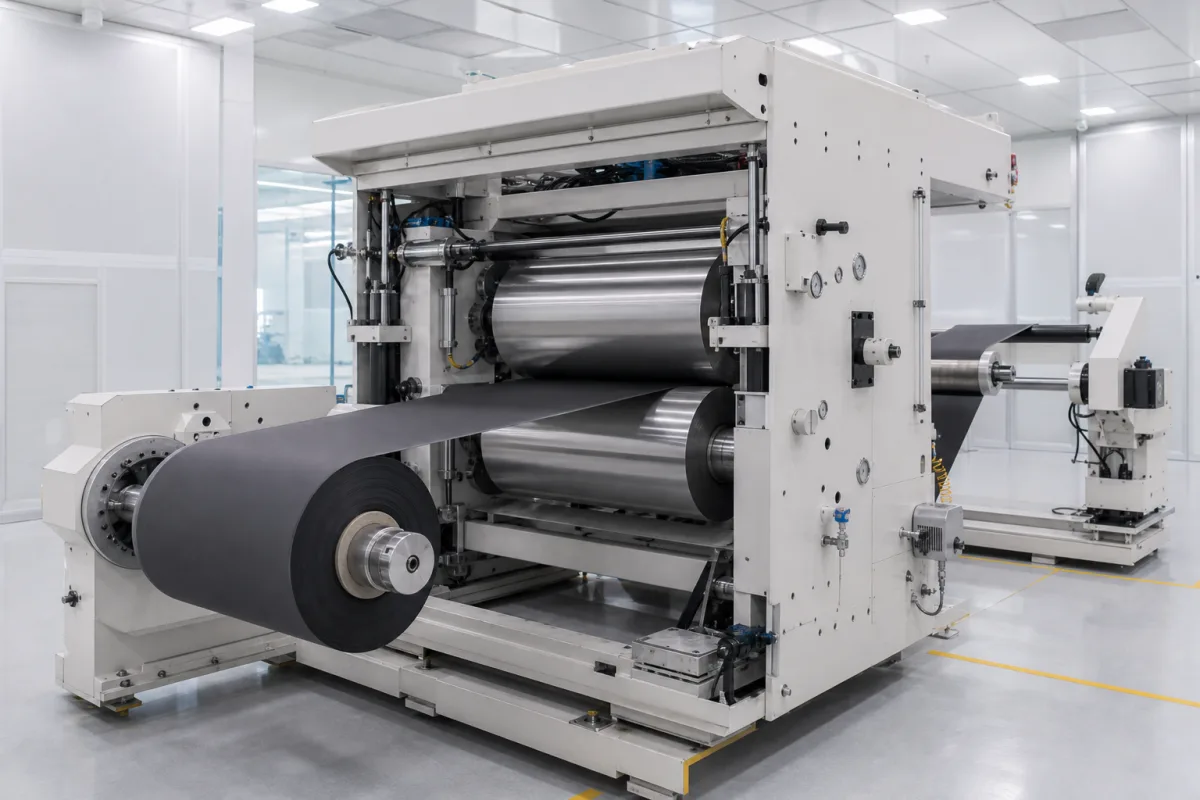
Battery Electrode Calendering Machine

Based on aggregated insights from multiple verified factory profiles within the CNFX directory, the standard Battery Electrode Calendering Machine used in the Electrical Equipment Manufacturing sector typically supports operational capacities ranging from standard industrial configurations to heavy-duty production requirements.

Technical Definition & Core Assembly

A canonical Battery Electrode Calendering Machine is characterized by the integration of Main Compression Rollers and Hydraulic Pressure System. In industrial production environments, manufacturers listed on CNFX commonly emphasize Hardened Steel construction to support stable, high-cycle operation across diverse manufacturing scenarios.

Industrial machine for compressing battery electrode coatings to precise thickness and density
Product Specifications

Technical details and manufacturing context for Battery Electrode Calendering Machine

Definition
A standalone industrial machine used in battery manufacturing to compress electrode coatings (anode or cathode) after coating and drying processes. It applies controlled pressure through heated rollers to achieve uniform electrode density, enhance electrical conductivity, and ensure consistent thickness. This process improves battery performance by optimizing active material loading and reducing internal resistance. The machine is essential for producing high-quality electrodes in lithium-ion, nickel-metal hydride, and other advanced battery types.
Working Principle
Electrode-coated foil passes between two counter-rotating heated rollers under precisely controlled pressure and temperature, compressing the coating to specified thickness and density while maintaining uniform web tension.
Common Materials
Hardened Steel, Tungsten Carbide, Stainless Steel, Industrial Ceramics
Technical Parameters
  • Maximum electrode coating width (mm) Standard Spec
  • Maximum linear pressure between rollers (kN) Standard Spec
Components / BOM
  • Main Compression Rollers
    Apply pressure and heat to compress electrode coating
    Material: Hardened steel with tungsten carbide coating
  • Hydraulic Pressure System
    Generate and control precise linear pressure between rollers
    Material: Stainless steel and industrial alloys
  • Temperature Control Unit
    Maintain precise roller temperature for optimal electrode compression
    Material: Stainless steel heating elements
  • Web Tension Control System
    Maintain consistent foil tension during processing
    Material: Precision bearings and sensors
  • Thickness Measurement Sensor Optional
    Real-time monitoring of electrode thickness during compression
    Material: Laser measurement components
Engineering Reasoning
50-200 kN roller force, 0.5-5.0 m/min line speed, 80-120°C roller temperature
Roller deflection exceeding 0.1 mm/m length at 250 kN force, coating density deviation >2% from 1.6 g/cm³ target
Design Rationale: Hertzian contact stress exceeding 1500 MPa yield strength of hardened steel rollers, causing plastic deformation and loss of parallelism
Risk Mitigation (FMEA)
Trigger Thermal expansion mismatch between roller core (coefficient 11.0×10⁻⁶/°C) and shell (coefficient 16.5×10⁻⁶/°C)
Mode: Roller surface micro-cracking and coating thickness variation exceeding ±2 μm tolerance
Strategy: Isothermal roller design with controlled gradient heating maintaining ΔT<5°C across roller cross-section
Trigger Electrode slurry adhesion exceeding 0.5 MPa shear strength to roller surface
Mode: Coating delamination and calendering force oscillation exceeding ±10% of setpoint
Strategy: Nanostructured DLC coating (coefficient of friction <0.1) with integrated ultrasonic cleaning at 40 kHz

Industry Taxonomies & Aliases

Commonly used trade names and technical identifiers for Battery Electrode Calendering Machine.

Industrial Ecosystem & Supply Chain DNA

Complementary Systems
Downstream Applications
Specialized Tooling

Application Fit & Sizing Matrix

Operational Limits
pressure: Up to 200 MPa (maximum calendering pressure)
other spec: Electrode coating width: 100-1000 mm, Line speed: 0.5-10 m/min, Thickness tolerance: ±1 μm
temperature: Ambient to 80°C (operating environment)
Media Compatibility
✓ Lithium-ion battery electrode slurries (anode/cathode) ✓ Solid-state battery electrode coatings ✓ Supercapacitor electrode materials
Unsuitable: Aqueous electrode slurries with high water content (corrosion risk to components)
Sizing Data Required
  • Maximum electrode coating width (mm)
  • Target electrode density (g/cc)
  • Required production throughput (meters/hour)

Reliability & Engineering Risk Analysis

Failure Mode & Root Cause
Roller Surface Degradation
Cause: Abrasive wear from electrode material particles and chemical corrosion from binder solvents, leading to uneven calendering and surface defects.
Hydraulic System Leakage
Cause: Seal degradation due to high-pressure cycling and thermal stress from continuous operation, resulting in pressure loss and inconsistent roll force.
Maintenance Indicators
  • Audible knocking or grinding from roller bearings, indicating misalignment or lubrication failure.
  • Visible electrode foil wrinkling or thickness variation, signaling roller parallelism issues or pressure inconsistencies.
Engineering Tips
  • Implement predictive maintenance with vibration analysis on roller bearings and laser alignment checks to detect early misalignment.
  • Use advanced condition monitoring for hydraulic fluid cleanliness and temperature, coupled with scheduled seal replacements based on pressure cycle counts.

Compliance & Manufacturing Standards

Reference Standards
ISO 9001:2015 - Quality Management Systems CE Marking - Machinery Directive 2006/42/EC ASTM E18-22 - Standard Test Methods for Rockwell Hardness
Manufacturing Precision
  • Roller Parallelism: +/- 0.01 mm
  • Roller Surface Roughness: Ra ≤ 0.4 μm
Quality Inspection
  • Dimensional Verification via Laser Scanning
  • Non-Destructive Testing (NDT) - Ultrasonic Testing

Factories Producing Battery Electrode Calendering Machine

Verified manufacturers with capability to produce this product in China

✓ 93% Supplier Capability Match Found

P Procurement Specialist from Germany Jan 24, 2026
★★★★★
"Impressive build quality. Especially the Maximum Web Width (mm) is very stable during long-term operation."
Technical Specifications Verified
T Technical Director from Brazil Jan 21, 2026
★★★★★
"As a professional in the Electrical Equipment Manufacturing sector, I confirm this Battery Electrode Calendering Machine meets all ISO standards."
Technical Specifications Verified
P Project Engineer from Canada Jan 18, 2026
★★★★★
"Standard OEM quality for Electrical Equipment Manufacturing applications. The Battery Electrode Calendering Machine arrived with full certification."
Technical Specifications Verified
Verification Protocol

“Feedback is collected from verified sourcing managers during RFQ (Request for Quote) and factory evaluation processes on CNFX. These reports represent historical performance data and technical audit summaries from our B2B manufacturing network.”

15 sourcing managers are analyzing this specification now. Last inquiry for Battery Electrode Calendering Machine from Mexico (11m ago).

Supply Chain Commonly Integrated Components

Rotor Assembly

The rotating component of an actuator motor that converts electrical energy into mechanical motion

Explore Specs →
Stator Assembly

The stationary component of an electric motor that generates a rotating magnetic field when energized.

Explore Specs →
Wire Tensioner

A device that applies and maintains precise tension on electrical wire during the winding process of transformers.

Explore Specs →
Wire Guide System

A precision mechanical system that guides and positions wire during the winding process on a transformer winding machine.

Explore Specs →

Frequently Asked Questions

What is the main purpose of a battery electrode calendering machine?

The machine compresses battery electrode coatings to achieve precise thickness and density, which is critical for optimal battery performance, energy density, and longevity in lithium-ion and other advanced battery production.

How does the thickness control system work in this calendering machine?

It uses precision thickness measurement sensors combined with real-time feedback to the hydraulic pressure system and web tension controls, maintaining accuracy within micrometers (μm) throughout the continuous production process.

What materials are used in the compression rollers and why?

Rollers are typically made from hardened steel, tungsten carbide, or industrial ceramics to withstand high linear pressures (kN/cm), maintain precise surface finish, and resist wear during continuous operation with abrasive electrode materials.

Can I contact factories directly on CNFX?

CNFX is an open directory, not a transaction platform. Each factory profile provides direct contact information and production details to help you initiate direct inquiries with Chinese suppliers.

Get Quote for Battery Electrode Calendering Machine

Request technical pricing, lead times, or customized specifications for Battery Electrode Calendering Machine directly from verified manufacturing units.

Your business information is encrypted and only shared with verified Battery Electrode Calendering Machine suppliers.

Thank you! Your message has been sent. We'll respond within 1–3 business days.

Need to Manufacture Battery Electrode Calendering Machine?

Connect with verified factories specializing in this product category

Add Your Factory Contact Us
Previous Product
Battery Cell Tab Connector
Next Product
Battery Electrode Slitting Machine