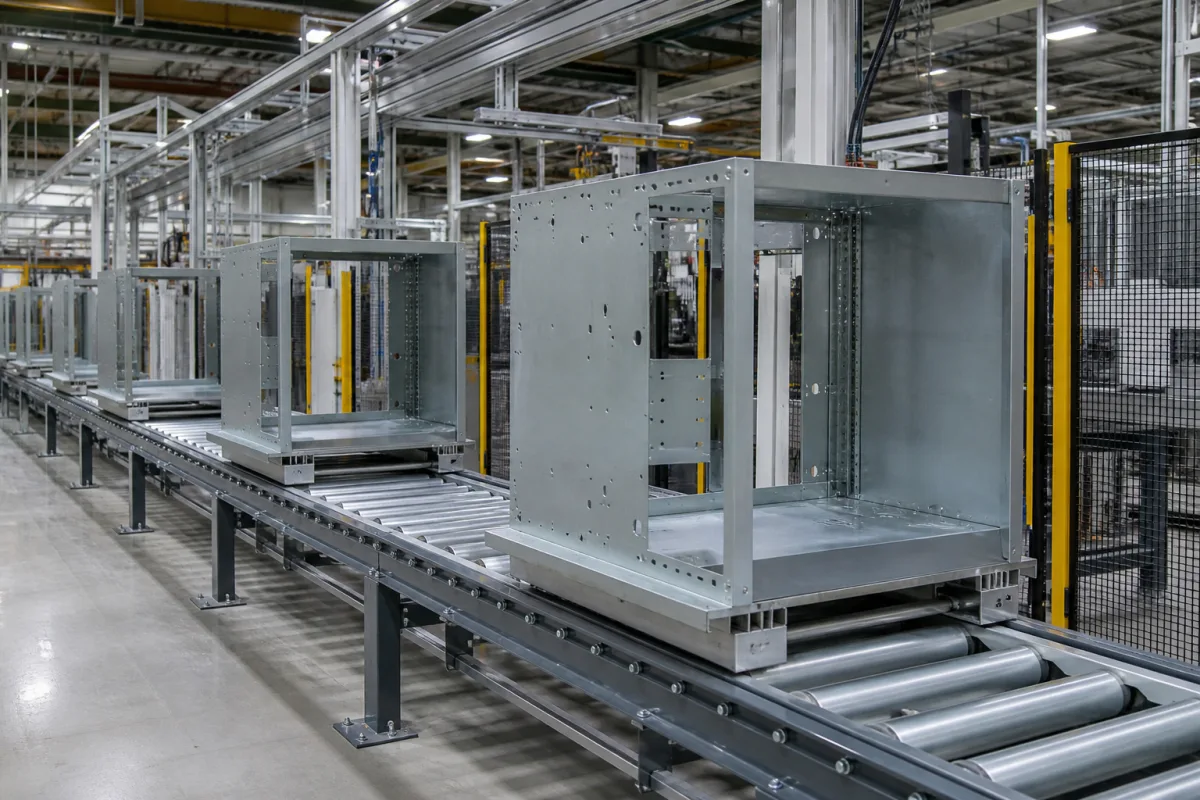
Cabinet assembly transport line (heavy workpiece-carrier roller conveyor for switchgear)
Heavy-load roller transport line carrying switchgear and control-cabinet frames on workpiece carriers between assembly stations: load per metre and per drive, roller pitch, accumulation and lift stations
In switchgear and control-cabinet assembly, the empty frame is set on a workpiece carrier at the start of the line and travels on powered rollers from station to station while busbars, breakers, wiring and doors are fitted, so its weight grows along the line. The transport line therefore has to carry the finished cabinet, stop and hold it at each station, and let carriers queue without pushing into each other. Ask three things first: the heaviest finished cabinet and its carrier footprint, the load per metre and per drive section, and which stations need lifting, rotating or accumulation.
Roller transport lines for assembling switchgear, control cabinets and similar heavy enclosures: chain-driven and accumulating roller sections, workpiece carriers, separating stops, lift and positioning units and their drives. Conveyor systems as a plant-wide category comparing belt, roller, chain, screw and modular types are covered on the Conveyor systems page. Pallet conveyors for transport pallets at the end of packaging lines, light workpiece-carrier systems for small parts, and conveyors inside shot-blasting machines are outside this page.
CNFX editorial research · Sources checked October 12, 2026 · 4 sources
Rate the rollers for the finished cabinet, per metre and per drive
MiniTec describes its RMS Max roller assembly system as a workpiece carrier transfer system for particularly heavy parts, rated up to 1,000 kg per linear metre and up to 6,000 kg per drive, with drive sections up to 9 m long and speeds up to 9 m/min. Its lighter RMS system is listed at up to 350 kg per workpiece carrier, 1,200 kg per drive and 15 m/min. [1]
The same comparison lists RMS Max guide widths of 600 mm or more, workpiece carriers 600 to 2,500 mm long, 60 mm rollers at a standard pitch of 75 or 150 mm, and accumulation rollers with internal friction driven by an electric motor through a tangential chain; the RMS figures are 400, 500 or 600 mm widths, 400 to 2,000 mm carriers and 50 mm rollers at 60, 120 or 180 mm. [1]
Editorial calculation: a full 9 m RMS Max drive section at 1,000 kg/m would carry 9,000 kg, above the 6,000 kg per-drive limit, so a fully loaded 9 m section averages no more than about 667 kg/m (6,000 ÷ 9). Check both limits against the number of cabinets queued on one drive. [1]
Hytrol rates its chain-driven roller conveyors by model: the 199-CRR carries cartons or pallets up to 250 lb per linear foot, the 25-CRR 1,000 lb/ft and the 36-CRRH 2,000 lb/ft. [2] Editorial calculation: these convert to about 372, 1,488 and 2,976 kg/m (1 lb/ft = 0.4536 kg ÷ 0.3048 m ≈ 1.488 kg/m). [2]
Give the supplier the heaviest finished cabinet and its centre of gravity, the carrier length and width, the number of carriers queued per section, line length and layout, the station list with cycle time, lifting, rotating and transfer needs, the stop positions and positioning accuracy, power supply, and the guarding and emergency-stop arrangement.
02
Let cabinets queue without contact and stop them at each station
Hytrol's chain-driven roller models with its EZLogic system accumulate cartons or pallets with zero back pressure, which it says reduces collisions that may damage product; its 199-CREZD, 25-CREZD and 36-CREZD are rated at 250, 1,000 and 2,000 lb per foot. [2]
MiniTec's RMS Max carriers use anodised aluminium frames with centering bushes for positioning and replaceable UHMW slide rails; it lists adjustable accumulation pressure, four precision ball bearings per accumulation roller, pneumatic or electric separating stops with damping, and a pneumatic lifting and positioning unit. [1]
Promation's line for large elevator control cabinets of 650 lb (about 295 kg, editorial conversion) combined power-driven roller conveyors with air-bladder lifts, product rotating stations with overhead lighting, tool trolleys and power crossover stations in a progressive assembly line. [4]
03
Specify the chain drive and its upkeep
Hytrol's installation bulletin for its 199-CRR lists 1.9 in. tread rollers each carrying two 40A18 sprockets, #40 chain at 4 in. roller centres, and 1/2, 1 and 2 HP TEFC motors for 230/460 V AC, three-phase, 60 Hz. [3]
The bulletin calls for lubricating the drive chain every 2,080 hours of operation or every 6 months, whichever comes first, in normal environments, and lists chain stretch from lack of lubrication and improper tension among causes of excessive chain and sprocket wear. [3]
04
Guard the line where people work beside it
Hytrol's bulletin sets out its conveyor safety precautions: a conveyor over a walkway or work station counts as guarded by location only if all moving parts are at least 8 ft (2.44 m) above the floor, and conveyors over exit passageways need at least 6 ft 8 in (2.032 m) headroom. [3]
Where a conveyor that could cause injury starts automatically or from a remote location, the bulletin calls for an audible warning, which a flashing light may supplement or replace, before start-up; remotely controlled conveyors need emergency stop buttons, pull cords or similar devices that act directly on that conveyor and cannot be overridden from elsewhere. [3] On a cabinet line, fitters work at every station, so ask where stops and pull cords sit relative to each station.
05
Values to fix for a cabinet transport line
Field
Published values from reviewed sources
Ask the supplier for
Rated load capacity (kg/m)
RMS Max up to 1,000 kg/m; Hytrol 250–2,000 lb/ft. [1][2]
Explore company information and manufacturing capabilities, then discuss the scope of your project with a relevant supplier.
Share this page
Compiled and source-reviewed by the CNFX editorial team.
Each manufacturer above links to the page on that company's own website where the product is listed, with the date we checked it. How we source and review
· Page last updated 13 October 2026
Buyer questions
How much can a heavy carrier roller line carry?
MiniTec lists RMS Max at up to 1,000 kg per metre and 6,000 kg per drive, with drive sections up to 9 m. [1]
What is zero-pressure accumulation?
Hytrol's EZLogic chain-driven roller models let cartons or pallets queue with zero back pressure to reduce collisions. [2]
How often should the drive chain be lubricated?
Hytrol's 199-CRR bulletin says every 2,080 operating hours or 6 months, whichever comes first, in normal environments. [3]
Sources and what still needs a direct check
Sources checked 2026-10-12. MiniTec and Hytrol are conveyor makers describing their own systems; Promation's line is reported by Circuits Assembly. Load ratings depend on each maker's test basis, so ask how the rating is defined.