Industry-Verified Manufacturing Data (2026)

Sensors

Based on aggregated insights from multiple verified factory profiles within the CNFX directory, the standard Sensors used in the Machinery and Equipment Manufacturing sector typically supports operational capacities ranging from standard industrial configurations to heavy-duty production requirements.

Technical Definition & Core Assembly

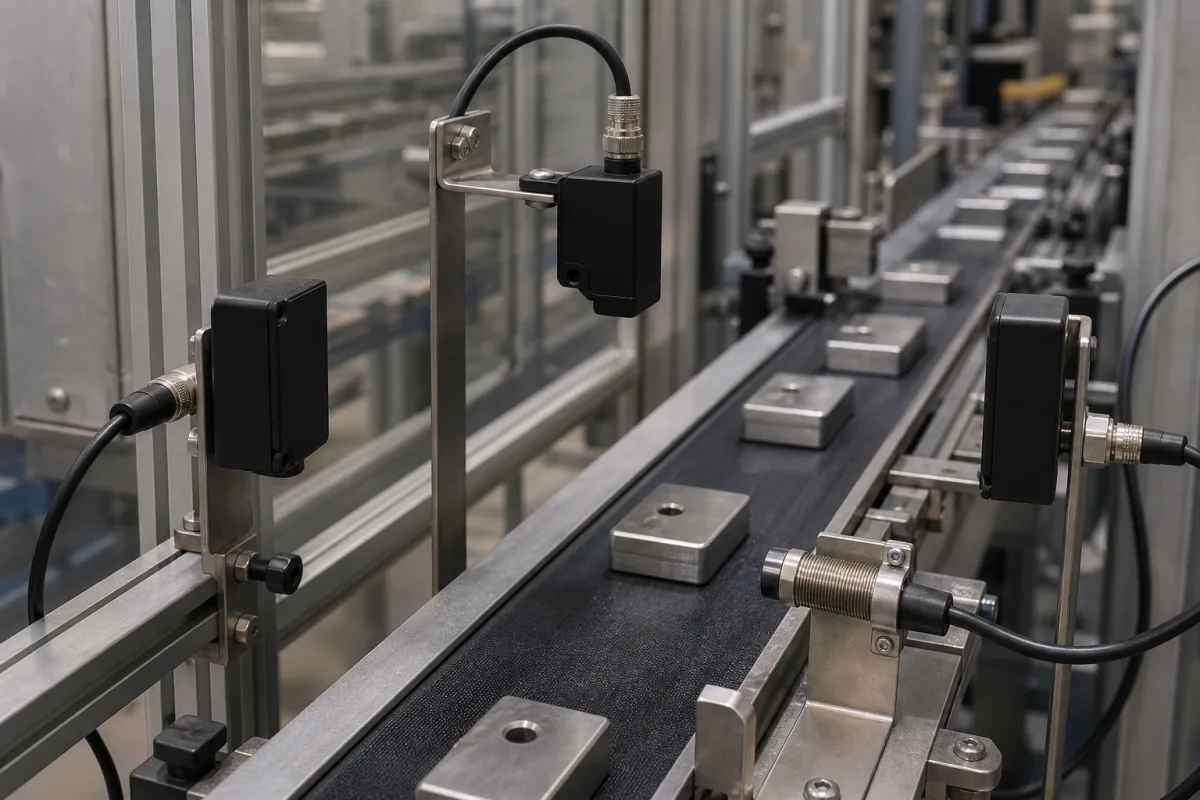
A canonical Sensors is characterized by the integration of Sensing Element and Housing. In industrial production environments, manufacturers listed on CNFX commonly emphasize Stainless steel housing construction to support stable, high-cycle operation across diverse manufacturing scenarios.

Devices that detect and measure physical properties or environmental conditions in conveyor systems

Product Specifications

Technical details and manufacturing context for Sensors

Definition
Sensors in conveyor transport systems are electronic components that monitor various parameters such as object presence, position, speed, temperature, weight, and alignment. They provide critical feedback to control systems for automated operation, safety, and efficiency optimization.
Working Principle
Sensors convert physical phenomena (position, proximity, temperature, pressure, etc.) into electrical signals using various technologies including photoelectric, inductive, capacitive, ultrasonic, or laser-based detection methods. These signals are processed by control systems to make operational decisions.
Common Materials
Stainless steel housing, Polycarbonate lenses, Electronic components, Copper wiring
Technical Parameters
  • Detection range and mounting dimensions (mm) Per Request
Components / BOM
  • Sensing Element
    Detects physical changes in the environment
    Material: Semiconductor or specialized sensing material
  • Housing
    Protects internal components from environmental factors
    Material: Stainless steel or industrial plastic
  • Lens/Window
    Allows detection signals to pass through while protecting the sensor
    Material: Polycarbonate or glass
  • Signal Processor
    Converts raw sensor data into usable output signals
    Material: Electronic circuit board with microchips
  • Connection Interface
    Provides electrical connections to the control system
    Material: Copper contacts with plastic insulation
Engineering Reasoning
0-150°C temperature, 0-1000 kPa pressure, 0-100% relative humidity
Thermal: 175°C (sensor element degradation), Pressure: 1200 kPa (diaphragm rupture), Humidity: 100% RH sustained >24h (corrosion initiation)
Design Rationale: Thermal: Semiconductor junction breakdown at 175°C (silicon intrinsic temperature), Pressure: Yield strength exceedance of 316L stainless steel diaphragm at 1200 kPa, Humidity: Electrochemical corrosion of copper traces at dew point conditions
Risk Mitigation (FMEA)
Trigger Electrostatic discharge (ESD) event exceeding 8 kV
Mode: Integrated circuit gate oxide breakdown in signal conditioning electronics
Strategy: TVS diode array with 5 ns response time and 15 kV clamping voltage at PCB input stage
Trigger Mechanical vibration at 200 Hz resonance frequency with 5 g acceleration
Mode: Solder joint fatigue failure (Coffin-Manson model: N_f=1000 cycles at Δε=0.01)
Strategy: Conformal coating application (urethane-based, 50 μm thickness) and anti-vibration mounting with natural frequency >400 Hz

Industry Taxonomies & Aliases

Commonly used trade names and technical identifiers for Sensors.

Applied To / Applications

This component is essential for the following industrial systems and equipment:

Industrial Ecosystem & Supply Chain DNA

Complementary Systems
Downstream Applications
Specialized Tooling

Application Fit & Sizing Matrix

Operational Limits
pressure: 0 to 10 bar (absolute), 0 to 5 bar (differential)
other spec: Flow Rate: 0.01 to 10 m/s, Slurry Concentration: ≤30% solids by weight, Humidity: 0-100% RH non-condensing
temperature: -40°C to +85°C (operational), -50°C to +100°C (storage)
Media Compatibility
✓ Dry bulk materials (grains, powders) ✓ Packaged goods (boxes, containers) ✓ Liquid containers (bottles, drums)
Unsuitable: Explosive atmospheres (ATEX Zone 0) without proper certification
Sizing Data Required
  • Conveyor belt width (mm)
  • Required detection resolution (mm)
  • Maximum object speed (m/s)

Reliability & Engineering Risk Analysis

Failure Mode & Root Cause
Drift and Calibration Loss
Cause: Environmental exposure (temperature extremes, humidity, corrosive atmospheres), sensor aging, or mechanical stress altering internal components, leading to inaccurate readings over time.
Signal Interruption or Electrical Failure
Cause: Wiring degradation (e.g., broken wires, loose connections), moisture ingress causing short circuits, or power supply issues disrupting data transmission.
Maintenance Indicators
  • Erratic or inconsistent readings (e.g., sudden spikes, drops, or zero values) compared to expected process conditions.
  • Physical damage signs like cracked housings, corrosion on connectors, or audible buzzing/humming from the sensor unit.
Engineering Tips
  • Implement regular calibration schedules based on manufacturer guidelines and environmental severity, using traceable standards to maintain accuracy.
  • Ensure proper installation with environmental protection (e.g., enclosures, seals) and secure, shielded wiring to prevent mechanical and electrical stressors.

Compliance & Manufacturing Standards

Reference Standards
ISO 9001:2015 - Quality management systems IEC 60751:2008 - Industrial platinum resistance thermometers and platinum temperature sensors CE Marking - Conformity with EU directives for safety and electromagnetic compatibility
Manufacturing Precision
  • Temperature Accuracy: +/-0.5°C for Class A sensors
  • Response Time: +/-10% of specified value for dynamic sensors
Quality Inspection
  • Calibration Verification against NIST-traceable standards
  • Environmental Stress Testing (temperature, humidity, vibration)

Factories Producing Sensors

Verified manufacturers with capability to produce this product in China

✓ 98% Supplier Capability Match Found

P Project Engineer from Singapore Jan 13, 2026
★★★★★
"Found 27+ suppliers for Sensors on CNFX, but this spec remains the most cost-effective."
Technical Specifications Verified
S Sourcing Manager from Germany Jan 10, 2026
★★★★★
"The technical documentation for this Sensors is very thorough, especially regarding technical reliability."
Technical Specifications Verified
P Procurement Specialist from Brazil Jan 07, 2026
★★★★★
"Reliable performance in harsh Machinery and Equipment Manufacturing environments. No issues with the Sensors so far."
Technical Specifications Verified
Verification Protocol

“Feedback is collected from verified sourcing managers during RFQ (Request for Quote) and factory evaluation processes on CNFX. These reports represent historical performance data and technical audit summaries from our B2B manufacturing network.”

10 sourcing managers are analyzing this specification now. Last inquiry for Sensors from Turkey (1h ago).

Supply Chain Compatible Machinery & Devices

Automated Assembly Line System

Integrated production system for sequential component assembly operations

Explore Specs →
Automated Powder Coating System

Integrated industrial system for applying dry powder coatings to metal substrates.

Explore Specs →
Centrifugal Pump Impeller

Rotating component that transfers energy to fluid in centrifugal pumps.

Explore Specs →
High-Precision CNC Laser Cutting Machine

Computer-controlled industrial machine using focused laser beams to cut sheet metal with micron-level accuracy.

Explore Specs →

Frequently Asked Questions

What makes these sensors suitable for harsh industrial environments?

These sensors feature stainless steel housings for corrosion resistance and polycarbonate lenses that withstand impact and chemical exposure, making them ideal for demanding machinery manufacturing settings.

How do these sensors integrate with existing conveyor systems?

They include standardized connection interfaces and signal processors that easily connect to PLCs and control systems, with copper wiring ensuring reliable data transmission in industrial environments.

What types of measurements can these conveyor sensors detect?

They detect various physical properties including temperature, pressure, position, and speed, as well as environmental conditions like humidity and vibration, using specialized sensing elements for each parameter.

Can I contact factories directly on CNFX?

CNFX is an open directory, not a transaction platform. Each factory profile provides direct contact information and production details to help you initiate direct inquiries with Chinese suppliers.

Get Quote for Sensors

Request technical pricing, lead times, or customized specifications for Sensors directly from verified manufacturing units.

Your business information is encrypted and only shared with verified Sensors suppliers.

Thank you! Your message has been sent. We'll respond within 1–3 business days.

Need to Manufacture Sensors?

Connect with verified factories specializing in this product category

Add Your Factory Contact Us
Previous Product
Sensor/Transducer
Next Product
Sensors (optional)