Industry-Verified Manufacturing Data (2026)

LED array/module

Based on aggregated insights from multiple verified factory profiles within the CNFX directory, the standard LED array/module used in the Electrical Equipment Manufacturing sector typically supports operational capacities ranging from standard industrial configurations to heavy-duty production requirements.

Technical Definition & Core Assembly

A canonical LED array/module is characterized by the integration of LED chips and Substrate/PCB. In industrial production environments, manufacturers listed on CNFX commonly emphasize Semiconductor chips (GaN, GaAs, etc.) construction to support stable, high-cycle operation across diverse manufacturing scenarios.

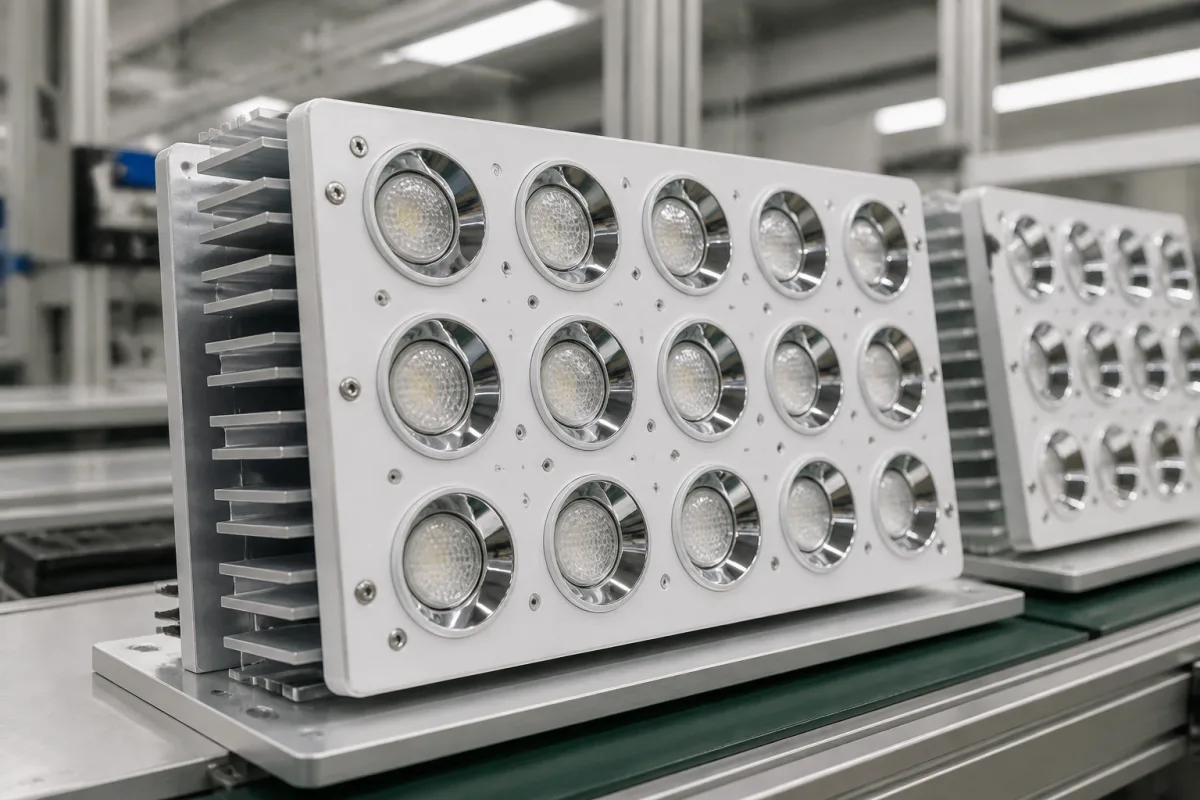
A modular assembly of multiple LED chips arranged in a specific pattern on a substrate, serving as the core light-emitting component in LED lighting systems.
Product Specifications

Technical details and manufacturing context for LED array/module

Definition
An LED array/module is a fundamental component within LED lighting systems that integrates multiple individual LED chips onto a single substrate or circuit board. It functions as the primary light source, with the arrangement and configuration of LEDs determining the overall light output pattern, intensity, and color characteristics. These modules are designed for easy integration into larger lighting fixtures and systems, providing standardized electrical and mechanical interfaces.
Working Principle
LED arrays/modules operate by converting electrical energy into light through electroluminescence. When forward voltage is applied to the semiconductor material within each LED chip, electrons recombine with electron holes, releasing energy in the form of photons. The array/module configuration allows for controlled current distribution across multiple LEDs, enabling uniform illumination, color mixing, and thermal management through the substrate design.
Common Materials
Semiconductor chips (GaN, GaAs, etc.), Ceramic or metal-core PCB substrate, Phosphor coatings (for white LEDs), Encapsulation epoxy/silicone, Copper traces
Technical Parameters
  • Physical dimensions including length, width, and thickness of the module (mm) Standard Spec
Components / BOM
  • LED chips
    Individual light-emitting semiconductor devices that produce photons when electrically excited
    Material: Gallium nitride (GaN), Gallium arsenide (GaAs)
  • Substrate/PCB
    Provides mechanical support, electrical connections, and thermal dissipation for the LED chips
    Material: Aluminum, ceramic, or FR4 circuit board
  • Encapsulation
    Protects LED chips from environmental factors and provides optical control of light output
    Material: Epoxy resin or silicone
  • Phosphor layer
    Converts blue or UV light from LED chips to white light through wavelength conversion
    Material: YAG:Ce phosphor or other phosphor compounds
  • Electrical contacts
    Provide connection points for power input and control signals to the module
    Material: Copper with gold or tin plating
Engineering Reasoning
2.8-3.6 V forward voltage per LED chip, 20-150 mA forward current per chip, -40°C to +85°C ambient temperature
Junction temperature exceeding 150°C, forward current exceeding 200% of rated value for >100 ms, electrostatic discharge >1000 V
Design Rationale: Thermal runaway due to negative temperature coefficient of forward voltage, electromigration in bond wires at >150°C, phosphor thermal quenching above 180°C
Risk Mitigation (FMEA)
Trigger Thermal interface degradation with thermal resistance increase >5 K/W
Mode: LED junction temperature exceeds 150°C causing catastrophic failure
Strategy: Direct thermal path design with thermal vias to metal core PCB, using thermal interface materials with conductivity >3 W/m·K
Trigger Current imbalance exceeding 15% between parallel LED strings
Mode: Individual LED overcurrent leading to premature lumen depreciation >30%
Strategy: Current mirror circuits with 1% tolerance resistors, active current balancing using constant current drivers with <5% ripple

Industry Taxonomies & Aliases

Commonly used trade names and technical identifiers for LED array/module.

Applied To / Applications

This component is essential for the following industrial systems and equipment:

Industrial Ecosystem & Supply Chain DNA

Complementary Systems
Downstream Applications
Specialized Tooling

Application Fit & Sizing Matrix

Operational Limits
pressure: Atmospheric (not pressure-rated)
other spec: Max forward current: 350-1000mA per LED (depends on chip), junction temperature: ≤125°C, humidity: 5-95% RH non-condensing
temperature: -40°C to +85°C (operating), -40°C to +100°C (storage)
Media Compatibility
✓ Indoor ambient air ✓ Dry inert gas environments ✓ Encapsulated in silicone/optical resin
Unsuitable: Direct liquid immersion or high-moisture condensing environments
Sizing Data Required
  • Required luminous flux (lumens)
  • Beam angle/optical distribution pattern
  • Thermal management capability (heat sink design)

Reliability & Engineering Risk Analysis

Failure Mode & Root Cause
Thermal degradation
Cause: Excessive heat accumulation due to poor thermal management, inadequate heat sinking, or high ambient temperatures, leading to phosphor degradation, solder joint failure, and accelerated lumen depreciation.
Electrolytic capacitor failure
Cause: Premature aging of electrolytic capacitors in the driver circuitry due to high operating temperatures, voltage spikes, or poor-quality components, resulting in flickering, dimming, or complete driver failure.
Maintenance Indicators
  • Visible flickering or intermittent operation, indicating driver or power supply instability
  • Significant color shift (e.g., yellowing or blue tint) or dark spots on the LED array, suggesting thermal damage or phosphor degradation
Engineering Tips
  • Ensure proper thermal design with adequate heat sinking and ventilation; maintain ambient temperatures below manufacturer specifications to prevent thermal runaway and extend LED lifespan.
  • Use high-quality, surge-protected power supplies and implement regular inspection of driver components, especially capacitors, to preemptively replace aging parts before failure.

Compliance & Manufacturing Standards

Reference Standards
IEC 62031:2018 - LED modules for general lighting - Safety specifications ANSI C78.377-2017 - Specifications for the Chromaticity of Solid State Lighting Products EN 62471:2008 - Photobiological safety of lamps and lamp systems
Manufacturing Precision
  • LED placement accuracy: +/-0.1mm
  • Thermal resistance: +/-5% of specified value
Quality Inspection
  • Luminous flux and color temperature measurement
  • Thermal cycling and humidity testing

Factories Producing LED array/module

Verified manufacturers with capability to produce this product in China

✓ 94% Supplier Capability Match Found

T Technical Director from United Arab Emirates Jan 02, 2026
★★★★★
"Great transparency on the LED array/module components. Essential for our Electrical Equipment Manufacturing supply chain."
Technical Specifications Verified
P Project Engineer from Australia Dec 30, 2025
★★★★☆
"The LED array/module we sourced perfectly fits our Electrical Equipment Manufacturing production line requirements. (Delivery took slightly longer than expected, but technical support was excellent.)"
Technical Specifications Verified
S Sourcing Manager from Singapore Dec 27, 2025
★★★★★
"Found 28+ suppliers for LED array/module on CNFX, but this spec remains the most cost-effective."
Technical Specifications Verified
Verification Protocol

“Feedback is collected from verified sourcing managers during RFQ (Request for Quote) and factory evaluation processes on CNFX. These reports represent historical performance data and technical audit summaries from our B2B manufacturing network.”

7 sourcing managers are analyzing this specification now. Last inquiry for LED array/module from Mexico (1h ago).

Supply Chain Compatible Machinery & Devices

Circuit Breaker Trip Unit

Protective control module for electrical circuit breakers

Explore Specs →
Circuit Breaker Arc Chute

Electrical component that extinguishes arcs in circuit breakers

Explore Specs →
Medium Voltage Switchgear Assembly Line

Automated production system for assembling medium voltage electrical switchgear.

Explore Specs →
Motor Terminal Block

Electrical connection interface for motor windings

Explore Specs →

Frequently Asked Questions

What are the advantages of ceramic substrates versus metal-core PCBs in LED arrays?

Ceramic substrates offer superior electrical insulation and thermal conductivity for high-power applications, while metal-core PCBs provide excellent heat dissipation at lower cost for moderate-power industrial LED modules.

How does phosphor coating affect the performance of white LED arrays?

Phosphor coatings convert blue LED light to white light through wavelength conversion. Quality coatings ensure consistent color temperature (CCT), high color rendering index (CRI), and long-term stability against thermal degradation in industrial environments.

What thermal management considerations are crucial for LED array reliability?

Effective thermal management requires proper substrate selection (ceramic/metal-core), adequate copper trace design for heat spreading, encapsulation materials with high thermal conductivity, and integration with heatsinks in final lighting assemblies to maintain optimal junction temperatures.

Can I contact factories directly on CNFX?

CNFX is an open directory, not a transaction platform. Each factory profile provides direct contact information and production details to help you initiate direct inquiries with Chinese suppliers.

Get Quote for LED array/module

Request technical pricing, lead times, or customized specifications for LED array/module directly from verified manufacturing units.

Your business information is encrypted and only shared with verified LED array/module suppliers.

Thank you! Your message has been sent. We'll respond within 1–3 business days.

Need to Manufacture LED array/module?

Connect with verified factories specializing in this product category

Add Your Factory Contact Us
Previous Product
Lamination Feeding and Stacking Module
Next Product
LED Driver