Industry-Verified Manufacturing Data (2026)

Power Regulator (SSR/Contactor)

Based on aggregated insights from multiple verified factory profiles within the CNFX directory, the standard Power Regulator (SSR/Contactor) used in the Electrical Equipment Manufacturing sector typically supports operational capacities ranging from standard industrial configurations to heavy-duty production requirements.

Technical Definition & Core Assembly

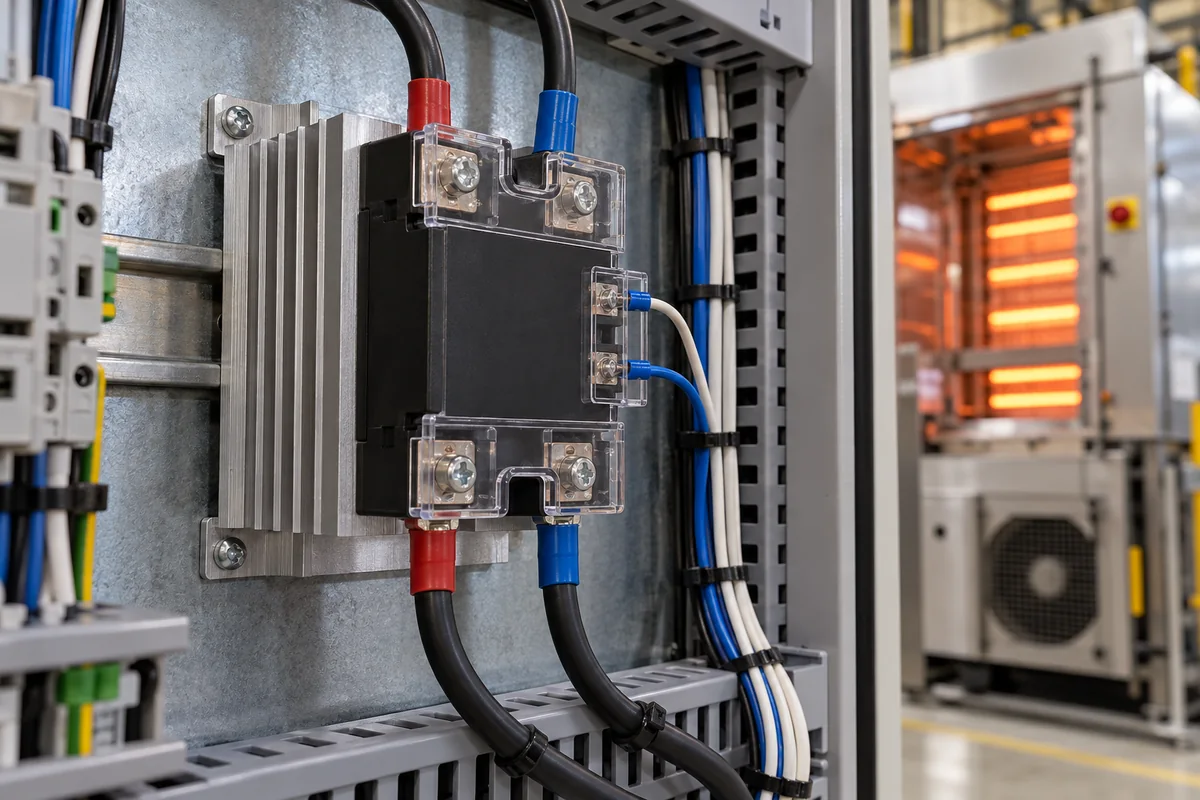
A canonical Power Regulator (SSR/Contactor) is characterized by the integration of Heat Sink and Control Circuit. In industrial production environments, manufacturers listed on CNFX commonly emphasize Copper construction to support stable, high-cycle operation across diverse manufacturing scenarios.

An electrical switching device that controls power delivery to heating elements by regulating current flow.
Product Specifications

Technical details and manufacturing context for Power Regulator (SSR/Contactor)

Definition
A critical component within Heating Element & Control Systems that manages electrical power supply to heating elements through precise switching mechanisms. It ensures controlled heating by modulating power based on temperature feedback, protecting equipment from overloads, and enabling energy-efficient operation in industrial heating applications.
Working Principle
Uses solid-state relays (SSR) or electromechanical contactors to switch AC/DC power to heating elements. SSRs employ semiconductor switching (thyristors/triacs) triggered by low-voltage control signals, providing silent, fast switching with no moving parts. Contactors use electromagnetic coils to mechanically close contacts, handling high currents. Both respond to control signals from temperature controllers to maintain setpoint temperatures.
Common Materials
Copper, Silicon semiconductor materials, Ceramic substrates, Plastic housing
Technical Parameters
  • Current rating (typically 10-200A for industrial heating applications) (A) Standard Spec
Components / BOM
  • Heat Sink
    Dissipates heat generated during switching operations to prevent overheating
    Material: Aluminum alloy
  • Control Circuit
    Processes input signals and triggers the switching mechanism
    Material: Printed circuit board with electronic components
  • Terminal Blocks
    Provides secure electrical connections for power and control wires
    Material: Copper with plastic insulation
Engineering Reasoning
0-40 A continuous current, 24-480 VAC switching voltage, -40°C to +80°C ambient temperature
Contact welding at 150% rated current for >100 ms, dielectric breakdown at 600 VAC, thermal runaway at 125°C junction temperature
Design Rationale: Contact welding due to joule heating exceeding material melting point (copper: 1085°C), dielectric breakdown via Townsend avalanche at 3×10⁶ V/m field strength, thermal runaway from positive temperature coefficient of semiconductor junctions
Risk Mitigation (FMEA)
Trigger Inductive load switching without snubber circuit
Mode: Contact arcing causing pitting and increased contact resistance
Strategy: RC snubber network with 100 Ω resistor and 0.1 μF capacitor across contacts
Trigger Ambient temperature exceeding 80°C with inadequate heat sinking
Mode: Thermal runaway in semiconductor switching element
Strategy: Forced air cooling maintaining 2 m/s airflow or liquid cooling plate with 0.5 K/W thermal resistance

Industry Taxonomies & Aliases

Commonly used trade names and technical identifiers for Power Regulator (SSR/Contactor).

Applied To / Applications

This component is essential for the following industrial systems and equipment:

Industrial Ecosystem & Supply Chain DNA

Complementary Systems
Downstream Applications
Specialized Tooling

Application Fit & Sizing Matrix

Operational Limits
pressure: N/A (solid-state device, no pressure rating)
other spec: Current rating: 10-100A typical, Voltage: 24-600VAC/DC, Switching frequency: <1Hz to 100Hz
temperature: -40°C to +80°C (ambient), up to +125°C (heat sink dependent)
Media Compatibility
✓ Resistive heating elements ✓ Industrial ovens/furnaces ✓ Motor loads (with appropriate derating)
Unsuitable: Explosive atmospheres (unless specifically rated for hazardous locations)
Sizing Data Required
  • Load current (Amps RMS)
  • Supply voltage (VAC/VDC)
  • Duty cycle/On-time duration

Reliability & Engineering Risk Analysis

Failure Mode & Root Cause
Contact Welding
Cause: Excessive inrush current or frequent switching under load causing contacts to fuse together permanently
Insulation Breakdown
Cause: Thermal cycling, moisture ingress, or voltage spikes degrading dielectric properties leading to short circuits
Maintenance Indicators
  • Audible buzzing or chattering during operation indicating contact bounce or arcing
  • Visible discoloration, charring, or melting on housing/terminals suggesting overheating
Engineering Tips
  • Install snubber circuits or soft-start devices to limit inrush currents and reduce contact arcing
  • Implement regular thermographic inspections to detect abnormal heating patterns before catastrophic failure

Compliance & Manufacturing Standards

Reference Standards
ISO 9001:2015 (Quality Management Systems) IEC 60947-4-1 (Low-voltage switchgear and controlgear - Contactors and motor-starters) EN 61810-1 (Electromechanical elementary relays)
Manufacturing Precision
  • Contact resistance: ≤50 mΩ at rated current
  • Insulation resistance: ≥100 MΩ at 500 VDC
Quality Inspection
  • Dielectric strength test (Hi-Pot test) at 2.5kV AC for 1 minute
  • Contact bounce measurement ≤5ms at rated voltage/current

Factories Producing Power Regulator (SSR/Contactor)

Verified manufacturers with capability to produce this product in China

✓ 93% Supplier Capability Match Found

P Procurement Specialist from Germany Feb 28, 2026
★★★★★
"Great transparency on the Power Regulator (SSR/Contactor) components. Essential for our Electrical Equipment Manufacturing supply chain."
Technical Specifications Verified
T Technical Director from Brazil Feb 25, 2026
★★★★★
"The Power Regulator (SSR/Contactor) we sourced perfectly fits our Electrical Equipment Manufacturing production line requirements."
Technical Specifications Verified
P Project Engineer from Canada Feb 22, 2026
★★★★★
"Found 21+ suppliers for Power Regulator (SSR/Contactor) on CNFX, but this spec remains the most cost-effective."
Technical Specifications Verified
Verification Protocol

“Feedback is collected from verified sourcing managers during RFQ (Request for Quote) and factory evaluation processes on CNFX. These reports represent historical performance data and technical audit summaries from our B2B manufacturing network.”

10 sourcing managers are analyzing this specification now. Last inquiry for Power Regulator (SSR/Contactor) from USA (27m ago).

Supply Chain Compatible Machinery & Devices

Circuit Breaker Trip Unit

Protective control module for electrical circuit breakers

Explore Specs →
Circuit Breaker Arc Chute

Electrical component that extinguishes arcs in circuit breakers

Explore Specs →
Medium Voltage Switchgear Assembly Line

Automated production system for assembling medium voltage electrical switchgear.

Explore Specs →
Motor Terminal Block

Electrical connection interface for motor windings

Explore Specs →

Frequently Asked Questions

What is the difference between an SSR and a contactor in power regulation?

An SSR (Solid State Relay) uses semiconductor materials like silicon for silent, fast switching without moving parts, while traditional contactors use electromagnetic coils and physical contacts. Both regulate power delivery to heating elements, but SSRs offer longer lifespan and noiseless operation.

How do the materials (copper, silicon, ceramic) affect the power regulator's performance?

Copper ensures efficient current conduction and heat dissipation, silicon semiconductors enable precise switching control, and ceramic substrates provide electrical insulation and thermal stability. Together, they deliver reliable power regulation with minimal energy loss.

What maintenance is required for this power regulator with heat sink and control circuit?

Regular inspection of the heat sink for dust accumulation, checking terminal block connections for tightness, and monitoring the control circuit for proper signal response. No moving parts mean minimal maintenance compared to mechanical contactors.

Can I contact factories directly on CNFX?

CNFX is an open directory, not a transaction platform. Each factory profile provides direct contact information and production details to help you initiate direct inquiries with Chinese suppliers.

Get Quote for Power Regulator (SSR/Contactor)

Request technical pricing, lead times, or customized specifications for Power Regulator (SSR/Contactor) directly from verified manufacturing units.

Your business information is encrypted and only shared with verified Power Regulator (SSR/Contactor) suppliers.

Thank you! Your message has been sent. We'll respond within 1–3 business days.

Need to Manufacture Power Regulator (SSR/Contactor)?

Connect with verified factories specializing in this product category

Add Your Factory Contact Us
Previous Product
Power Quality Analyzer
Next Product
Power Regulator / SCR Controller