Industry-Verified Manufacturing Data (2026)

Servo/Stepper Motors

Based on aggregated insights from multiple verified factory profiles within the CNFX directory, the standard Servo/Stepper Motors used in the Electrical Equipment Manufacturing sector typically supports operational capacities ranging from standard industrial configurations to heavy-duty production requirements.

Technical Definition & Core Assembly

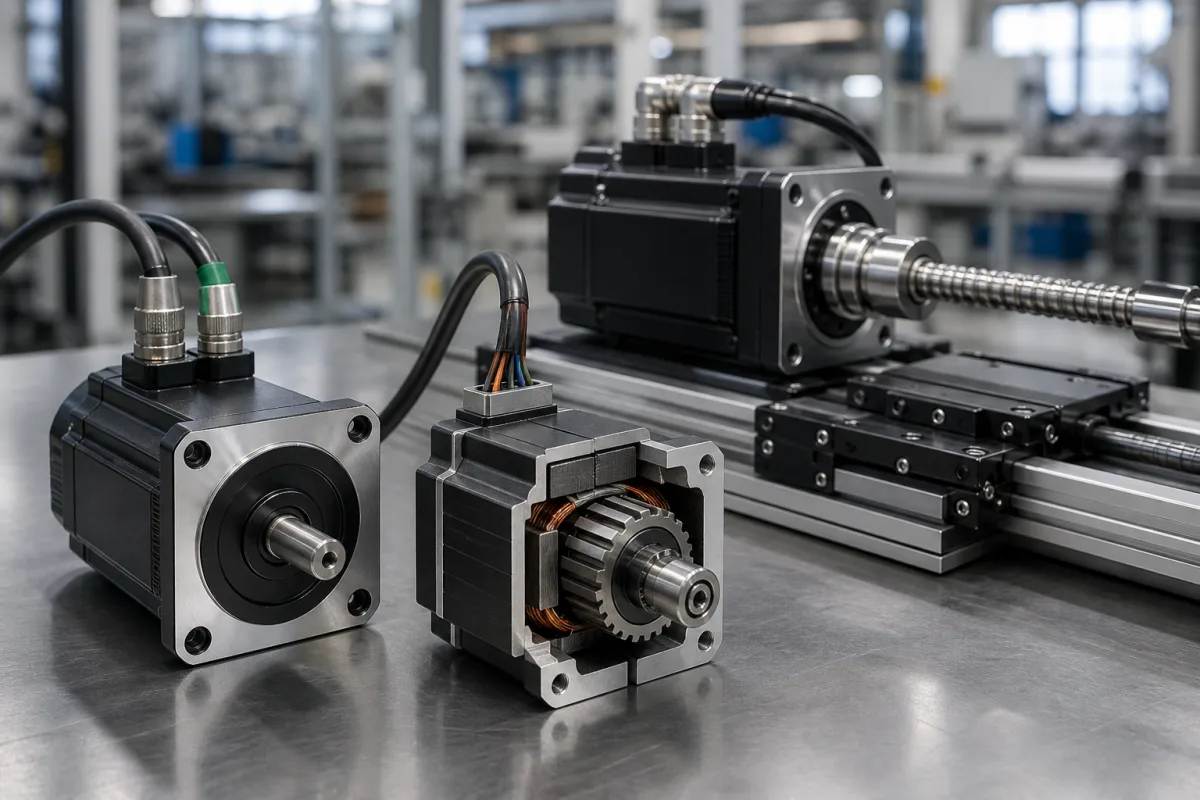
A canonical Servo/Stepper Motors is characterized by the integration of Rotor and Stator. In industrial production environments, manufacturers listed on CNFX commonly emphasize Electrical steel laminations construction to support stable, high-cycle operation across diverse manufacturing scenarios.

Precision electric motors that provide controlled rotational motion for positioning and speed control in industrial automation systems.
Product Specifications

Technical details and manufacturing context for Servo/Stepper Motors

Definition
Servo and stepper motors are electromechanical actuators that convert electrical signals into precise mechanical motion within industrial systems. Servo motors use closed-loop feedback systems (typically with encoders) to achieve high accuracy in position, velocity, and torque control, while stepper motors operate in discrete steps without feedback, making them suitable for applications requiring precise positioning at lower speeds. Both types are essential for automation tasks requiring controlled movement, such as robotic arms, CNC machines, conveyor systems, and packaging equipment.
Working Principle
Servo motors operate using a closed-loop control system where a controller sends signals to the motor driver, which powers the motor to achieve desired position/speed. An encoder provides real-time feedback to the controller for continuous adjustment. Stepper motors work through electromagnetic pulses that rotate the rotor in discrete angular steps (typically 1.8° or 0.9° per pulse) without requiring feedback, with each pulse corresponding to a specific movement increment.
Common Materials
Electrical steel laminations, Copper windings, Permanent magnets (neodymium/ferrite), Aluminum/steel housing
Technical Parameters
  • Rated torque output of the motor (Nm) Customizable
Components / BOM
  • Rotor
    Rotating part containing permanent magnets or iron core that interacts with stator magnetic fields
    Material: Permanent magnets (servo) or soft iron (stepper)
  • Stator
    Stationary part with windings that create electromagnetic fields to drive rotor movement
    Material: Electrical steel laminations with copper windings
  • Encoder Optional
    Provides position/speed feedback to controller for closed-loop control (servo motors)
    Material: Optical/ magnetic sensors with code disk
  • Shaft
    Mechanical output connection that transfers torque to the load
    Material: Hardened steel
Engineering Reasoning
0.1-6000 rpm rotational speed, 0.01-100 Nm torque, 24-480 VDC input voltage
Stall torque exceeding 150% rated torque for >2 seconds, winding temperature >155°C (Class F insulation), bearing temperature >120°C
Design Rationale: Permanent magnet demagnetization at Curie temperature (80-200°C depending on NdFeB/SmCo composition), insulation breakdown at >600 V/mm dielectric strength threshold, bearing lubricant viscosity breakdown at >120°C
Risk Mitigation (FMEA)
Trigger Back-EMF voltage spike exceeding 1.5x rated voltage during rapid deceleration
Mode: Insulation breakdown in stator windings causing phase-to-phase short circuit
Strategy: Dynamic braking circuits with 400V MOV surge protectors and regenerative energy dissipation resistors
Trigger Radial load exceeding 1.2x bearing dynamic load rating (C) from misaligned couplings
Mode: Ball bearing raceway spalling and increased vibration (>4.5 mm/s RMS)
Strategy: Precision alignment with laser alignment tools to <0.05 mm offset and angular misalignment <0.1°

Industry Taxonomies & Aliases

Commonly used trade names and technical identifiers for Servo/Stepper Motors.

Applied To / Applications

This component is essential for the following industrial systems and equipment:

Industrial Ecosystem & Supply Chain DNA

Complementary Systems
Downstream Applications
Specialized Tooling

Application Fit & Sizing Matrix

Operational Limits
altitude: Up to 1000m above sea level (standard)
humidity: 20-80% RH (non-condensing)
vibration: Up to 5G (depending on model and mounting)
temperature: -10°C to +40°C (standard), -20°C to +70°C (extended range available)
Media Compatibility
✓ Clean industrial environments ✓ Controlled factory floors ✓ Enclosed machinery with dust protection
Unsuitable: Submerged or high-pressure washdown environments without IP69K rating
Sizing Data Required
  • Required torque (Nm or oz-in)
  • Maximum speed (RPM)
  • Load inertia (kg·m² or oz-in·s²)

Reliability & Engineering Risk Analysis

Failure Mode & Root Cause
Bearing Failure
Cause: Contamination ingress, improper lubrication, or excessive axial/radial loads leading to wear, overheating, and eventual seizure or vibration.
Winding Insulation Breakdown
Cause: Thermal overloading, moisture ingress, voltage spikes, or aging causing short circuits, reduced torque, or complete motor burnout.
Maintenance Indicators
  • Unusual audible grinding, clicking, or whining noises during operation
  • Excessive vibration or overheating detected by touch or thermal imaging
Engineering Tips
  • Implement strict contamination control and regular bearing lubrication schedules using manufacturer-specified greases
  • Use proper drive tuning, voltage regulation, and thermal management to prevent electrical and thermal stress on windings

Compliance & Manufacturing Standards

Reference Standards
ISO 9409-1:2004 (Mechanical interface dimensions for servo/stepper motors) ANSI/IEEE 112-2017 (Standard Test Procedure for Polyphase Induction Motors and Generators) DIN EN 60034-1:2018 (Rotating electrical machines - Rating and performance)
Manufacturing Precision
  • Shaft runout: ≤0.02 mm
  • Mounting face flatness: ≤0.05 mm
Quality Inspection
  • Vibration analysis (ISO 10816-3)
  • Insulation resistance test (IEC 60034-27-1)

Factories Producing Servo/Stepper Motors

Verified manufacturers with capability to produce this product in China

✓ 96% Supplier Capability Match Found

T Technical Director from Australia Jan 06, 2026
★★★★★
"The Servo/Stepper Motors we sourced perfectly fits our Electrical Equipment Manufacturing production line requirements."
Technical Specifications Verified
P Project Engineer from Singapore Jan 03, 2026
★★★★☆
"Found 34+ suppliers for Servo/Stepper Motors on CNFX, but this spec remains the most cost-effective. (Delivery took slightly longer than expected, but technical support was excellent.)"
Technical Specifications Verified
S Sourcing Manager from Germany Dec 31, 2025
★★★★★
"The technical documentation for this Servo/Stepper Motors is very thorough, especially regarding technical reliability."
Technical Specifications Verified
Verification Protocol

“Feedback is collected from verified sourcing managers during RFQ (Request for Quote) and factory evaluation processes on CNFX. These reports represent historical performance data and technical audit summaries from our B2B manufacturing network.”

18 sourcing managers are analyzing this specification now. Last inquiry for Servo/Stepper Motors from India (1h ago).

Supply Chain Commonly Integrated Components

Control Cabinet

Electrical enclosure housing control systems for automated industrial equipment

Explore Specs →
Rotor Assembly

The rotating component of an actuator motor that converts electrical energy into mechanical motion

Explore Specs →
Stator Assembly

The stationary component of an electric motor that generates a rotating magnetic field when energized.

Explore Specs →
Wire Tensioner

A device that applies and maintains precise tension on electrical wire during the winding process of transformers.

Explore Specs →

Frequently Asked Questions

What are the key differences between servo and stepper motors for industrial applications?

Servo motors use feedback systems (typically encoders) for precise closed-loop control, making them ideal for high-speed, high-torque applications requiring accuracy. Stepper motors operate in open-loop with precise step movements, better for lower-speed positioning where cost is a factor.

What materials are used in servo/stepper motor construction and why?

Electrical steel laminations reduce eddy current losses, copper windings provide efficient electromagnetic fields, permanent magnets (neodymium/ferrite) create strong magnetic fields, and aluminum/steel housings offer durability and heat dissipation for industrial environments.

How do encoders improve servo motor performance in automation systems?

Encoders provide real-time feedback on position, speed, and direction, enabling closed-loop control that corrects errors instantly. This ensures precise positioning, consistent speed regulation, and improved system reliability in electrical equipment manufacturing applications.

Can I contact factories directly on CNFX?

CNFX is an open directory, not a transaction platform. Each factory profile provides direct contact information and production details to help you initiate direct inquiries with Chinese suppliers.

Get Quote for Servo/Stepper Motors

Request technical pricing, lead times, or customized specifications for Servo/Stepper Motors directly from verified manufacturing units.

Your business information is encrypted and only shared with verified Servo/Stepper Motors suppliers.

Thank you! Your message has been sent. We'll respond within 1–3 business days.

Need to Manufacture Servo/Stepper Motors?

Connect with verified factories specializing in this product category

Add Your Factory Contact Us
Previous Product
Servo Bending Unit
Next Product
Setting Interface