Industry-Verified Manufacturing Data (2026)

Welding Power Supplies

Based on aggregated insights from multiple verified factory profiles within the CNFX directory, the standard Welding Power Supplies used in the Motor Vehicle Manufacturing sector typically supports operational capacities ranging from standard industrial configurations to heavy-duty production requirements.

Technical Definition & Core Assembly

A canonical Welding Power Supplies is characterized by the integration of Inverter Module and Transformer. In industrial production environments, manufacturers listed on CNFX commonly emphasize Copper (windings) construction to support stable, high-cycle operation across diverse manufacturing scenarios.

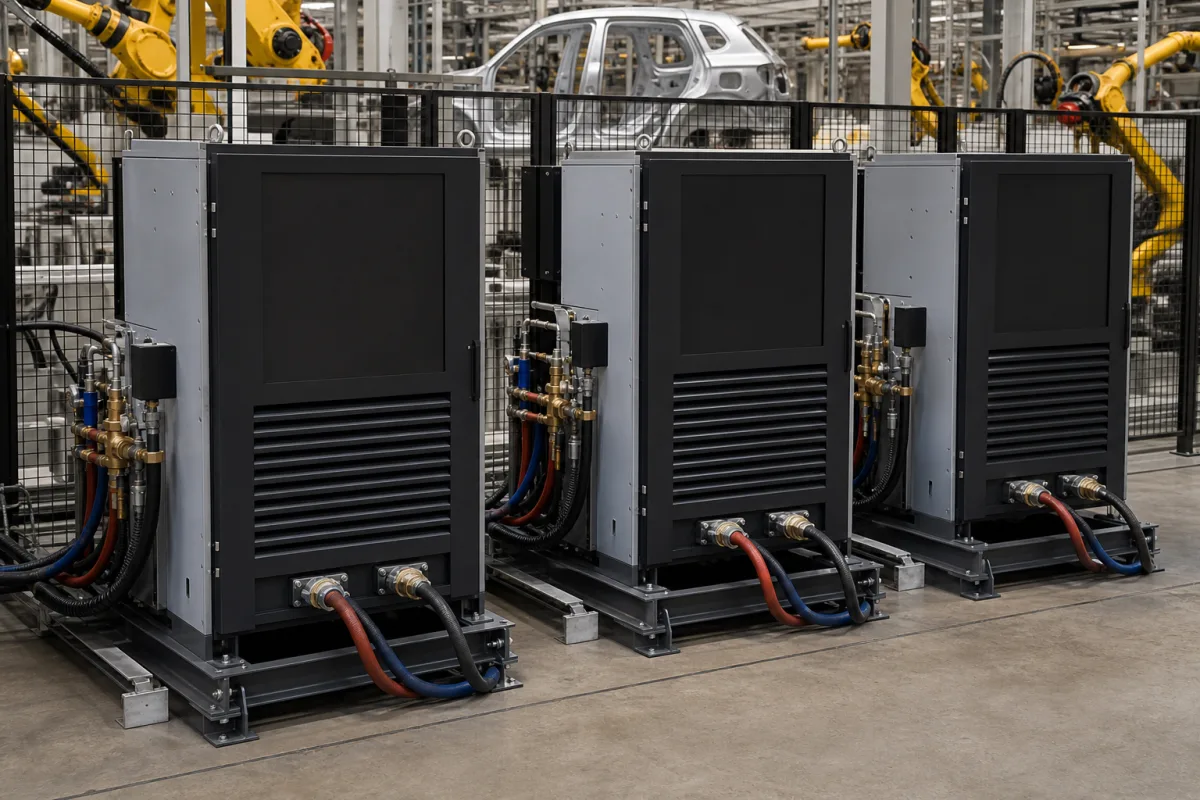
Electrical power conversion and control units that provide stable, regulated electrical energy for robotic welding operations in automotive body assembly.

Product Specifications

Technical details and manufacturing context for Welding Power Supplies

Definition
Welding power supplies are critical components within the Smart Robotic Body-in-White Assembly System that convert incoming electrical power into the precise voltage, current, and waveform characteristics required for various robotic welding processes (such as resistance spot welding, MIG/MAG, or laser welding). They ensure consistent weld quality, energy efficiency, and process control by regulating electrical output based on real-time feedback from the robotic welding cells.
Working Principle
Welding power supplies typically operate by first rectifying and filtering AC input power to create a stable DC bus. Advanced inverter technology then uses high-frequency switching (IGBTs or MOSFETs) to transform this DC into precisely controlled AC or DC output with adjustable voltage, current, and pulse characteristics. Microprocessor-based controllers monitor welding parameters and adjust output in real-time to maintain optimal arc stability or resistance heating, often communicating with the robotic system's main controller for synchronized operation.
Common Materials
Copper (windings), Silicon steel (cores), Aluminum (heat sinks), Electronic components (semiconductors, capacitors)
Technical Parameters
  • Maximum output current rating, typically ranging from 200A to 600A for automotive body welding applications (A) Standard Spec
Components / BOM
  • Inverter Module
    High-frequency switching of DC power to create controlled AC output
    Material: Semiconductor components (IGBTs/MOSFETs) on ceramic substrates
  • Transformer
    Steps down voltage and provides electrical isolation
    Material: Copper windings with silicon steel core
  • Control Board
    Microprocessor-based control of welding parameters and communication interface
    Material: FR4 PCB with electronic components
  • Cooling System
    Heat dissipation from power semiconductors and transformers
    Material: Aluminum heat sinks with fans or liquid cooling plates
Engineering Reasoning
15-40 VDC output, 200-600 A welding current, 60-95% duty cycle at 40°C ambient
Insulation breakdown at >1500 VAC dielectric strength, thermal shutdown at >85°C internal temperature, current regulation failure beyond ±5% of setpoint
Design Rationale: Electromigration in IGBT semiconductor junctions at >125°C junction temperature, dielectric breakdown in transformer windings at >1500 V/mm electric field strength, electrolytic capacitor electrolyte evaporation at >105°C case temperature
Risk Mitigation (FMEA)
Trigger Input voltage transient exceeding 480 VAC for >100 μs
Mode: IGBT gate oxide puncture causing permanent short circuit
Strategy: Three-stage protection: MOV surge suppressor (300 J), series inductor (50 μH), and TVS diode clamping at 800 V
Trigger Continuous operation at 100% duty cycle for >30 minutes
Mode: Thermal runaway in output rectifier diodes exceeding 175°C junction temperature
Strategy: Forced-air cooling with NTC thermistor feedback loop triggering 50% power reduction at 70°C heatsink temperature

Industry Taxonomies & Aliases

Commonly used trade names and technical identifiers for Welding Power Supplies.

Industrial Ecosystem & Supply Chain DNA

Complementary Systems
Downstream Applications
Specialized Tooling

Application Fit & Sizing Matrix

Operational Limits
pressure: N/A (electrical device, no fluid pressure)
other spec: Input voltage: 380-480V AC 3-phase ±10%, Output current: 50-600A DC, Duty cycle: 60-100% at rated output, Protection class: IP23 minimum
temperature: 0°C to 40°C ambient operating range, -20°C to 70°C storage
Media Compatibility
✓ MIG/MAG welding with steel alloys ✓ Aluminum TIG welding with AC output ✓ Stainless steel pulsed welding applications
Unsuitable: Explosive atmospheres (ATEX zones) without proper certification
Sizing Data Required
  • Required welding current (A) for material thickness
  • Duty cycle (%) for production line throughput
  • Input power supply characteristics (voltage/phase)

Reliability & Engineering Risk Analysis

Failure Mode & Root Cause
Overheating of power components
Cause: Inadequate cooling due to dust accumulation on heat sinks/fans, poor ventilation, or excessive duty cycle beyond rated capacity
Capacitor degradation/electrolyte leakage
Cause: Thermal stress from high operating temperatures, voltage spikes, or aging beyond service life, leading to reduced filtering efficiency and potential short circuits
Maintenance Indicators
  • Unusual buzzing or humming from transformer/inductors, indicating loose windings or core saturation
  • Intermittent or unstable arc despite proper settings, suggesting failing power regulation components
Engineering Tips
  • Implement regular cleaning of cooling systems and maintain ambient temperature below manufacturer specifications to prevent thermal stress on semiconductors and capacitors
  • Use voltage stabilizers or surge protectors to shield sensitive electronics from line voltage fluctuations and transients

Compliance & Manufacturing Standards

Reference Standards
ISO 17657-1:2017 - Resistance welding - Welding current measurement for resistance welding equipment ANSI/AWS C7.4:2020 - Process Specification for Electron Beam Welding DIN EN ISO 15614-1:2017 - Specification and qualification of welding procedures for metallic materials - Arc welding
Manufacturing Precision
  • Output Current Stability: +/- 2% of set value
  • Duty Cycle Accuracy: +/- 5% at rated output
Quality Inspection
  • Insulation Resistance Test (IR Test)
  • Output Waveform Analysis (Oscilloscope Verification)

Factories Producing Welding Power Supplies

Verified manufacturers with capability to produce this product in China

✓ 94% Supplier Capability Match Found

P Project Engineer from United Arab Emirates Feb 22, 2026
★★★★★
"Impressive build quality. Especially the technical reliability is very stable during long-term operation."
Technical Specifications Verified
S Sourcing Manager from Australia Feb 19, 2026
★★★★★
"As a professional in the Motor Vehicle Manufacturing sector, I confirm this Welding Power Supplies meets all ISO standards."
Technical Specifications Verified
P Procurement Specialist from Singapore Feb 16, 2026
★★★★★
"Standard OEM quality for Motor Vehicle Manufacturing applications. The Welding Power Supplies arrived with full certification."
Technical Specifications Verified
Verification Protocol

“Feedback is collected from verified sourcing managers during RFQ (Request for Quote) and factory evaluation processes on CNFX. These reports represent historical performance data and technical audit summaries from our B2B manufacturing network.”

15 sourcing managers are analyzing this specification now. Last inquiry for Welding Power Supplies from Turkey (19m ago).

Supply Chain Compatible Machinery & Devices

Automotive Wireless Power Transfer System

Wireless charging system for electric vehicles using electromagnetic induction.

Explore Specs →
Automotive Solid-State Battery Pack

High-energy-density solid-state battery system for electric vehicles

Explore Specs →
Automotive Active Grille Shutter System

Aerodynamic system with motorized shutters for vehicle thermal and efficiency management.

Explore Specs →
Automotive Active Suspension Damping System

Electronically controlled suspension system for vehicle stability and comfort.

Explore Specs →

Frequently Asked Questions

What makes welding power supplies suitable for automotive manufacturing?

These power supplies provide stable, regulated electrical energy essential for precision robotic welding in automotive body assembly, ensuring consistent weld quality and production efficiency.

How do the materials like copper and silicon steel enhance performance?

Copper windings offer high conductivity for efficient power transfer, while silicon steel cores minimize energy loss and heat generation, improving reliability and longevity in demanding automotive environments.

What maintenance is required for welding power supplies in vehicle production?

Regular inspection of cooling systems, cleaning of heat sinks, and monitoring of electronic components are recommended to prevent downtime and maintain optimal performance in continuous automotive assembly operations.

Can I contact factories directly on CNFX?

CNFX is an open directory, not a transaction platform. Each factory profile provides direct contact information and production details to help you initiate direct inquiries with Chinese suppliers.

Get Quote for Welding Power Supplies

Request technical pricing, lead times, or customized specifications for Welding Power Supplies directly from verified manufacturing units.

Your business information is encrypted and only shared with verified Welding Power Supplies suppliers.

Thank you! Your message has been sent. We'll respond within 1–3 business days.

Need to Manufacture Welding Power Supplies?

Connect with verified factories specializing in this product category

Add Your Factory Contact Us
Previous Product
Wastegate
Next Product
Wheel Hub