Editorial Technical Reference

Vacuum-Pressure Chamber

This page explains how Vacuum-Pressure Chamber is classified within Electrical Equipment Manufacturing. Technical values and manufacturer relationships are research references; confirm the current specification and supplier evidence for each order.

Technical Definition & Core Assembly

A sealed enclosure for controlled vacuum and pressure conditions in impregnation processes.
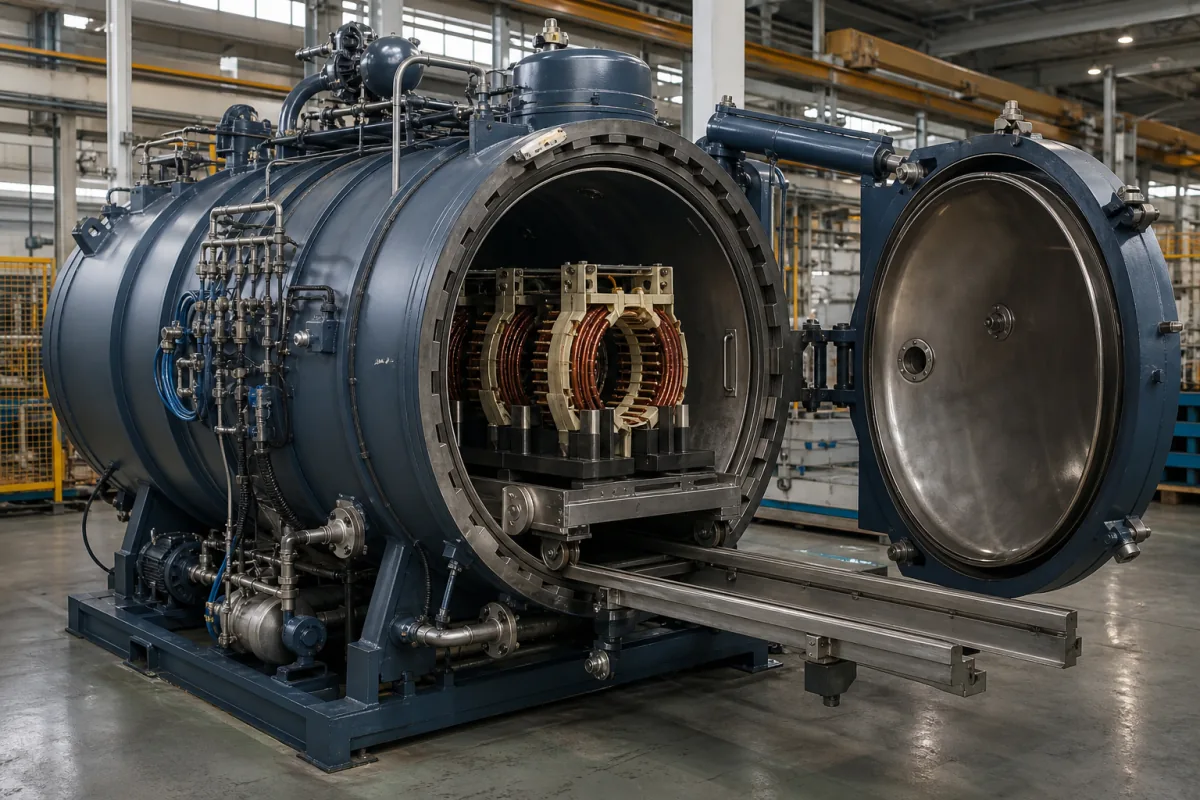
Representative product image. Confirm appearance and specifications with the manufacturer.

Product Specifications

Technical details and manufacturing context for Vacuum-Pressure Chamber

Definition
The Vacuum-Pressure Chamber is a component used in electric motor manufacturing, specifically within coil impregnation and curing ovens. Its purpose is to create and maintain controlled vacuum and pressure environments that facilitate the thorough impregnation of motor coil windings with resin. By first evacuating the chamber to remove air and moisture from the windings, and then applying pressure, the resin is forced into all voids and interstices of the coil structure, ensuring complete encapsulation and optimal electrical insulation properties. This process is critical for enhancing the durability and performance of electric motors, as it eliminates air pockets that could lead to partial discharge or insulation failure. The chamber is constructed from materials such as Stainless Steel 304/316L, with a tempered glass viewport for observation and high-temperature seals to maintain integrity under varying conditions. Key parameters include a chamber volume ranging from 0.5 to 5 m³, an operating pressure of 1.0–1.6 MPa, an ultimate vacuum of 0.1–1 Pa, and a temperature range of -20 to 150°C (with optional heating/cooling jacket for resin viscosity control). Pressure accuracy is maintained at ±0.01 MPa, and the vacuum leak rate is ≤0.05 Pa·m³/s (per ISO 21360). The chamber operates on a three-phase 380 V AC supply (IEC 60038) and offers ingress protection ratings of IP54–IP65 (IEC 60529). Weight ranges from 1500 to 8000 kg, and the footprint is 2–10 m², depending on size and pressure rating. These specifications are reference values; actual model-specific data must be confirmed with the manufacturer. The chamber is designed for integration into impregnation systems, and its selection depends on workpiece size, batch throughput, and required vacuum/pressure levels. Proper installation, operation, and maintenance are essential to ensure consistent impregnation results and long service life.
Working Principle
The chamber operates by first creating a vacuum to extract air and moisture from the motor coil windings. This step is crucial because trapped air can prevent resin from fully penetrating the windings, to voids and reduced insulation performance. After reaching the desired vacuum level, the chamber is pressurized, forcing the impregnation resin into all voids and interstices of the coil structure. The pressure helps the resin flow into even the smallest gaps, ensuring complete encapsulation. The process is controlled to maintain precise pressure and vacuum levels, with accuracy of ±0.01 MPa, to achieve consistent results. The chamber's design includes features such as a viewport for monitoring and seals to maintain vacuum integrity. The optional heating/cooling jacket allows for temperature control to adjust resin viscosity, optimizing penetration. The entire cycle is carefully managed to eliminate air pockets and achieve optimal electrical insulation properties.
Common Materials
Stainless Steel 304/316, Tempered Glass Viewport, High-Temperature Seals
Technical Parameters
ParameterTypical rangeNotes & selection driver
Chamber Volume0.5–5 Select based on workpiece size and batch throughput
Ultimate Vacuum0.1–1 PaLower ultimate vacuum improves impregnation quality
Temperature Range-20–150 °CHeating/cooling jacket optional for resin viscosity control
Pressure Accuracy±0.01 MPaRequired for consistent impregnation results
Vacuum Leak Rate≤0.05 Pa·m³/sEnsures vacuum integrity during hold cyclesISO 21360
Power Supply380 ±10% V ACThree-phase, 50/60 HzIEC 60038
Ingress ProtectionIP54–IP65Higher rating for dusty or wet environmentsIEC 60529
Chamber Material304/316L316L for corrosive media; 304 for general useASTM A240
Weight1500–8000 kgDepends on size and pressure rating; affects installation
Footprint2–10 Include clearance for door swing and maintenance

Ranges are indicative industry figures for RFQ preparation, not a supplier commitment. Confirm every value and standard with the legal manufacturer before ordering.

Components / BOM
  • Chamber Body
    The chamber shell itself: encloses the process volume and carries the operating pressure and temperature.
  • Vacuum Pump Connection Port Part
    Interface for connecting vacuum pumping system to evacuate chamber
    Material: Stainless Steel
  • Pressure Relief Valve
    Safety device to prevent over-pressurization of the chamber
    Material: Stainless Steel
  • Observation Window
    Allows visual monitoring of impregnation process without breaking vacuum/pressure seal
    Material: Tempered Glass with O-ring Seal
  • Heating Jacket
    Maintains optimal resin temperature during impregnation process
    Material: Stainless Steel with Insulation

Industrial Ecosystem & Supply Chain Structure

Complementary Systems
Downstream Applications
Specialized Tooling

Application Fit & Sizing Matrix

Operational Limits
pressure: Vacuum: 0.1 to 10 mbar absolute, Pressure: 1 to 10 bar gauge
other spec: Chamber volume: 50L to 5000L, Cycle time: 30-120 minutes, Leak rate: <0.1 mbar/min
temperature: -20°C to 150°C (typical for impregnation processes)
Media Compatibility
✓ Epoxy resins ✓ Polyurethane impregnants ✓ Silicone-based sealants
Unsuitable: Highly corrosive acids (e.g., hydrochloric acid) due to material degradation risks
Sizing Data Required
  • Maximum part dimensions (LxWxH)
  • Required throughput (parts/hour)
  • Impregnant viscosity at process temperature

Reliability & Engineering Risk Analysis

Failure Mode & Root Cause
Vacuum seal degradation
Cause: Thermal cycling and mechanical stress causing gasket material hardening, compression set, or surface scoring on sealing faces, leading to leaks and loss of vacuum integrity.
Pressure vessel fatigue cracking
Cause: Cyclic pressure loading (vacuum to pressure cycles) inducing stress concentrations at weld joints, ports, or geometric discontinuities, potentially leading to crack initiation and propagation over time.
Maintenance Indicators
  • Audible hissing or whistling during vacuum/pressure cycles indicating seal leaks
  • Visible condensation or frost forming on chamber exterior during operation suggesting insulation failure or excessive thermal gradients
Engineering Tips
  • Implement predictive maintenance using helium leak testing at regular intervals to detect seal degradation before operational failure occurs
  • Apply controlled ramp rates for pressure and vacuum cycles to minimize thermal and mechanical shock stresses on vessel components

Indicative industry ranges for design and RFQ preparation. Confirm the exact figures and applicable standard with the manufacturer before specifying.

Compliance & Manufacturing Standards

Applicable Standards
ISO 21358:2020 (Vacuum technology - Vacuum gauges - Specifications for hot cathode ionization gauges) ASME BPVC Section VIII (Rules for Construction of Pressure Vessels) DIN 28400-1:2016 (Vacuum technology - Acceptance specifications for vacuum pumps - Part 1: Measurement of performance characteristics)

Quoted from the published standard.

Manufacturing Precision
  • Leak rate: ≤ 1×10⁻⁹ mbar·L/s
  • Flatness of sealing surfaces: ≤ 0.05 mm/m
Quality Inspection
  • Helium leak detection test
  • Pressure cycling endurance test

Manufacturers of Vacuum-Pressure Chamber

Manufacturer profiles associated with Vacuum-Pressure Chamber.

Sourcing Vacuum-Pressure Chamber from China?
Tell us your specification and target quantity — we will match it against manufacturer records and come back with the factories that fit.
Request manufacturers We manufacture this

Manufacturer listings support early research and capability understanding. They are not certification, ranking, or transaction guarantees.

Technical documentation
Request current drawings, revision history, and a signed specification sheet.
Manufacturing capability
Verify equipment lists, process limits, capacity, and representative production evidence.
Inspection readiness
Confirm test methods, calibrated equipment, sampling plans, and traceable reports.
Supplier transparency
Check the legal entity, factory address, ownership, certifications, and direct contacts.

CNFX does not score or rank suppliers. Buyers must verify all claims and documents with the legal manufacturer before ordering.

Supply Chain Compatible Machinery & Devices

Circuit Breaker Arc Chute

The Circuit Breaker Arc Chute is a critical safety component in electrical circuit breakers, designed to rapidly extinguish electric arcs that form during circuit interruption.

Explore Specs →
Medium Voltage Switchgear Assembly Line

Automated production system for assembling medium voltage electrical switchgear.

Explore Specs →
Motor Terminal Block

A motor terminal block is a standardized electrical component that provides secure, insulated connection points for motor winding leads.

Explore Specs →
PLC Control System

A digital industrial computer control system that monitors inputs, makes decisions based on a custom program, and controls outputs to automate industrial processes.

Explore Specs →

Frequently Asked Questions

What is the purpose of the vacuum-pressure chamber?

The chamber creates controlled vacuum and pressure conditions to facilitate thorough resin impregnation into motor coil windings, ensuring complete penetration and elimination of air pockets before curing.

What materials are used in the chamber construction?

The chamber is typically made of Stainless Steel 304/316L, with a tempered glass viewport and high-temperature seals. Material selection depends on the application and media.

What are the key parameters to consider when selecting a chamber?

Key parameters include chamber volume (0.5–5 m³), operating pressure (1.0–1.6 MPa), ultimate vacuum (0.1–1 Pa), temperature range (-20 to 150°C), pressure accuracy (±0.01 MPa), and vacuum leak rate (≤0.05 Pa·m³/s). These must be confirmed for the specific model.

How do I verify that the chamber meets my requirements?

You should consult the manufacturer or supplier to confirm model-specific values for all parameters, including standards compliance (e.g., ISO 21360, IEC 60038, IEC 60529). The listed standards are references for verification, not proof of certification.

Data Basis

Editorial classification, named public sources where available, and source-reviewed manufacturer records.

Preliminary Technical Classification
This page supports structured research, RFQ preparation, and supplier evaluation. It does not replace buyer-led supplier qualification, standards review, or technical approval.
Buyer enquiry

Request manufacturing insight for Vacuum-Pressure Chamber

Ask for use case, specification boundaries, supplier type, and RFQ preparation information for this product.

Where it goes
Straight to the CNFX editorial desk, and to the manufacturer if this product is linked to a claimed profile. Nothing is broadcast to a supplier list.
Your details stay here
We do not sell or rent enquiry data, and we do not add you to a mailing list. Used only to answer this request.
No commission, no middleman
CNFX is a directory. We take no cut of any order and never negotiate on a supplier's behalf.
What we don't claim
A listing is not an endorsement. Qualify every supplier and verify every figure yourself before ordering.

Your business information is used only to process this request.

Thank you! Your message has been sent. We'll respond within 1–3 business days.
Sorry, we couldn't send your message. Please try again, or email us at contact@cnfx.com.

Need to Manufacture Vacuum-Pressure Chamber?

Compare manufacturer profiles with relevant product and process capability.

Previous Product
Trip Mechanism (Circuit Breaker)
Next Product
Vacuum-Pressure Impregnation (VPI) Chamber
Get QuotesChat