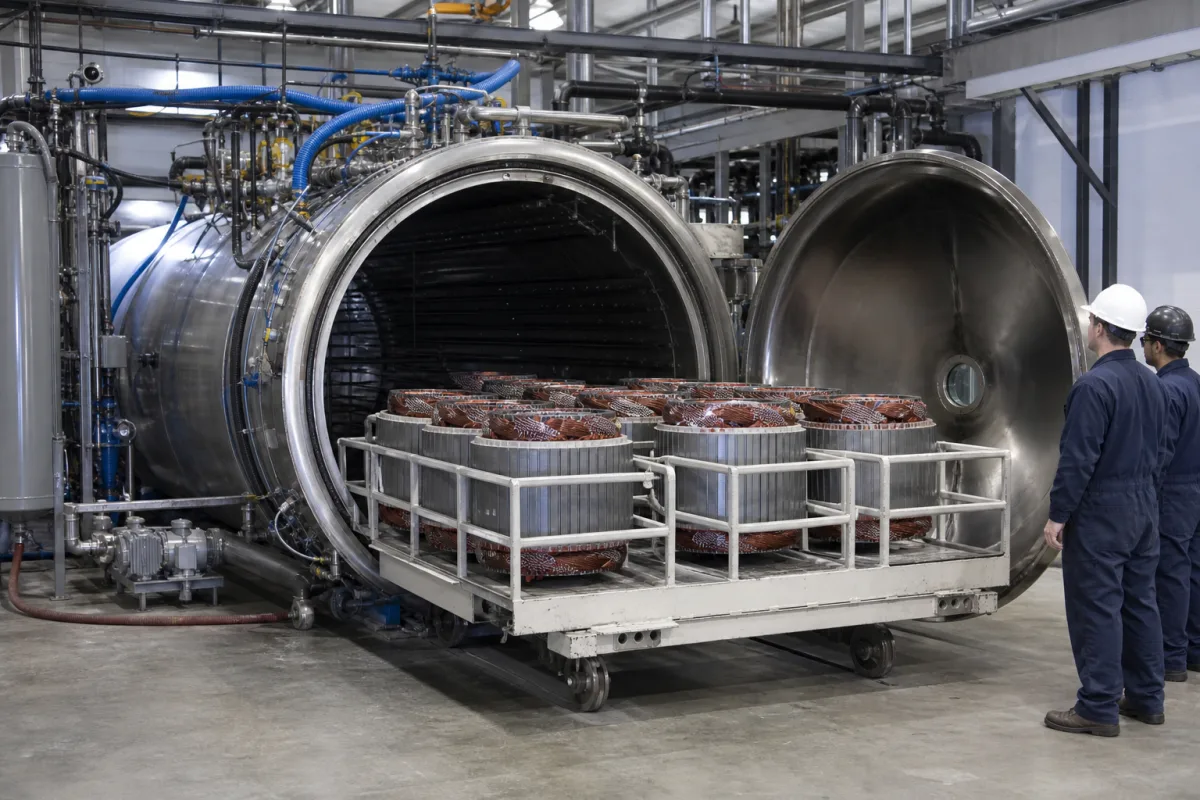
VPI vessels for electrical windings · Vacuum-pressure tanks with resin storage and transfer that degas and dry stators, coils and transformer parts under vacuum, flood them with resin or varnish, pressurise to drive it in, return the excess and send the parts to oven cure
A vacuum pressure impregnation (VPI) chamber is a pressure vessel in which electrical windings such as motor stators, coils and transformer parts are first put under vacuum to remove air and moisture, then flooded with insulating resin or varnish and pressurised so the resin fills every gap before oven curing. Ask three things first: what parts and sizes must fit, which resin and vacuum and pressure cycle the insulation system requires, and how resin is stored, transferred, temperature-controlled and monitored.
Vacuum pressure impregnation vessels and their resin storage, transfer, vacuum and pressure systems for motor, generator and transformer windings and similar parts. Cast-resin vacuum casting equipment, curing ovens, insulating resins themselves and transformer oil processing are outside this page.
CNFX editorial research · Sources checked October 11, 2026 · 4 sources
Hedrich describes VPI as non-porous impregnation of components with insulating media such as varnishes, oils, resins and waxes: the parts are degassed and dried under vacuum and then impregnated by applying pressure. It adapts systems to the application with options such as a stirrer, cooling coil, exhaust devices and capacitance meters to control impregnation. [1]
Hedrich says the impregnating medium can be moved between storage and impregnating vessel by a feed pump, optionally heated in the supply line and cooled in the return line to adjust viscosity; where the medium need not be heated, transfer is by pressure difference, including under vacuum. For small parts, compact systems stack the storage and impregnating tanks so the medium moves by pressure difference and gravity. [1]
Give the supplier the largest part dimensions and weight (stator, coil, transformer core), loading method (cart, crane), resin or varnish type, viscosity and storage temperature, resin batch volume, target vacuum and pressure, cycle times, heating or cooling of the resin, monitoring (capacitance, thermocouples), exhaust and solvent handling, and the oven arrangement.
02
Set the vacuum, pressure and cure cycle
EPRI's guide to motor stator insulation lists the key VPI steps as preparation, vacuum treatment, pressure treatment and oven cure. Preparation covers resin temperature and viscosity checks, release agent on parts that must stay clean, protecting leads, attaching thermocouples to the stator back iron and preheating the stator and oven. The preheated stator is put in the vacuum tank and vacuum drawn to a specified level, such as 1.0 mm Hg or less, held for a set time such as 1 hour, then used to draw resin from storage until it covers the stator by 3 in. [2]
The vacuum is released, the resin is pressurised to a specified level and held as long as reasonably possible, such as 8 hours overnight; pressure then returns the resin to storage, and the drained stator goes connection-end down into a preheated oven so the resin gels quickly, with a final bake on the order of 10 hours at 325 °F. EPRI notes that "one VPI treatment may be sufficient, but often two treatments are used, particularly when the NEMA water submergence test has been specified". Impregnation can be verified by partial discharge, power-factor tip-up, capacitance, sample coils or a water immersion test. [2]
EPRI explains that VPI removes air from the insulation layers under vacuum and that pressure forces resin into unfilled spaces; thixotropic resins thin under pressure and thicken when it is removed to stay in the coils. In global VPI, dry mica-tape coils are wound into the stator and the whole stator is impregnated and cured, bonding coils into the slots. [2]
A later cycle is set out in US patent 12,278,531 (The Timken Company, filed 11 April 2022, granted 15 April 2025). The coil or winding goes into the pressure vessel at room temperature instead of being preheated; vacuum is drawn to 2 Torr or less, but not below 400 mTorr, and held for at least 45 minutes; the winding is flooded with a low-viscosity epoxy, polyester or silicone resin (the patent gives less than 2000 cPs at 77 °F, tested to IEC 60455, as one meaning of low viscosity); vacuum is drawn again to between 2.5 Torr and 400 mTorr for at least 45 minutes, a lower limit set to prevent the resin boiling; then 80–100 psi is applied for at least 6 hours. The claims add an optional second round: vacuum of 2 Torr to 400 mTorr for at least 45 minutes and 80–100 psi for at least 4 hours. Cameras in pressure- and vacuum-sealed transparent enclosures inside the vessel let operators check remotely that the winding stays covered with resin. [3]
Editorial calculation: 1 Torr = 133.3 Pa, so 2 Torr ≈ 0.27 kPa abs, 2.5 Torr ≈ 0.33 kPa abs and 400 mTorr ≈ 0.053 kPa abs; 80–100 psi ≈ 0.55–0.69 MPa; 2000 cPs = 2 Pa·s and 77 °F = 25 °C. A vessel for this cycle therefore needs a vacuum system that reaches about 0.05 kPa abs and a design pressure above 0.69 MPa. [3]
Editorial calculation: 1.0 mm Hg is about 133 Pa (0.133 kPa abs); 3 in is 76 mm; 325 °F is about 163 °C. [2]
03
Match resin tank and oven temperatures to the resin's cure data
Researchers at the University of Salerno tested three one-component, VOC-free unsaturated polyester-imide resins sold for VPI of motor coils, curing each with the hardening schedule in its technical data sheet and measuring by DSC the temperature at which polymerization starts (Tsp) and the degree of cure reached. [4]
The authors note that Tsp strongly influences the hardening conditions and therefore the cost of the impregnation process, that the Voltatex sample still showed a residual exotherm between 150 and 200 °C after its cycle, and that cured samples had a Young's modulus of 1–1.5 GPa, strength of 15–25 MPa and strain at break of 2–4%. [4]
Editorial calculation: the three cure cycles last 2 h, 3 h and 16 h, against the final bake on the order of 10 h at 325 °F (163 °C) in EPRI's stator example, so oven capacity and cycle time depend on the resin chosen. Since polymerization starts from 86.1 °C for one of these resins, give the VPI supplier the resin's Tsp and data-sheet storage temperature, and ask for the maximum temperature the resin tank heater, transfer lines and impregnation vessel can reach. [4][2]
A horizontal VPI builder, and what to ask any supplier
Shenyang Weike Vacuum Technology is the company shown below; its project page lists horizontal VPI equipment designed, built and commissioned in-house.
Ask any supplier for vessel inside diameter and length, design pressure and vacuum, pump-down time, resin storage and transfer method, heating and cooling of resin, instrumentation and recording, pressure vessel code, door and loading arrangement, exhaust handling, footprint and weight.
05
Vessel, resin tank, vacuum, pressure, transfer, monitoring and cameras
The camera row comes from the Timken patent cycle; the other rows follow Hedrich and EPRI.
Remote check that the winding stays under resin. [3]
Sealed enclosures; positions.
06
Chamber size, pressure, vacuum and temperature for the quotation
Part sizes and the resin cycle come from your insulation system. Only the pressure, vacuum and temperature rows have published figures here, from EPRI and the Timken patent; the rest must come from the supplier.
Field
What it means and published values
Ask the supplier for
Chamber Diameter (mm)
Not stated in the reviewed sources.
Inside diameter.
Chamber Length (mm)
Not stated in the reviewed sources.
Inside length.
Design Pressure (MPa)
Pressure level set by the insulation process; e.g. 80–100 psi (≈0.55–0.69 MPa) held for at least 6 h. [2][3]
Design pressure.
Vacuum Level (kPa abs)
e.g. 1.0 mm Hg or less (≈0.133 kPa) [2]; 2 Torr to 400 mTorr (≈0.27–0.053 kPa), not lower, to avoid boiling the resin. [3]
Ultimate vacuum.
Operating Temperature (°C)
Stator and resin preheated to specified temperatures. [2]
Range.
Temperature Uniformity (°C)
Not stated in the reviewed sources.
Uniformity.
Heating Power (kW)
Not stated in the reviewed sources.
Power.
Pressure Rise Rate (MPa/min)
Not stated in the reviewed sources.
Rate.
Leak Rate (Pa·m³/s)
Not stated in the reviewed sources.
Leak rate.
Control Accuracy (MPa)
Not stated in the reviewed sources.
Accuracy.
Material Grade
Not stated in the reviewed sources.
Vessel material.
Weight (kg)
Not stated in the reviewed sources.
Weight.
07
Send the part, resin and cycle data together
Paste it into your enquiry below or into an email to a maker, then replace every bracket.
1 company lists this product among what they make. Company figures are quoted from each
company's own website; every card states where the relationship came from.
Shenyang Weike Vacuum Technology Co., Ltd.
Manufacturing site to be confirmed for the order
Lists horizontal vacuum pressure impregnation (VPI) equipment and describes itself as focused on VPI systems, with in-house design, manufacturing and commissioning.
Product scope checked 2026-10-12
VPI equipment project page · profile compiled by CNFX from public sources
Explore company information and manufacturing capabilities, then discuss the scope of your project with a relevant supplier.
Share this page
Compiled and source-reviewed by the CNFX editorial team.
Each manufacturer above links to the page on that company's own website where the product is listed, with the date we checked it. How we source and review
· Page last updated 13 October 2026
Buyer questions
How does vacuum pressure impregnation work?
Parts are degassed and dried under vacuum, flooded with resin, then pressurised so resin fills the gaps, before oven cure. [1][2]
What vacuum is used for motor stators?
EPRI's guide gives an example of 1.0 mm Hg or less, held for a prescribed time such as 1 hour. [2]
How is VPI quality checked?
EPRI lists partial discharge, power-factor tip-up, capacitance, sample coils and water immersion tests. [2]
What vacuum and pressure does a VPI cycle use?
US patent 12,278,531 draws 2 Torr or less (not below 400 mTorr) for at least 45 minutes, then applies 80–100 psi for at least 6 hours. [3]
How long does VPI resin take to cure?
Data-sheet cycles for three VOC-free polyester-imide VPI resins tested at the University of Salerno were 2 h at 150 °C, 16 h at 140 °C, and 2 h at 130 °C plus 1 h at 150 °C; the last reached 93.3% cure. [4]
Sources and what still needs a direct check
Sources checked 2026-10-11. Hedrich builds VPI equipment; EPRI published a guide to motor stator insulation and VPI treatment; the University of Salerno measured the cure of three commercial VPI resins; US patent 12,278,531 (The Timken Company) gives a room-temperature VPI cycle with stated vacuum levels, pressures and hold times.