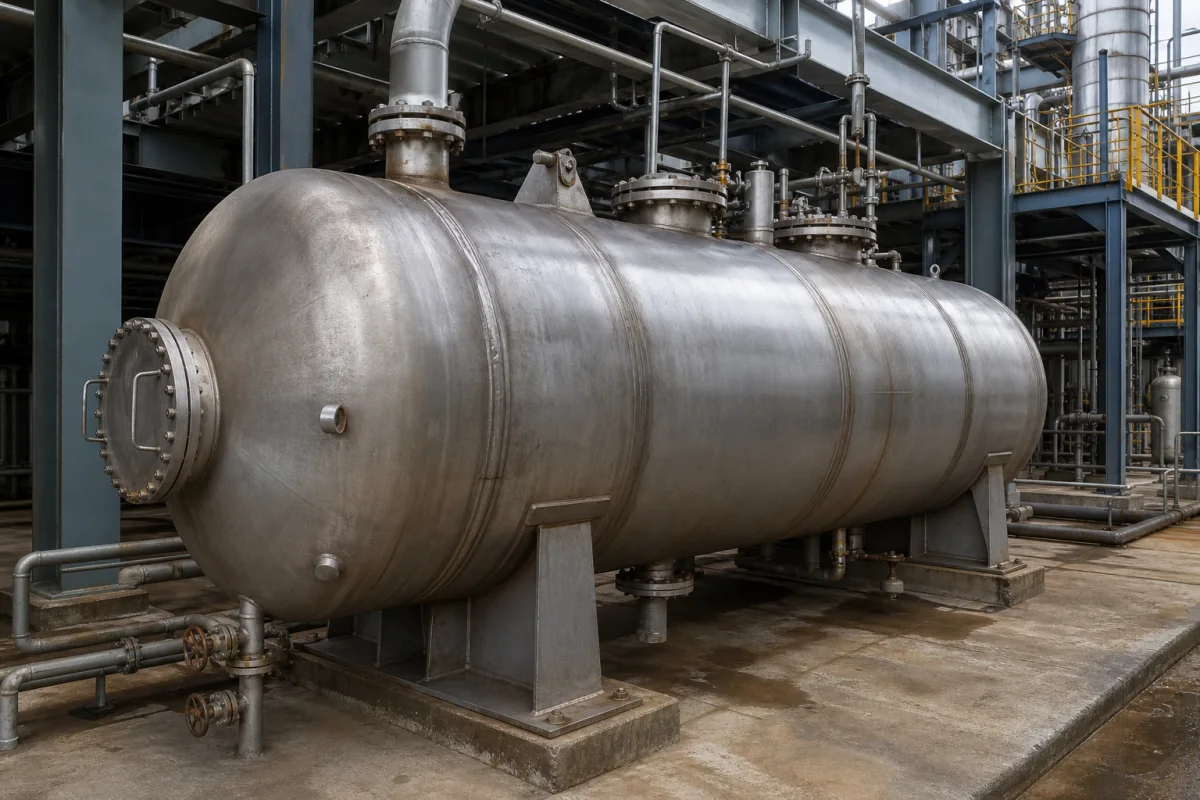
Clad low-alloy pressure vessel shell: Cr-Mo base plate for strength at temperature, a corrosion-resistant clad layer for the process, and when that layer may carry load
The rolled and welded cylinder of a chemical reactor or process vessel, bought as plate: a chromium-molybdenum base steel for pressure and temperature, and a stainless or nickel-alloy clad layer for the process side
The shell of a chemical reactor is the rolled and welded cylinder that carries the pressure load; for high-temperature hydrogen service such as hydrotreating reactors, Industeel supplies low-alloy chromium-molybdenum plate for it, pre-rolled to shell radius if ordered. Where the process side is corrosive, that plate is supplied clad: a thinner layer of stainless steel or nickel alloy bonded to the base steel by explosion welding or hot rolling, so the shell can be rolled and seam-welded as one composite. Buying the shell therefore means buying two materials and a bond between them. This page covers the shell as plate: what strength the base steel keeps as it gets thicker and after post-weld heat treatment, when the clad layer may be counted in the pressure calculation, and how a purchaser specifies and tests the bond.
Cylindrical shell courses for chemical reactors and other pressure vessels made from low-alloy Cr-Mo plate, plain or clad with stainless steel or nickel alloy: base-plate grades and their strength by thickness, heat treatment limits, clad plate tolerances and bond tests, and the conditions under which the clad layer counts toward wall thickness. Complete vessels, their design codes, test pressures and in-service inspection are covered on the Pressure vessel page; manway nozzles, covers and swing bolts on the Pressure vessel manway assembly page; carbon and carbon-manganese EN 10028-2 plate on the Pressure vessel quality steel plate page; stainless shells of vacuum chambers, loaded by atmospheric pressure from outside, on the Vacuum chamber body page.
CNFX editorial research · Sources checked October 13, 2026 · 3 sources
2¼Cr-1Mo-¼V shell plate: yield strength by thickness band up to 250 mm, and the heat treatment it is guaranteed through
Industeel's CromElso 22V datasheet (11/2024) describes a 2¼Cr-1Mo-¼V steel for pressure equipment in high-temperature hydrogen service, such as hydrotreating reactors and exchangers, certified to ASTM/ASME A/SA-542 type D class 4a and EN 10028-2 13CrMoV9-10. [1]
The datasheet gives tempering at 725 °C minimum with properties guaranteed for a maximum post-weld heat treatment of 705 °C for 40 hours, Brinell hardness ≤ 235 as delivered and ≤ 225 after PWHT, and a clean-steel guarantee of J-factor ≤ 80, P ≤ 0.007 % and P + Sn ≤ 0.012 % against temper embrittlement. Plates run from 5 mm to 250 mm, up to 20 tons each by continuous casting and 80 tons or more by the ingot route, and can be delivered pre-rolled to shell radius. [1]
Industeel positions the vanadium grade against its conventional 2¼Cr-1Mo plate (A/SA-387 grade 22) for higher service temperature and reduced wall thickness from the higher tensile properties, within the limits of API RP 941. [1] Editorial calculation from the EN values: yield strength falls from 455 MPa below 60 mm to 415 MPa in the 150–250 mm band, a drop of about 8.8 %, so a heavier shell does not keep the strength of the thinner plate.
Guaranteed transverse tensile property at room temperature
State the design temperature and hydrogen partial pressure, the plate standard and grade, the shell thickness band, and the PWHT time and temperature the fabricator will apply, so the plate is certified for that cycle.
02
When the clad layer may count in the wall: ASTM A263–A265 limits of 1½ in composite, 70 ksi tensile and 40 ksi yield
EWI summarises the provisions in ASTM A263, A264 and A265 under which a clad layer of stainless steel or nickel alloy may be treated as carrying structural load. [2]
EWI points out the cost of the last row: the vessel designer must add base-steel thickness to make up for the clad layer that is disregarded, which raises material and fabrication cost. It reports tests on 0.25 in diameter tension samples taken normal to the bond of clads on SA 516-70 carbon steel with no fracture at the bond zones, and argues that, after a clad plate is rolled and seam-welded into a cylindrical reactor, the circumferential tension is the stress to consider. [2]
Editorial calculation: 1½ in is 38.1 mm, and 40,000 psi and 70,000 psi are about 276 MPa and 483 MPa. Set beside the Industeel values, a 2¼Cr-1Mo-¼V base plate with 415–455 MPa yield is above the 40 ksi limit at every thickness listed, so on these provisions a stainless clad layer on it serves only for corrosion resistance and the base steel alone is sized for pressure. [2][1]
The clad layer serves only for corrosion resistance [2]
Say whether the clad layer is to be counted in the pressure design, and give the base-steel specification so the supplier can confirm that the clad standard allows it.
03
Buying clad plate for a shell: thickness tolerances, 140 MPa bond shear, bend tests and ultrasonic level C
A Bharat Heavy Electricals (BHEL) technical delivery condition for UNS N10276 (C-276) clad carbon steel plate to ASTM A265, written for absorber lining in flue-gas desulphurisation, shows how a purchaser turns the clad plate standard into order requirements. [3]
Editorial calculation from the tolerance rule: for a 20 mm composite the allowed over-thickness is 3 mm (10 % would be 2 mm), and for a 50 mm composite it is 5 mm. [3] The specification also rejects any plate that proves defective during rolling, forming, machining or erection regardless of earlier certification, and does not allow repairs to the clad plate. [3] Editorial note: BHEL's plate is for a lining, not a pressure shell; a reactor shell order adds the pressure design code and the base steel's own heat treatment to these bond requirements.
No more than one joint in the cladding sheet before cladding, 100 % radiographed; none in the base plate [3]
Give base and clad thickness separately, the bonding route, bond test method and acceptance value, ultrasonic acceptance level, and whether the plate is to be supplied rolled to radius.
04
What to send for a clad pressure vessel shell
Paste it into your enquiry below or into an email to a maker, then replace every bracket.
Vessel: [service; design pressure and temperature; hydrogen partial pressure]
Shell: [inside diameter; course length; base thickness]
Base plate: [standard and grade; PWHT cycle]
Clad: [alloy; thickness; bonding route; counted in design: yes/no]
Tests: [bond shear or bend; UT standard and level; tensile at design temperature]
Supply: [flat plate or rolled to radius; bevels]
Explore company information and manufacturing capabilities, then discuss the scope of your project with a relevant supplier.
Share this page
Compiled and source-reviewed by the CNFX editorial team.
Each manufacturer above links to the page on that company's own website where the product is listed, with the date we checked it. How we source and review
· Page last updated 13 October 2026
Buyer questions
How thick can 2¼Cr-1Mo-¼V shell plate be made?
Industeel lists CromElso 22V from 5 mm to 250 mm, with EN yield strength of 455 MPa below 60 mm and 415 MPa at 150–250 mm. [1]
Can the clad layer be counted in the shell thickness?
Under the ASTM A263–A265 provisions summarised by EWI, only when the composite is 1½ in or less and the base steel's specified minimum tensile and yield are no more than 70 ksi and 40 ksi. [2]
What bond strength is asked for clad plate?
BHEL's delivery condition for C-276 clad carbon steel asks a shear strength of at least 140 MPa, or bend tests in which two of three show no more than 50 % separation. [3]
Sources and what still needs a direct check
Sources checked 2026-10-13. Three sources: Industeel's (ArcelorMittal) CromElso 22V plate datasheet, EWI's article on stress-bearing clad layers under ASTM A263–A265, and BHEL's technical delivery condition for C-276 clad carbon steel plate.