Industry-Verified Manufacturing Data (2026)

Tension Adjustment Mechanism

Based on aggregated insights from multiple verified factory profiles within the CNFX directory, the standard Tension Adjustment Mechanism used in the Machinery and Equipment Manufacturing sector typically supports operational capacities ranging from standard industrial configurations to heavy-duty production requirements.

Technical Definition & Core Assembly

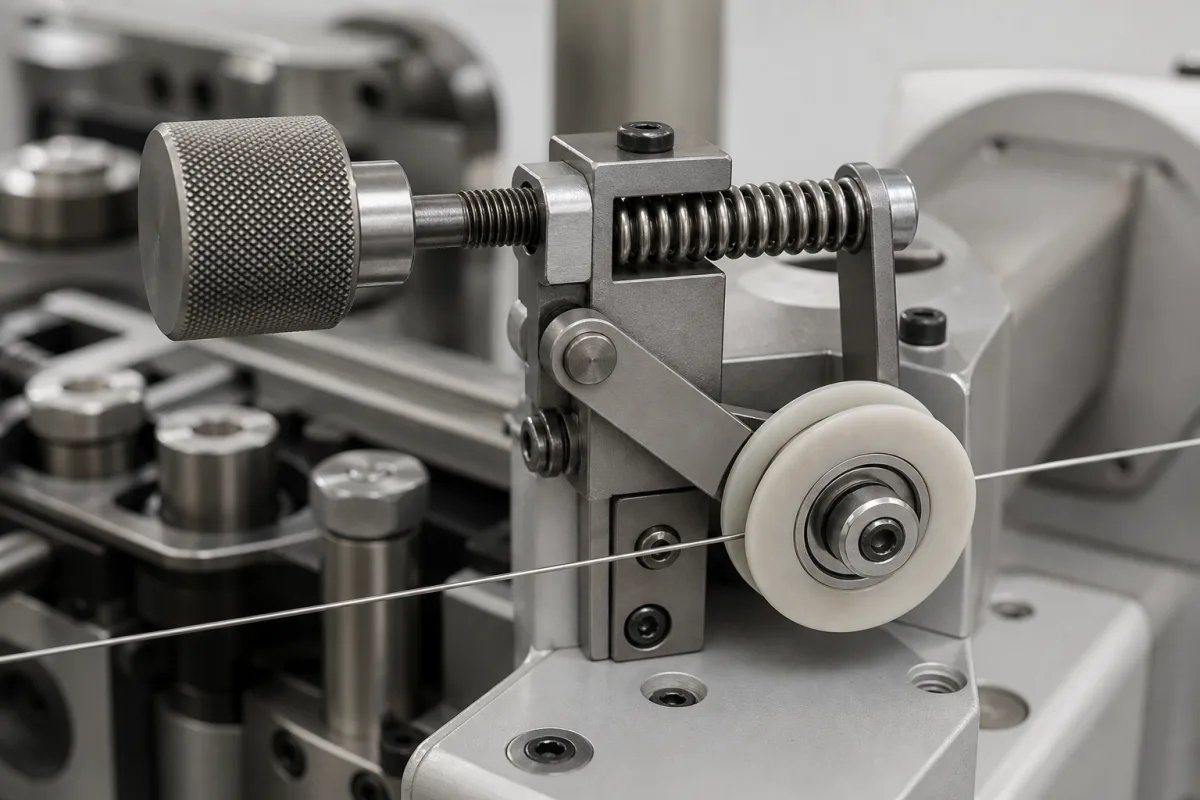
A canonical Tension Adjustment Mechanism is characterized by the integration of Adjustment Screw/Knob and Tensioning Arm or Slide. In industrial production environments, manufacturers listed on CNFX commonly emphasize Carbon Steel construction to support stable, high-cycle operation across diverse manufacturing scenarios.

A mechanical component within a wire tensioner that enables precise control and modification of the tension applied to a wire or cable.
Product Specifications

Technical details and manufacturing context for Tension Adjustment Mechanism

Definition
The Tension Adjustment Mechanism is a critical sub-assembly of a Wire Tensioner, responsible for providing the means to increase, decrease, or maintain a specific tension level on a wire, cable, or filament. It functions as the user interface or automated control point for setting the operational tension, ensuring the wire is taut enough for its intended purpose (e.g., guiding, winding, or applying force) without being over-stressed.
Working Principle
The mechanism typically works by converting an input force or motion (e.g., turning a knob, rotating a screw, or activating a pneumatic/hydraulic actuator) into a controlled displacement of a tensioning element (like a pulley, roller, or clamp). This displacement changes the effective path length or spring compression acting on the wire, thereby altering the resisting force (tension) according to principles of mechanics (e.g., lever arm, screw thread, or spring force). Fine-thread screws, calibrated springs, and lever arms are common design elements that allow for precise, incremental adjustments.
Common Materials
Carbon Steel, Stainless Steel, Aluminum Alloy
Technical Parameters
  • The maximum adjustable tension range the mechanism can apply to the wire. (N) Customizable
Components / BOM
  • Adjustment Screw/Knob
    Provides the user interface for manual input; rotation translates to linear displacement.
    Material: Steel or Plastic
  • Tensioning Arm or Slide
    The moving part that directly applies force to or alters the path of the wire.
    Material: Steel or Aluminum Alloy
  • Locking Nut or Clamp
    Secures the adjustment screw or arm in place to maintain the set tension and prevent drift.
    Material: Steel
  • Calibration Spring (if applicable)
    Provides a known, predictable force against which the adjustment acts, allowing for tension measurement or setting.
    Material: Spring Steel
Engineering Reasoning
5-150 N
180 N tensile load
Design Rationale: Yield strength exceedance of AISI 304 stainless steel (205 MPa) causing plastic deformation in spring elements
Risk Mitigation (FMEA)
Trigger Corrosive environment exposure (chloride concentration > 25 ppm)
Mode: Spring constant degradation (reduction from 50 N/mm to <30 N/mm)
Strategy: 316L stainless steel material substitution with 0.03% max carbon content
Trigger Thread pitch wear from 1.5 mm to >1.7 mm due to abrasive particulate contamination
Mode: Positional hysteresis exceeding 0.2 mm
Strategy: Hard chrome plating (25-50 μm thickness) on adjustment screw threads

Industry Taxonomies & Aliases

Commonly used trade names and technical identifiers for Tension Adjustment Mechanism.

Applied To / Applications

This component is essential for the following industrial systems and equipment:

Industrial Ecosystem & Supply Chain DNA

Complementary Systems
Downstream Applications
Specialized Tooling

Application Fit & Sizing Matrix

Operational Limits
pressure: 0 to 10 bar
other spec: Wire diameter range: 0.5mm to 10mm
temperature: -40°C to 120°C
Media Compatibility
✓ Steel cables ✓ Polymer-coated wires ✓ Stainless steel strands
Unsuitable: High-corrosion saltwater environments
Sizing Data Required
  • Maximum wire tension required (N)
  • Wire diameter (mm)
  • Required adjustment resolution (mm/revolution)

Reliability & Engineering Risk Analysis

Failure Mode & Root Cause
Thread wear and galling
Cause: Inadequate lubrication combined with excessive tension loads leading to metal-to-metal contact and adhesive wear in adjustment threads
Spring fatigue and permanent set
Cause: Cyclic over-tensioning beyond design limits causing material fatigue and loss of elastic properties in tensioning springs
Maintenance Indicators
  • Audible clicking or grinding noises during tension adjustment
  • Visible misalignment or uneven tension distribution across the mechanism
Engineering Tips
  • Implement regular lubrication schedule with anti-wear additives specifically for threaded components under tension loads
  • Install tension monitoring sensors to prevent over-tensioning and maintain operation within 80-90% of maximum design capacity

Compliance & Manufacturing Standards

Reference Standards
ISO 286-1:2010 - Geometrical product specifications (GPS) - ISO code system for tolerances on linear sizes ANSI B4.1-1967 (R2009) - Preferred Limits and Fits for Cylindrical Parts DIN 7184-1:1986 - Tolerances for linear dimensions; general tolerances
Manufacturing Precision
  • Bore diameter: +/-0.02mm
  • Parallelism of mounting surfaces: 0.1mm
Quality Inspection
  • Dimensional verification with coordinate measuring machine (CMM)
  • Hardness testing per ASTM E18-22

Factories Producing Tension Adjustment Mechanism

Verified manufacturers with capability to produce this product in China

✓ 92% Supplier Capability Match Found

T Technical Director from United States Jan 06, 2026
★★★★★
"Reliable performance in harsh Machinery and Equipment Manufacturing environments. No issues with the Tension Adjustment Mechanism so far."
Technical Specifications Verified
P Project Engineer from United Arab Emirates Jan 03, 2026
★★★★☆
"Testing the Tension Adjustment Mechanism now; the technical reliability results are within 1% of the laboratory datasheet. (Delivery took slightly longer than expected, but technical support was excellent.)"
Technical Specifications Verified
S Sourcing Manager from Australia Dec 31, 2025
★★★★★
"Impressive build quality. Especially the technical reliability is very stable during long-term operation."
Technical Specifications Verified
Verification Protocol

“Feedback is collected from verified sourcing managers during RFQ (Request for Quote) and factory evaluation processes on CNFX. These reports represent historical performance data and technical audit summaries from our B2B manufacturing network.”

17 sourcing managers are analyzing this specification now. Last inquiry for Tension Adjustment Mechanism from India (31m ago).

Supply Chain Compatible Machinery & Devices

Hydraulic Press

Industrial machine using hydraulic pressure to compress, form, or assemble materials

Explore Specs →
Heavy-Duty CNC Plasma Cutting Machine

Industrial machine for precision metal cutting using plasma arc technology

Explore Specs →
Automated Assembly Line System

Integrated production system for sequential component assembly operations

Explore Specs →
Automated Powder Coating System

Integrated industrial system for applying dry powder coatings to metal substrates.

Explore Specs →

Frequently Asked Questions

What materials are available for the tension adjustment mechanism?

Our tension adjustment mechanisms are manufactured from carbon steel for maximum durability, stainless steel for corrosion resistance, and aluminum alloy for lightweight applications.

How does the calibration spring work in the tension adjustment mechanism?

The calibration spring provides consistent resistance and allows for precise tension measurement and adjustment, ensuring repeatable tension settings in industrial applications.

What maintenance is required for the tension adjustment mechanism?

Regular inspection of the adjustment screw, locking nut, and tensioning arm is recommended. Lubrication of moving parts and checking for wear on the calibration spring will ensure optimal performance.

Can I contact factories directly on CNFX?

CNFX is an open directory, not a transaction platform. Each factory profile provides direct contact information and production details to help you initiate direct inquiries with Chinese suppliers.

Get Quote for Tension Adjustment Mechanism

Request technical pricing, lead times, or customized specifications for Tension Adjustment Mechanism directly from verified manufacturing units.

Your business information is encrypted and only shared with verified Tension Adjustment Mechanism suppliers.

Thank you! Your message has been sent. We'll respond within 1–3 business days.

Need to Manufacture Tension Adjustment Mechanism?

Connect with verified factories specializing in this product category

Add Your Factory Contact Us
Previous Product
Template/Schema Handler
Next Product
Tension Adjustment System