Industry-Verified Manufacturing Data (2026)

Automated Optical Inspection (AOI) System

Based on aggregated insights from multiple verified factory profiles within the CNFX directory, the standard Automated Optical Inspection (AOI) System used in the Electronic Component Manufacturing sector typically supports operational capacities ranging from standard industrial configurations to heavy-duty production requirements.

Technical Definition & Core Assembly

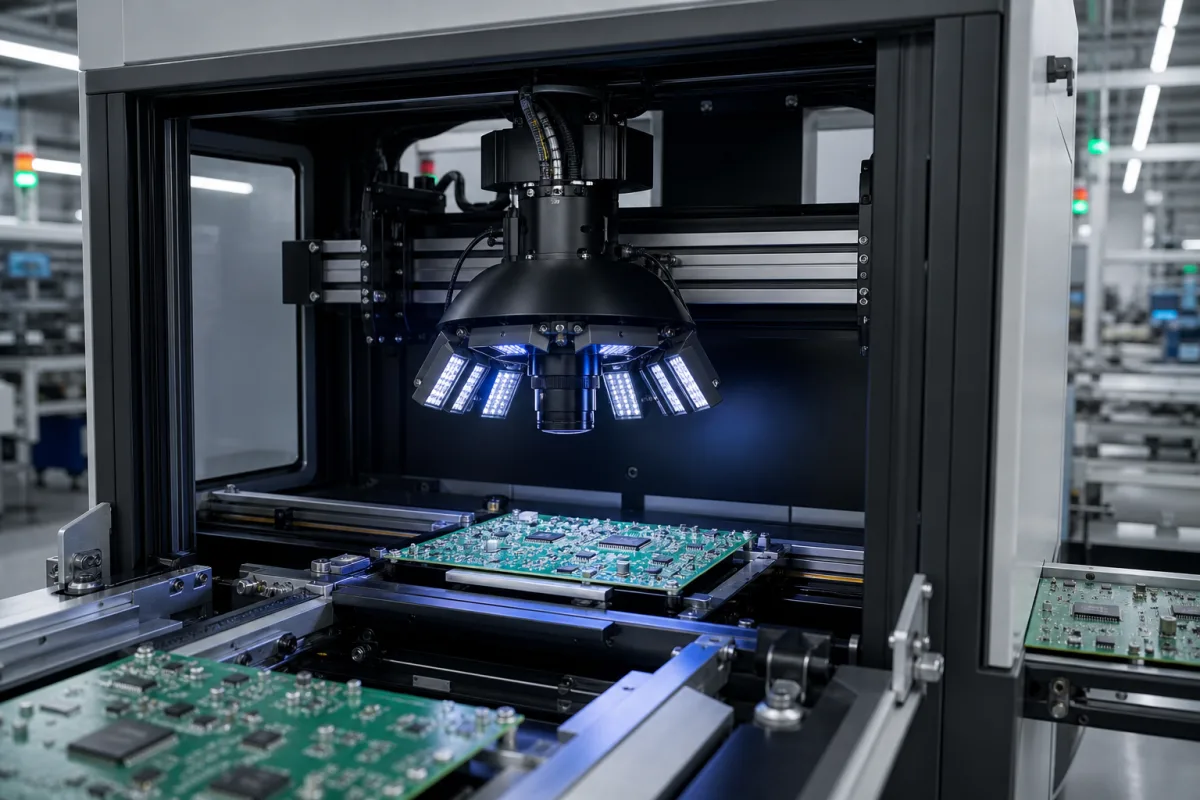
A canonical Automated Optical Inspection (AOI) System is characterized by the integration of Vision Camera Module and Lighting System. In industrial production environments, manufacturers listed on CNFX commonly emphasize aluminum frame construction to support stable, high-cycle operation across diverse manufacturing scenarios.

Automated vision system for electronic component quality inspection

Product Specifications

Technical details and manufacturing context for Automated Optical Inspection (AOI) System

Definition
An integrated production system that uses high-resolution cameras, lighting modules, and image processing algorithms to automatically inspect electronic components and printed circuit boards for defects during manufacturing. The system typically includes material handling modules, multiple inspection stations, and data management interfaces. It performs non-contact inspection of solder joints, component placement, markings, and physical defects at production line speeds.
Working Principle
High-resolution cameras capture images of components under controlled lighting, which are analyzed by computer vision algorithms to detect defects against programmed acceptance criteria.
Common Materials
aluminum frame, optical glass, copper wiring, steel rails, PCB controllers
Technical Parameters
  • Minimum detectable defect size (μm/pixel) Customizable
  • Maximum inspection throughput (components/hour) Customizable
Components / BOM
Engineering Reasoning
0.5-3.0 m focal distance, 5-100 μm pixel resolution, 0.1-10.0 m/s conveyor speed
Optical resolution degradation beyond 150 μm pixel size, illumination intensity drop below 500 lux, lens contamination exceeding 0.5% surface coverage
Design Rationale: Diffraction-limited optical resolution (Rayleigh criterion: θ = 1.22λ/D), Lambertian reflectance reduction from surface contamination, thermal lensing at >45°C ambient temperature
Risk Mitigation (FMEA)
Trigger LED array intensity decay below 70% of initial output after 10,000 hours
Mode: Insufficient illumination causing false defect detection
Strategy: Redundant LED banks with staggered duty cycles and real-time photodiode feedback control
Trigger Vibration amplitude exceeding 0.5 mm at 50-200 Hz frequency range
Mode: Image blurring beyond 3-pixel motion artifact
Strategy: Active vibration isolation mounts with piezoelectric damping and FFT-based resonance cancellation

Industry Taxonomies & Aliases

Commonly used trade names and technical identifiers for Automated Optical Inspection (AOI) System.

Industrial Ecosystem & Supply Chain DNA

Complementary Systems
Downstream Applications
Specialized Tooling

Application Fit & Sizing Matrix

Operational Limits
humidity: 30-70% RH non-condensing
vibration: <0.5G at 5-200 Hz
temperature: 15-35°C (operating), 0-50°C (storage)
illumination: Controlled ambient lighting (500-1000 lux recommended)
Media Compatibility
✓ PCB assemblies with SMT components ✓ BGA and QFN packages ✓ Solder paste inspection post-reflow
Unsuitable: High-vibration industrial floors or environments with excessive airborne particulates (e.g., grinding dust)
Sizing Data Required
  • Maximum PCB panel size (X, Y dimensions)
  • Minimum detectable defect size (in microns or mils)
  • Required inspection throughput (units per hour)

Reliability & Engineering Risk Analysis

Failure Mode & Root Cause
Optical Component Degradation
Cause: Accumulation of dust, oil mist, or particulates on lenses, mirrors, or cameras, combined with thermal cycling and vibration, leading to reduced image clarity, misalignment, or calibration drift.
Mechanical Positioning System Failure
Cause: Wear or backlash in linear guides, ball screws, or servo motors due to inadequate lubrication, contamination ingress, or repetitive stress, resulting in inaccurate part positioning or inspection errors.
Maintenance Indicators
  • Increasing false reject rates or inconsistent inspection results, indicating optical or calibration issues.
  • Unusual audible noises (e.g., grinding, clicking) from motion components or erratic movements during system operation.
Engineering Tips
  • Implement a preventive maintenance schedule for cleaning optical components with approved materials and verifying calibration using standardized targets.
  • Ensure proper environmental controls (e.g., clean, temperature-stable air) and use sealed or protected designs for sensitive mechanical and optical parts to minimize contamination and thermal stress.

Compliance & Manufacturing Standards

Reference Standards
ISO 9001:2015 - Quality management systems ANSI/ISA-95.00.01-2010 - Enterprise-control system integration CE Marking - EU conformity for machinery safety (Directive 2006/42/EC)
Manufacturing Precision
  • Measurement accuracy: +/-0.01mm
  • Repeatability: 0.005mm
Quality Inspection
  • Calibration verification using NIST-traceable standards
  • Performance validation with known defect test boards

Factories Producing Automated Optical Inspection (AOI) System

Verified manufacturers with capability to produce this product in China

✓ 98% Supplier Capability Match Found

T Technical Director from Singapore Jan 07, 2026
★★★★★
"As a professional in the Electronic Component Manufacturing sector, I confirm this Automated Optical Inspection (AOI) System meets all ISO standards."
Technical Specifications Verified
P Project Engineer from Germany Jan 04, 2026
★★★★☆
"Standard OEM quality for Electronic Component Manufacturing applications. The Automated Optical Inspection (AOI) System arrived with full certification. (Delivery took slightly longer than expected, but technical support was excellent.)"
Technical Specifications Verified
S Sourcing Manager from Brazil Jan 01, 2026
★★★★★
"Great transparency on the Automated Optical Inspection (AOI) System components. Essential for our Electronic Component Manufacturing supply chain."
Technical Specifications Verified
Verification Protocol

“Feedback is collected from verified sourcing managers during RFQ (Request for Quote) and factory evaluation processes on CNFX. These reports represent historical performance data and technical audit summaries from our B2B manufacturing network.”

18 sourcing managers are analyzing this specification now. Last inquiry for Automated Optical Inspection (AOI) System from Brazil (11m ago).

Frequently Asked Questions

What is the maximum throughput of this AOI system?

This Automated Optical Inspection system achieves a throughput of units/hour, making it suitable for high-volume electronic component manufacturing lines while maintaining precise quality control standards.

What types of lighting does this vision inspection system support?

The system features count different lighting types to accommodate various electronic component surfaces and materials, ensuring optimal image capture for defect detection across diverse manufacturing applications.

How does the rejection mechanism work in this AOI equipment?

When defects are detected by the vision camera module and image processing unit, the rejection mechanism automatically removes faulty components from the production line using precision-controlled actuators integrated with the conveyor system.

Can I contact factories directly on CNFX?

CNFX is an open directory, not a transaction platform. Each factory profile provides direct contact information and production details to help you initiate direct inquiries with Chinese suppliers.

Get Quote for Automated Optical Inspection (AOI) System

Request technical pricing, lead times, or customized specifications for Automated Optical Inspection (AOI) System directly from verified manufacturing units.

Your business information is encrypted and only shared with verified Automated Optical Inspection (AOI) System suppliers.

Thank you! Your message has been sent. We'll respond within 1–3 business days.

Need to Manufacture Automated Optical Inspection (AOI) System?

Connect with verified factories specializing in this product category

Add Your Factory Contact Us
Previous Product
Automated Die Attach Machine
Next Product
Automated Printed Circuit Board Assembly Line