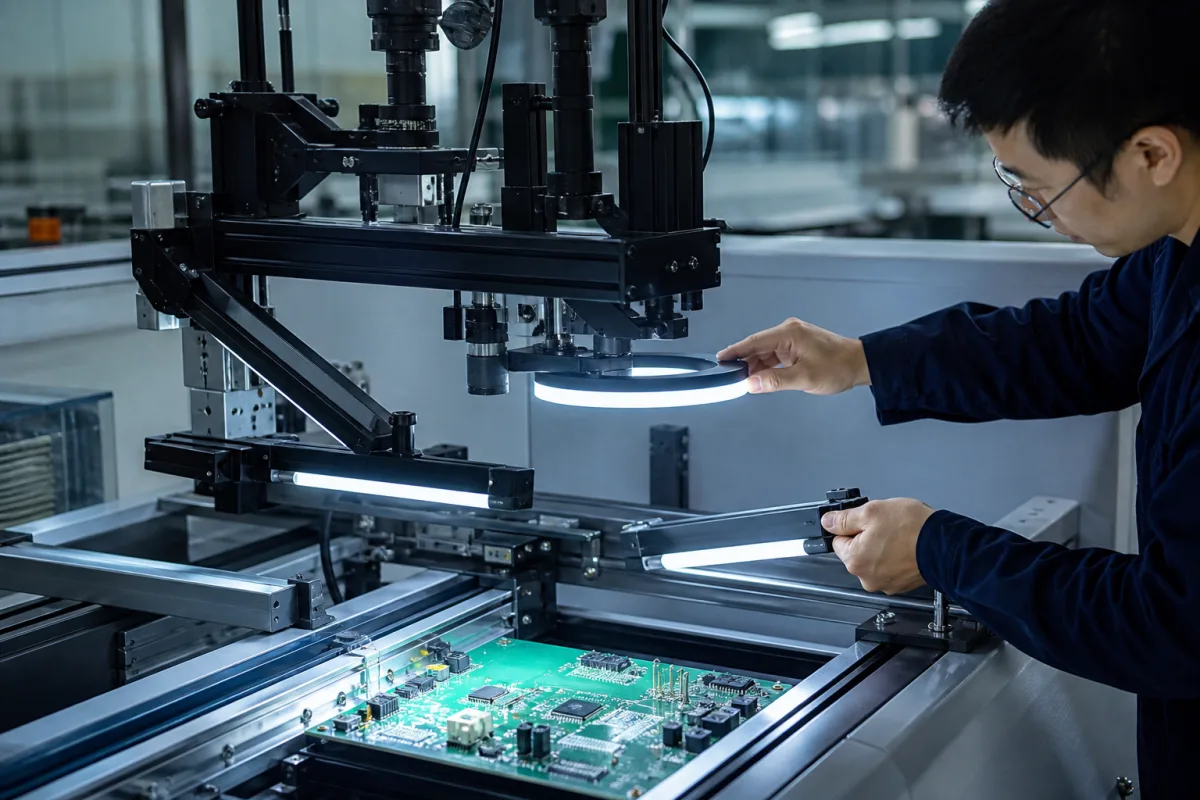
Inspection lighting system for human visual inspection workstations
Lighting for people who inspect by eye · Task illuminance, minimum and ratio limits, colour rendering and standard daylight viewing
An inspection lighting system, as used on this page, is the task and local lighting built into a workstation or booth where a person examines parts, boards, prints or finishes by eye: luminaires, diffusers, drivers and the surround around the task. Ask three things first: what illuminance the task needs on the inspected surface and how even it must be, how bright the work area may be against its surroundings, and whether colour must be judged, in which case the light source's colour quality and daylight simulation matter.
Task, local and booth lighting for human visual inspection: workstation inspection lights, colour viewing booths and inspection luminaires with their drivers. LED lights and controllers that illuminate parts for cameras in machine vision are covered on the Machine vision illumination unit page. General area, street, sports, garage, greenhouse and vehicle lighting are outside this page.
CNFX editorial research · Sources checked October 12, 2026 · 5 sources
The Canadian Centre for Occupational Health and Safety (CCOHS), citing the IESNA Lighting Handbook, CSA Z412 and British Columbia regulations, recommends 1,000–2,000 lux for visual tasks of low contrast or very small size such as difficult inspections and assembly, 2,000–5,000 lux for such tasks over a prolonged period, and 5,000–10,000 lux for very prolonged and exacting tasks such as very detailed cloth inspection; it puts adequate general lighting between 500 and 1,000 lux measured 76 cm above the floor. [1]
The UK Health and Safety Executive's HSG38 sets 500 lux average and 200 lux minimum measured illuminance for work requiring perception of fine detail, naming factories assembling electronic components, and notes that using only the average may leave lower illuminances in parts of the work area; it says the illuminance needed also depends on the worker's age and the speed and accuracy required. [2]
HSE limits the ratio of illuminance between an individually lit task and the area around it to 5:1, and between areas separated by a barrier with frequent movement to 10:1. [2] Editorial calculation: a bench lit to 2,000 lux for difficult inspection needs a surround of at least 2,000 ÷ 5 = 400 lux to stay within HSE's 5:1 ratio. [1][2]
Give the supplier the task (what defect, what size, what contrast), the inspected surface size and distance from the light, required average and minimum lux on that surface, the room lighting around the station, whether colour is judged and to which standard, mounting (bench, overhead, booth), supply voltage, and any glare or reflection problems from shiny parts.
02
Light the task so colour is judged correctly
GTI Graphic Technology, a maker of colour viewing systems, explains that industrial colour work on plastics, paints, textiles and automotive parts follows ASTM D1729 with D65 daylight viewing, while graphic arts and photography follow ISO 3664:2025 with D50; both standards set colour quality, light intensity, evenness, viewing and illumination geometry, and surround. [3]
GTI's FAQ states that colour assessment requires a CRI of at least 90, that ASTM D1729 requires a daylight simulator rated at least B/C under CIE Publication 51 for critical colour work, that a B rating in the visible spectrum corresponds to 0.25–0.50 CIELAB ΔE, and that the surround for critical colour should be Munsell N7 grey, with white used for very light colours. [4]
GTI's Color Harmony Inspection System, for example, has three independently controlled luminaires with three light levels each, D65 lamps rated B/C, alternative sources such as CWF, TL84, incandescent A and UVA, and heights of 254 cm with widths of 107–168 cm. [5] Editorial note: ask for the lamp's CRI or CIE 51 rating, its correlated colour temperature, and the relamping interval, because GTI notes lamp ageing shifts colour. [3]
6 companies list this product among what they make. Company figures are quoted from each
company's own website; every card states where the relationship came from.
Explore company information and manufacturing capabilities, then discuss the scope of your project with a relevant supplier.
Share this page
Compiled and source-reviewed by the CNFX editorial team.
Each manufacturer above links to the page on that company's own website where the product is listed, with the date we checked it. How we source and review
· Page last updated 13 October 2026
Buyer questions
How much light does visual inspection need?
CCOHS, citing the IESNA handbook, gives 1,000–2,000 lux for difficult inspection and up to 5,000–10,000 lux for very prolonged exacting inspection. [1]
How bright may the task be against its surroundings?
HSE sets a maximum 5:1 ratio between an individually lit task and the area around it. [2]
What CRI is needed to judge colour?
GTI states colour assessment needs CRI of at least 90, and ASTM D1729 needs a B/C CIE 51 daylight rating. [4]
Sources and what still needs a direct check
Sources checked 2026-10-12. CCOHS and HSE are Canadian and UK occupational health and safety bodies; GTI Graphic Technology is a maker of colour viewing systems explaining the viewing standards its products follow.