Industry-Verified Manufacturing Data (2026)

Ejector System

Based on aggregated insights from multiple verified factory profiles within the CNFX directory, the standard Ejector System used in the Fabricated Metal Product Manufacturing sector typically supports operational capacities ranging from standard industrial configurations to heavy-duty production requirements.

Technical Definition & Core Assembly

A canonical Ejector System is characterized by the integration of Ejector Pin and Ejector Plate. In industrial production environments, manufacturers listed on CNFX commonly emphasize Tool Steel construction to support stable, high-cycle operation across diverse manufacturing scenarios.

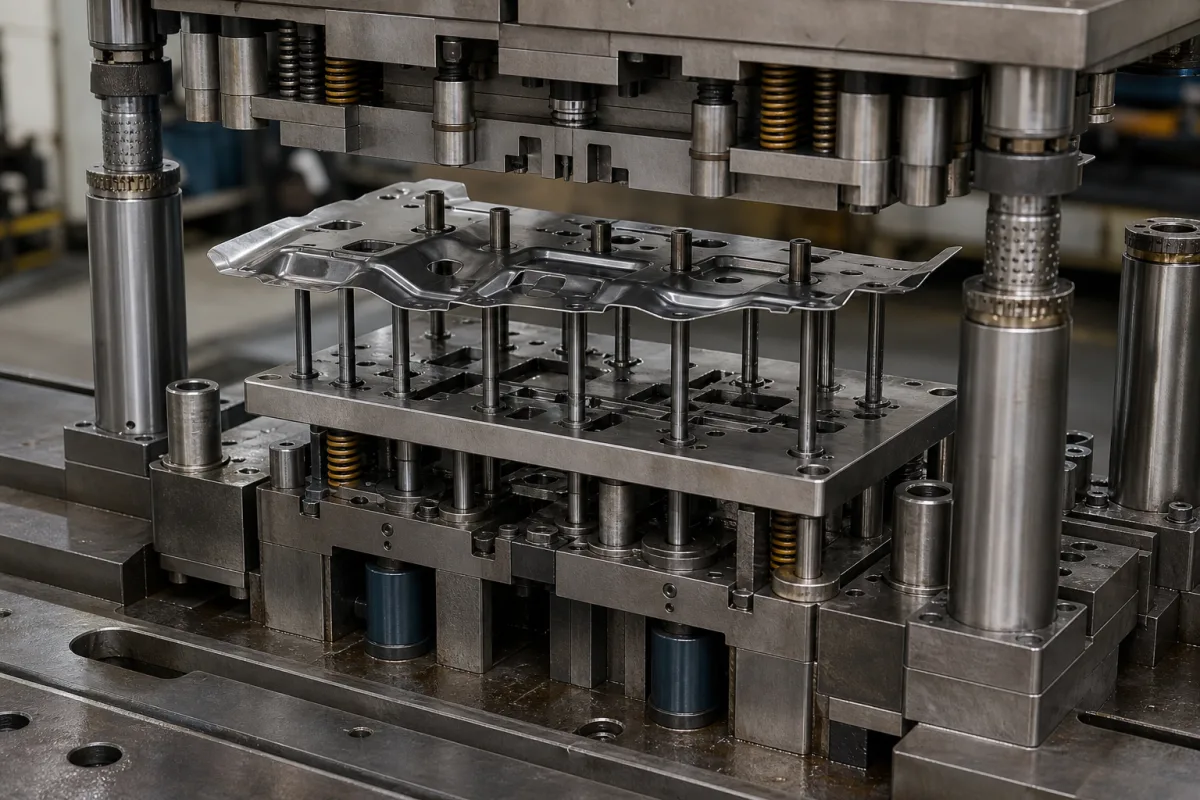
A mechanical system within a die set that removes formed parts from the die cavity after the molding or stamping process.
Product Specifications

Technical details and manufacturing context for Ejector System

Definition
The ejector system is a critical component of a die set that facilitates the removal of finished parts from the die cavity. It operates after the forming cycle (e.g., injection molding, stamping, forging) is complete, using pins, sleeves, or blades to push or lift the part from the mold or die surfaces, ensuring proper part release and preventing damage to the part or the tooling.
Working Principle
The system is typically activated by the opening stroke of the press or molding machine. As the die halves separate, an ejector plate (driven by the machine's ejector rod or a hydraulic/mechanical mechanism) moves forward, pushing the ejector pins through guide holes in the die. These pins make contact with the formed part and apply force to dislodge it from the core or cavity. The system then retracts before the next cycle begins.
Common Materials
Tool Steel, Alloy Steel
Technical Parameters
  • Ejector pin diameter and length; ejector plate thickness and travel distance. (mm) Customizable
Components / BOM
  • Ejector Pin
    Directly contacts and pushes the molded/stamped part out of the die cavity.
    Material: Tool Steel
  • Ejector Plate
    Holds the ejector pins and transmits the ejection force from the machine to the pins.
    Material: Alloy Steel
  • Return Pin
    Ensures the ejector plate retracts to its starting position before the next cycle.
    Material: Tool Steel
Engineering Reasoning
0.5-2.0 MPa hydraulic pressure, 0.1-0.5 mm/s ejection velocity, 20-150 kN ejection force
Hydraulic pressure exceeding 2.5 MPa causes seal extrusion failure; ejection velocity exceeding 1.0 mm/s induces part deformation; ejection force exceeding 200 kN causes pin buckling
Design Rationale: Seal extrusion failure occurs when hydraulic pressure exceeds the yield strength of nitrile rubber (15 MPa) combined with clearance gap (0.05 mm) creating extrusion pressure of 2.5 MPa; pin buckling follows Euler's critical load formula P_cr = (π²EI)/(KL)² where E=210 GPa (steel), I=πd⁴/64, K=2 (fixed-free), L=pin length
Risk Mitigation (FMEA)
Trigger Hydraulic fluid contamination exceeding ISO 4406 18/16/13 cleanliness level
Mode: Spool valve stiction causing delayed ejection timing
Strategy: Install 3 μm absolute filtration with differential pressure monitoring at 0.3 bar threshold
Trigger Misalignment exceeding 0.02 mm/mm between ejector plate and die shoe
Mode: Eccentric loading causing pin scoring and increased friction coefficient from 0.1 to 0.3
Strategy: Precision ground guide pillars with H7/g6 fit tolerance and 0.8 μm surface finish

Industry Taxonomies & Aliases

Commonly used trade names and technical identifiers for Ejector System.

Applied To / Applications

This component is essential for the following industrial systems and equipment:

Industrial Ecosystem & Supply Chain DNA

Complementary Systems
Downstream Applications
Specialized Tooling

Application Fit & Sizing Matrix

Operational Limits
pressure: Up to 100 bar (hydraulic actuated systems)
other spec: Stroke length: 10-500 mm, Cycle rate: Up to 120 cycles/min, Force capacity: 1-50 kN
temperature: -20°C to 200°C (typical for standard seals/materials)
Media Compatibility
✓ Thermoplastic molded parts ✓ Metal stamped components ✓ Rubber molded products
Unsuitable: High-viscosity materials requiring excessive ejection force (>50 kN)
Sizing Data Required
  • Part ejection force requirement (kN)
  • Die cavity depth/stroke length (mm)
  • Production cycle rate (cycles/min)

Reliability & Engineering Risk Analysis

Failure Mode & Root Cause
Wear and erosion of nozzle/throat
Cause: High-velocity fluid flow containing abrasive particles or corrosive media causing material degradation over time
Performance degradation due to fouling
Cause: Accumulation of deposits, scale, or foreign materials on internal surfaces, reducing flow efficiency and vacuum/pressure capabilities
Maintenance Indicators
  • Audible change in operating sound (hissing, whistling, or irregular noise patterns)
  • Visible performance deviation (reduced vacuum/pressure generation, increased steam/fluid consumption for same output)
Engineering Tips
  • Implement regular performance monitoring with baseline comparisons of vacuum/pressure levels versus motive fluid consumption to detect early degradation
  • Install proper upstream filtration/separation and maintain strict fluid quality control to prevent abrasive/corrosive particle ingress

Compliance & Manufacturing Standards

Reference Standards
ISO 1219-1:2012 (Fluid power systems and components) ANSI/ASME B16.5:2020 (Pipe flanges and flanged fittings) DIN 24342:1993 (Hydraulic fluid power - Single rod cylinders)
Manufacturing Precision
  • Bore diameter: +/-0.01mm
  • Surface flatness: 0.05mm per 100mm
Quality Inspection
  • Pressure testing (leak and burst)
  • Dimensional verification with CMM

Factories Producing Ejector System

Verified manufacturers with capability to produce this product in China

✓ 92% Supplier Capability Match Found

S Sourcing Manager from United States Jan 12, 2026
★★★★★
"The Ejector System we sourced perfectly fits our Fabricated Metal Product Manufacturing production line requirements."
Technical Specifications Verified
P Procurement Specialist from United Arab Emirates Jan 09, 2026
★★★★☆
"Found 48+ suppliers for Ejector System on CNFX, but this spec remains the most cost-effective. (Delivery took slightly longer than expected, but technical support was excellent.)"
Technical Specifications Verified
T Technical Director from Australia Jan 06, 2026
★★★★★
"The technical documentation for this Ejector System is very thorough, especially regarding technical reliability."
Technical Specifications Verified
Verification Protocol

“Feedback is collected from verified sourcing managers during RFQ (Request for Quote) and factory evaluation processes on CNFX. These reports represent historical performance data and technical audit summaries from our B2B manufacturing network.”

16 sourcing managers are analyzing this specification now. Last inquiry for Ejector System from Mexico (1h ago).

Supply Chain Compatible Machinery & Devices

Hydraulic Press Brake

Industrial machine for bending sheet metal using hydraulic force.

Explore Specs →
Sheet Metal Guillotine Shear

Industrial machine for straight-line cutting of sheet metal

Explore Specs →
Metal Plate Rolling Machine

Industrial machine for bending metal plates into cylindrical or conical shapes

Explore Specs →
Hydraulic Cylinder Piston Rod

Precision-machined rod that transmits force in hydraulic cylinders.

Explore Specs →

Frequently Asked Questions

What materials are recommended for ejector systems in metal fabrication?

Tool steel and alloy steel are recommended for their durability, wear resistance, and ability to withstand high-pressure stamping and molding cycles in metal fabrication.

How does an ejector system work in a die set?

After a part is formed in the die cavity, the ejector system uses pins and plates to mechanically push the finished part out, ensuring smooth removal without damage to the part or die.

What are the key components of an ejector system BOM?

The essential components include ejector pins for part contact, ejector plates for force distribution, and return pins to reset the system for the next cycle in the manufacturing process.

Can I contact factories directly on CNFX?

CNFX is an open directory, not a transaction platform. Each factory profile provides direct contact information and production details to help you initiate direct inquiries with Chinese suppliers.

Get Quote for Ejector System

Request technical pricing, lead times, or customized specifications for Ejector System directly from verified manufacturing units.

Your business information is encrypted and only shared with verified Ejector System suppliers.

Thank you! Your message has been sent. We'll respond within 1–3 business days.

Need to Manufacture Ejector System?

Connect with verified factories specializing in this product category

Add Your Factory Contact Us
Previous Product
Door Panel
Next Product
Electrode Holder