Resistance welding · Electrode cooling flow and water tubes, holder size and alignment, tapers and maintenance
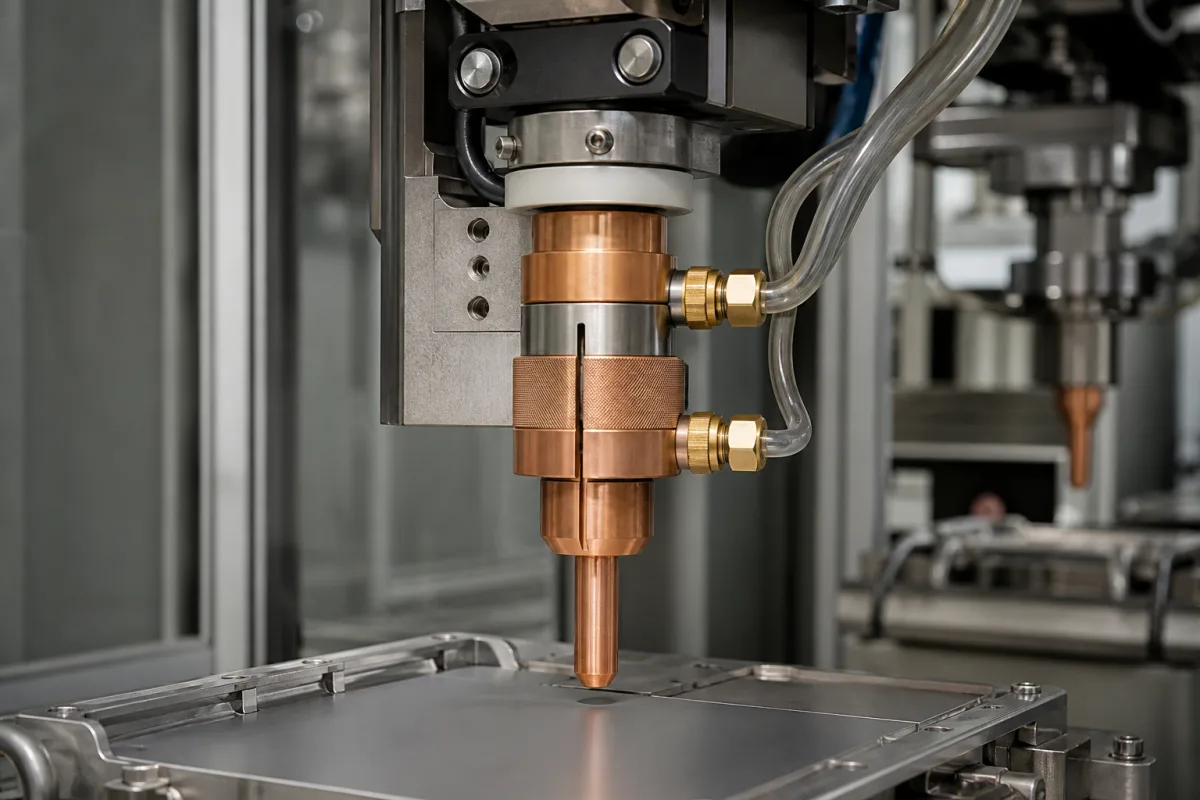
A resistance-welding electrode holder clamps a copper-alloy electrode or cap to the welding arm or gun, carries the welding current and force, and feeds cooling water to the inside of the electrode. Ask three things first: the cooling flow and water-tube arrangement, the holder diameter, taper and alignment for your electrodes, and the force and current it must carry.
Electrode holders and shanks for resistance spot and projection welding machines and guns, straight, offset and ejector types. Manual stick (MMA) electrode holders, EDM electrode holders and electrode holders for arc furnaces are outside this page.
CNFX editorial research · Sources checked October 12, 2026 · 4 sources
Set cooling flow, water temperature and tube position
TWI, the UK welding research organisation, lists cooling first among the factors in electrode wear, says it must be attended to first, and links inadequate cooling to electrode-life problems. It recommends 4 L/min through the electrodes for thin uncoated steel and 6 L/min or more for coated and thicker steels, inlet water not above 20 °C and outlet not above 30 °C, a cooling tube cut at 45° and aimed at the inside face of the electrode, checks that outlet blockages or back pressure do not reduce flow, and, with female caps, a holder drilled through to direct water onto the electrode. [1]
CMW, a resistance welding electrode maker, recommends 1.5 US gallons per minute of cold water, connecting the inlet so water flows through the centre tube first, a water tube within 0.25 inch of the bottom of the electrode water hole, re-adjusting the tube when electrode length changes, and angled, undamaged tube ends; it advises against holders without adjustable water deflector tubes. [2]
Tuffaloy describes its straight holders as having adjustable water tubes to maximise cooling of the tip, its Goldspot non-ejector holders as having a self-adjusting water tube, and its closed-couple design as having the water hose barbs angled at 60 degrees where space is tight. [3]
Editorial calculation: 1.5 US gal/min ≈ 5.7 L/min, between TWI's 4 and 6 L/min, and 0.25 inch ≈ 6.4 mm. [2][1] Ask the supplier for the holder's flow at your supply pressure and how the tube is adjusted.
Give the supplier the machine or gun type, electrode or cap type and taper, holder diameter and length, straight or offset geometry, welding force and current, cooling water pressure and temperature, and whether ejector holders are needed.
02
Size the holder, keep tapers clean and alignment true
TWI says electrode holders must be of sufficient diameter to avoid electrode skidding under load, that good alignment is crucial to avoid localised heating of the tip, and that the electrode diameter should be at least 2.5 to 3 times the tip diameter to improve cooling. [1]
CMW advises using ejector-type holders to simplify electrode removal, keeping electrode and holder tapers clean for leak-free conduction, avoiding holders with leaking or deformed tapers, not using pipe tape to stop leaks, and using rawhide or hard-rubber hammers for aligning electrodes. [2]
Tuffaloy's straight (barrel) holders are for rocker-arm and pedestal welders. The first page of its product table lists RWMA Class 2 barrels from 0.625 in to 1.5 in in diameter and 3, 6, 8 or 12 in long, for RWMA electrode tapers 4RW, 5RW, 6RW and 7RW, as Goldcrown ejector, Goldspot non-ejector and nickel-plated ejector types, some with a replaceable threaded electrode adapter. [3] Its standard offset holders come with 2 in or 4 in offsets, a 90° or 30° engagement angle, an optional ejector button, a threaded electrode adapter that can be replaced when the taper wears, and five shank diameters to accommodate different weld forces; the listed shank length is 3.5 in. [4]
Editorial calculation: for a 6 mm tip face, TWI's rule gives an electrode diameter of at least 15–18 mm. [1]
Editorial calculation: Tuffaloy's 0.625–1.5 in barrel diameters are about 15.9–38.1 mm, and its 2 and 4 in offsets about 51 and 102 mm (× 25.4). [3][4]
03
Compare what suppliers offer
Suppliers linked to this page list resistance-welding electrode holders; each card links to the page reviewed.
Agera lists electrode holders with spot-welding electrodes, caps and arms alongside its spot and butt welding machines.
04
Trace the holder components
This is a functional reference built from the sources cited; it is not one maker's parts list.
Part
Role
Fix in the order
Holder body
Carries force and current; diameter resists skidding. [1]
Diameter, length, geometry.
Taper seat
Holds the electrode; must be clean and undeformed. [2]
Taper size.
Water tube
Adjustable, angled tip near the water-hole bottom. [2][1]
Fill the specification fields with values for your welder
An electrode holder quotation needs values for your welder and electrodes. The table explains each field, gives published values where a reviewed source states them, and says what to obtain from the supplier.
Explore company information and manufacturing capabilities, then discuss the scope of your project with a relevant supplier.
Share this page
Compiled and source-reviewed by the CNFX editorial team.
Published product pages show what a company offers, not tested performance. Confirm the legal seller, factory and scope for your order. How we source and review
· Page last updated 13 October 2026
Buyer questions
How much cooling water does a spot-welding electrode need?
TWI recommends about 4 L/min for thin uncoated steel and 6 L/min or more for coated or thicker steel; CMW recommends 1.5 US gal/min (about 5.7 L/min). [1][2]
Where should the water tube end?
CMW says within 0.25 inch of the bottom of the electrode water hole, re-adjusted when electrode length changes. [2]
Why does holder diameter matter?
TWI says holders must be of sufficient diameter to avoid electrode skidding under load. [1]
What sizes do straight electrode holders come in?
Tuffaloy's straight holder table lists RWMA Class 2 barrels 0.625–1.5 in in diameter and 3–12 in long, for 4RW to 7RW electrode tapers, with or without ejectors. [3]
Sources and what still needs a direct check
Sources checked 2026-10-12. TWI is an independent welding research and technology organisation. CMW and Tuffaloy are resistance welding electrode and holder makers; their guidance and product tables describe their own products.