Industry-Verified Manufacturing Data (2026)

Robotic Welding Station

Based on aggregated insights from multiple verified factory profiles within the CNFX directory, the standard Robotic Welding Station used in the Motor Vehicle Manufacturing sector typically supports operational capacities ranging from standard industrial configurations to heavy-duty production requirements.

Technical Definition & Core Assembly

A canonical Robotic Welding Station is characterized by the integration of Industrial Robot Arm and Welding Torch. In industrial production environments, manufacturers listed on CNFX commonly emphasize Steel (structural frame) construction to support stable, high-cycle operation across diverse manufacturing scenarios.

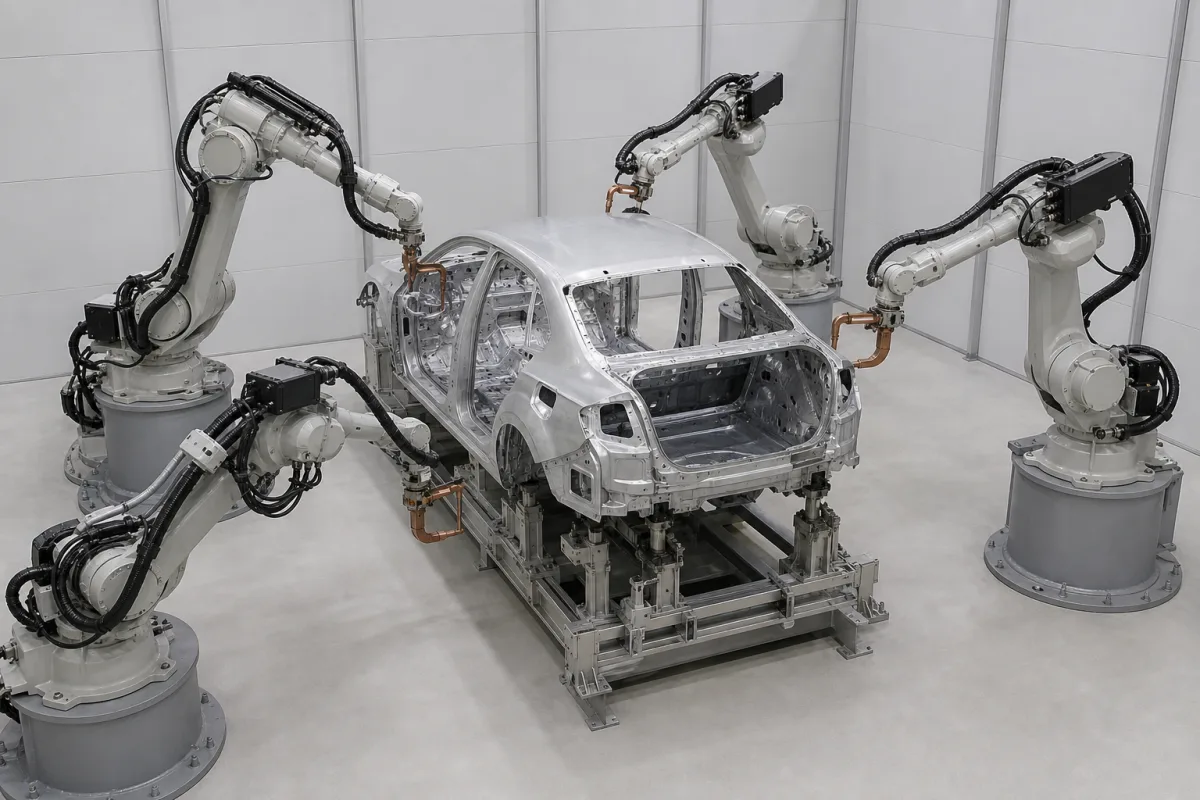
A specialized automated station within an assembly line that performs welding operations on vehicle body components using industrial robots.

Product Specifications

Technical details and manufacturing context for Robotic Welding Station

Definition
A critical component of the Automated Multi-Material Vehicle Body Assembly System, this station utilizes programmable industrial robots equipped with welding tools to join various metal components (such as steel, aluminum, or multi-material combinations) that form the vehicle's body structure. It ensures precise, consistent, and high-speed welding according to programmed paths, contributing to the structural integrity and dimensional accuracy of the final vehicle body assembly.
Working Principle
Industrial robots, guided by pre-programmed paths and parameters, manipulate welding torches (e.g., MIG/MAG, laser, or spot welding) to join metal components. The station typically includes a positioning fixture to hold the workpiece, the robot(s) with welding equipment, a welding power source, wire feeder (if applicable), and safety systems like fume extraction and light curtains. The process is controlled by a central PLC or robot controller that coordinates robot movement, welding parameters (current, voltage, speed), and sequencing with the broader assembly line.
Common Materials
Steel (structural frame), Aluminum (enclosures/guarding), Copper (electrical components)
Technical Parameters
  • Typical working envelope or reach of the robotic arm (e.g., 2000mm radius), defining the maximum size of workpiece it can weld. (mm) Standard Spec
Components / BOM
  • Industrial Robot Arm
    Precisely manipulates the welding torch along programmed paths to join components.
    Material: Aluminum/Steel (structure), Harmonic drives/gears (joints)
  • Welding Torch
    Delivers the welding arc/heat and filler material (if applicable) to the joint.
    Material: Copper alloy (conductive parts), Ceramic (insulation)
  • Workpiece Positioning Fixture
    Holds and precisely locates the vehicle body components during the welding process.
    Material: Steel (frame), Tool steel (clamping/locating pins)
  • Welding Power Source
    Provides controlled electrical current and voltage to create the welding arc.
    Material: Steel (enclosure), Copper/Electronic components (internals)
Engineering Reasoning
0.8-1.2 MPa (8-12 bar) shielding gas pressure, 15-25 V welding voltage, 150-300 A welding current
Shielding gas pressure <0.6 MPa causes porosity defects; Welding current >350 A causes electrode tip melting; Robot positioning accuracy >±0.5 mm causes misalignment
Design Rationale: Argon/CO2 shielding gas pressure below 0.6 MPa allows atmospheric contamination (nitrogen, oxygen absorption) causing porosity; Joule heating at >350 A exceeds copper electrode melting point (1085°C); Thermal expansion mismatch between robot arm components at >80°C ambient temperature causes positioning drift
Risk Mitigation (FMEA)
Trigger Power supply voltage fluctuation exceeding ±10% nominal 480V 3-phase
Mode: Welding transformer core saturation causing inconsistent arc stability
Strategy: Install voltage regulator with ±2% tolerance and harmonic filter at power input
Trigger Coolant flow rate reduction below 4 L/min due to pump degradation
Mode: Welding torch overheating leading to consumable tip deformation
Strategy: Implement redundant cooling circuit with flow sensor interlock at 3.5 L/min threshold

Industry Taxonomies & Aliases

Commonly used trade names and technical identifiers for Robotic Welding Station.

Industrial Ecosystem & Supply Chain DNA

Complementary Systems
Downstream Applications
Specialized Tooling

Application Fit & Sizing Matrix

Operational Limits
pressure: 0.5 to 1.0 MPa (air supply)
other spec: Maximum weld thickness: 6 mm, Positioning accuracy: ±0.1 mm, Cycle time: 30-120 seconds per component
temperature: 5°C to 40°C (operating environment)
Media Compatibility
✓ Mild steel automotive body panels ✓ Aluminum alloy components ✓ Galvanized steel sheets
Unsuitable: Explosive or highly flammable atmospheres (ATEX Zone 0/20)
Sizing Data Required
  • Maximum component dimensions (LxWxH)
  • Required welding throughput (parts per hour)
  • Available floor space and utility connections

Reliability & Engineering Risk Analysis

Failure Mode & Root Cause
Torch nozzle clogging
Cause: Accumulation of spatter and debris from welding process, inadequate shielding gas flow, or improper wire feed alignment
Servo motor encoder failure
Cause: Electrical noise interference, mechanical vibration leading to misalignment, or thermal stress from continuous operation
Maintenance Indicators
  • Inconsistent weld bead appearance (visual: irregular patterns, porosity, or excessive spatter)
  • Unusual grinding or clicking noises during arm movement (audible: indicating gear wear or bearing failure)
Engineering Tips
  • Implement a preventive maintenance schedule for torch cleaning and nozzle replacement based on arc hours, not calendar time
  • Install vibration monitoring sensors on critical axes and conduct regular thermal imaging to detect early motor and drive overheating

Compliance & Manufacturing Standards

Reference Standards
ISO 10218-1:2011 (Robots and robotic devices - Safety requirements) ANSI/RIA R15.06-2012 (Industrial Robots and Robot Systems - Safety Requirements) CE Marking (EU Machinery Directive 2006/42/EC)
Manufacturing Precision
  • Weld Seam Position: +/-0.5mm
  • Repeatability: +/-0.1mm
Quality Inspection
  • Visual Weld Inspection (AWS D1.1)
  • Non-Destructive Testing (Ultrasonic Testing)

Factories Producing Robotic Welding Station

Verified manufacturers with capability to produce this product in China

✓ 97% Supplier Capability Match Found

P Project Engineer from Canada Jan 29, 2026
★★★★★
"Great transparency on the Robotic Welding Station components. Essential for our Motor Vehicle Manufacturing supply chain."
Technical Specifications Verified
S Sourcing Manager from United States Jan 26, 2026
★★★★★
"The Robotic Welding Station we sourced perfectly fits our Motor Vehicle Manufacturing production line requirements."
Technical Specifications Verified
P Procurement Specialist from United Arab Emirates Jan 23, 2026
★★★★★
"Found 21+ suppliers for Robotic Welding Station on CNFX, but this spec remains the most cost-effective."
Technical Specifications Verified
Verification Protocol

“Feedback is collected from verified sourcing managers during RFQ (Request for Quote) and factory evaluation processes on CNFX. These reports represent historical performance data and technical audit summaries from our B2B manufacturing network.”

10 sourcing managers are analyzing this specification now. Last inquiry for Robotic Welding Station from USA (1h ago).

Supply Chain Compatible Machinery & Devices

Automotive Wireless Power Transfer System

Wireless charging system for electric vehicles using electromagnetic induction.

Explore Specs →
Automotive Solid-State Battery Pack

High-energy-density solid-state battery system for electric vehicles

Explore Specs →
Automotive Active Grille Shutter System

Aerodynamic system with motorized shutters for vehicle thermal and efficiency management.

Explore Specs →
Automotive Active Suspension Damping System

Electronically controlled suspension system for vehicle stability and comfort.

Explore Specs →

Frequently Asked Questions

What types of vehicle components can this robotic welding station handle?

This station is designed for welding vehicle body components such as frames, panels, and structural elements, with customizable fixtures to accommodate various part geometries in motor vehicle manufacturing.

How does the positioning fixture improve welding accuracy?

The workpiece positioning fixture securely holds components in precise alignment, ensuring consistent weld placement and reducing dimensional variations, which is critical for automotive assembly quality and fitment.

What safety features are included in the station's aluminum enclosures?

The aluminum enclosures provide guarding with safety interlocks, light curtains, and viewing windows to protect operators from welding arcs and robot movements while allowing process monitoring.

Can I contact factories directly on CNFX?

CNFX is an open directory, not a transaction platform. Each factory profile provides direct contact information and production details to help you initiate direct inquiries with Chinese suppliers.

Get Quote for Robotic Welding Station

Request technical pricing, lead times, or customized specifications for Robotic Welding Station directly from verified manufacturing units.

Your business information is encrypted and only shared with verified Robotic Welding Station suppliers.

Thank you! Your message has been sent. We'll respond within 1–3 business days.

Need to Manufacture Robotic Welding Station?

Connect with verified factories specializing in this product category

Add Your Factory Contact Us
Previous Product
Robotic Assembly Arms
Next Product
ROPS Frame