Industry-Verified Manufacturing Data (2026)

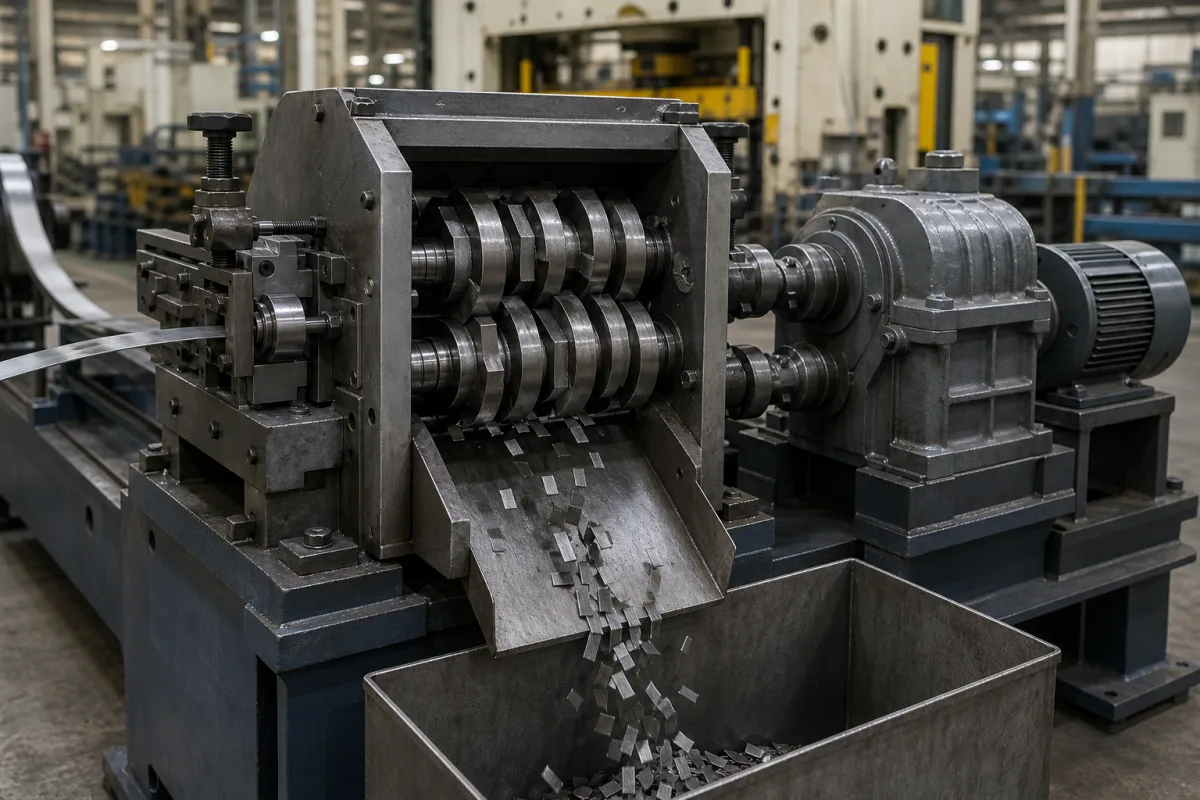
Scrap Cutter

Based on aggregated insights from multiple verified factory profiles within the CNFX directory, the standard Scrap Cutter used in the Machinery and Equipment Manufacturing sector typically supports operational capacities ranging from standard industrial configurations to heavy-duty production requirements.

Technical Definition & Core Assembly

A canonical Scrap Cutter is characterized by the integration of Upper Blade and Lower Blade. In industrial production environments, manufacturers listed on CNFX commonly emphasize Tool steel construction to support stable, high-cycle operation across diverse manufacturing scenarios.

A cutting mechanism integrated into progressive stamping presses that severs scrap material from stamped parts during continuous production.
Product Specifications

Technical details and manufacturing context for Scrap Cutter

Definition
The scrap cutter is an essential component of high-speed progressive stamping presses, designed to efficiently separate waste material (scrap) from the finished stamped parts as they move through the press line. It operates in synchronization with the press cycle to ensure clean cuts without interrupting production flow, maintaining dimensional accuracy of parts and preventing scrap accumulation that could damage dies or affect part quality.
Working Principle
The scrap cutter typically consists of a stationary blade and a moving blade actuated by the press ram or a separate hydraulic/pneumatic system. As the stamped strip advances through the die, the scrap cutter engages at predetermined positions to shear the connecting scrap skeleton or trim excess material. Timing is precisely controlled to match the press stroke, ensuring cuts occur during non-forming phases of the cycle.
Common Materials
Tool steel, Carbide
Technical Parameters
  • Cutting length capacity (mm) Customizable
Components / BOM
  • Upper Blade
    Moving cutting edge attached to the press ram or actuator
    Material: Tool steel
  • Lower Blade
    Stationary cutting edge mounted on the die or press bed
    Material: Tool steel
  • Blade Holder
    Secures blades in precise alignment and provides mounting interface
    Material: Alloy steel
  • Actuation Mechanism
    Hydraulic, pneumatic, or mechanical system that drives the cutting motion
    Material: Steel components with hydraulic/pneumatic elements
Engineering Reasoning
0.5-2.5 kN cutting force, 0.1-0.5 mm blade clearance, 20-80 strokes/min
Blade edge wear exceeding 0.15 mm radius, cutting force exceeding 3.0 kN, clearance deviation beyond ±0.05 mm
Design Rationale: Abrasive wear from material shear exceeding tool steel hardness (58-62 HRC), fatigue crack propagation at stress concentrations exceeding 450 MPa cyclic stress
Risk Mitigation (FMEA)
Trigger Progressive misalignment exceeding 0.1 mm cumulative tolerance stack-up
Mode: Asymmetric blade loading causing premature edge chipping
Strategy: Kinematic coupling alignment with 0.02 mm repeatability and laser interferometer verification
Trigger Resonant vibration at 120-180 Hz matching press stroke harmonics
Mode: Accelerated fatigue failure at blade mounting bolt holes
Strategy: Dynamic mass dampening with tuned vibration absorbers and finite element modal analysis optimization

Industry Taxonomies & Aliases

Commonly used trade names and technical identifiers for Scrap Cutter.

Industrial Ecosystem & Supply Chain DNA

Complementary Systems
Downstream Applications
Specialized Tooling

Application Fit & Sizing Matrix

Operational Limits
pressure: Max 10 bar (145 psi) hydraulic system pressure
other spec: Max scrap thickness: 3 mm (0.118 in), Min scrap width: 5 mm (0.197 in), Cutting frequency: Up to 1200 strokes/min
temperature: 0-80°C (32-176°F) ambient operating range
Media Compatibility
✓ Steel scrap (mild to high-strength) ✓ Aluminum scrap (various alloys) ✓ Copper/brass scrap
Unsuitable: Abrasive composite materials with embedded ceramics or carbides
Sizing Data Required
  • Press tonnage and stroke length
  • Scrap material type and thickness
  • Production speed (strokes per minute)

Reliability & Engineering Risk Analysis

Failure Mode & Root Cause
Blade edge degradation
Cause: Progressive wear from cutting abrasive materials, leading to dulling, chipping, or micro-fractures that reduce cutting efficiency and increase power consumption.
Bearing or drive system failure
Cause: Contamination from scrap particles entering seals, inadequate lubrication, or misalignment causing excessive vibration, overheating, and eventual seizure or mechanical breakdown.
Maintenance Indicators
  • Unusual vibrations or loud grinding noises during operation, indicating mechanical wear or misalignment.
  • Increased scrap residue or incomplete cuts, signaling blade dullness, improper clearance, or reduced cutting force.
Engineering Tips
  • Implement a regular sharpening and inspection schedule for blades based on material cut and usage hours, using precision tools to maintain optimal edge geometry and clearance angles.
  • Enhance sealing and filtration systems to prevent contaminant ingress, and use high-temperature, anti-wear lubricants suited for heavy-duty cutting applications, with scheduled lubrication intervals.

Compliance & Manufacturing Standards

Reference Standards
ISO 12100:2010 - Safety of machinery ANSI B11.19 - Performance criteria for safeguarding CE Marking - Machinery Directive 2006/42/EC
Manufacturing Precision
  • Blade alignment: +/-0.05mm
  • Cutting edge hardness: HRC 58-62
Quality Inspection
  • Non-destructive testing (NDT) for blade integrity
  • Functional safety test for emergency stop systems

Factories Producing Scrap Cutter

Verified manufacturers with capability to produce this product in China

✓ 94% Supplier Capability Match Found

P Project Engineer from United Arab Emirates Jan 09, 2026
★★★★★
"The Scrap Cutter we sourced perfectly fits our Machinery and Equipment Manufacturing production line requirements."
Technical Specifications Verified
S Sourcing Manager from Australia Jan 06, 2026
★★★★★
"Found 21+ suppliers for Scrap Cutter on CNFX, but this spec remains the most cost-effective."
Technical Specifications Verified
P Procurement Specialist from Singapore Jan 03, 2026
★★★★★
"The technical documentation for this Scrap Cutter is very thorough, especially regarding technical reliability."
Technical Specifications Verified
Verification Protocol

“Feedback is collected from verified sourcing managers during RFQ (Request for Quote) and factory evaluation processes on CNFX. These reports represent historical performance data and technical audit summaries from our B2B manufacturing network.”

14 sourcing managers are analyzing this specification now. Last inquiry for Scrap Cutter from USA (21m ago).

Supply Chain Compatible Machinery & Devices

Hydraulic Press

Industrial machine using hydraulic pressure to compress, form, or assemble materials

Explore Specs →
Heavy-Duty CNC Plasma Cutting Machine

Industrial machine for precision metal cutting using plasma arc technology

Explore Specs →
Automated Assembly Line System

Integrated production system for sequential component assembly operations

Explore Specs →
Automated Powder Coating System

Integrated industrial system for applying dry powder coatings to metal substrates.

Explore Specs →

Frequently Asked Questions

What materials are used in scrap cutter construction?

Scrap cutters are typically constructed from durable tool steel for structural components and carbide for cutting blades, ensuring longevity and precision in high-volume stamping operations.

How does a scrap cutter improve progressive stamping efficiency?

By automatically severing scrap material from stamped parts during continuous production, scrap cutters eliminate manual intervention, reduce downtime, and maintain consistent workflow in machinery manufacturing.

What maintenance do scrap cutters require?

Regular inspection of blade sharpness, lubrication of actuation mechanisms, and checking blade holder alignment are essential. Carbide blades typically last longer but should be replaced when wear affects cutting performance.

Can I contact factories directly on CNFX?

CNFX is an open directory, not a transaction platform. Each factory profile provides direct contact information and production details to help you initiate direct inquiries with Chinese suppliers.

Get Quote for Scrap Cutter

Request technical pricing, lead times, or customized specifications for Scrap Cutter directly from verified manufacturing units.

Your business information is encrypted and only shared with verified Scrap Cutter suppliers.

Thank you! Your message has been sent. We'll respond within 1–3 business days.

Need to Manufacture Scrap Cutter?

Connect with verified factories specializing in this product category

Add Your Factory Contact Us
Previous Product
Scoring Module
Next Product
Scraper