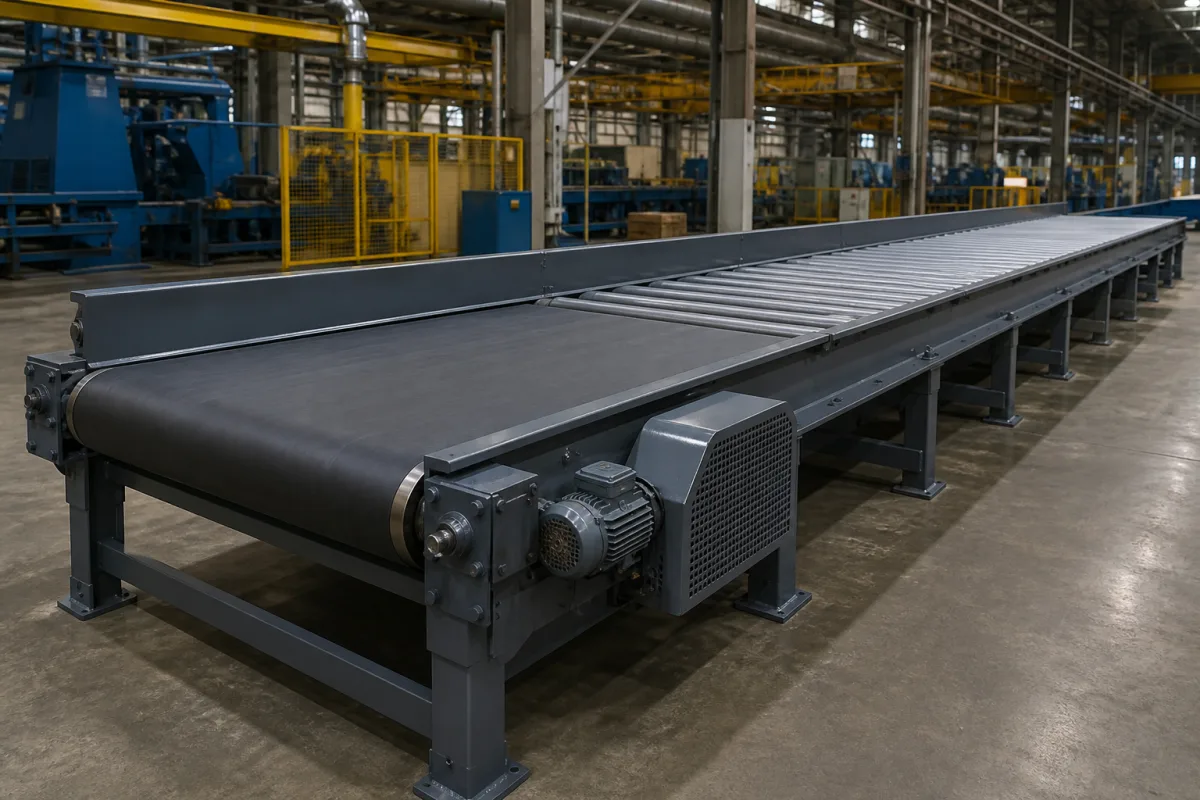
Part transfer conveyor for metal fabrication cells: belt and roller sections
Metal fabrication cells · Belt sections for stampings, roller staging sections, roller pitch and part-presence sensing of steel and non-ferrous parts
A part transfer conveyor in a metal fabrication cell carries parts from one station to the next: a powered belt section that takes stampings or cut parts off a press, laser or saw, and roller sections that stage and accumulate them before bending, welding or packing. Ask three things first: which belt cover suits the parts' edges, oil and temperature, how close the rollers must be for the smallest part, and how part presence will be sensed when the parts are not steel.
Short powered belt and roller conveyor sections used inside metal fabrication cells to move stampings, blanks and work-in-progress between machines, with their belt cover, roller pitch, drive and part-presence sensors. Conveyor systems as a plant-wide category, comparing belt, roller, chain, screw and modular types and their guarding rules, are covered on the Conveyor systems page. Bulk-material belt conveyors, chip conveyors, bucket elevators and conveyor chain or rollers sold alone are outside this page.
CNFX editorial research · Sources checked October 12, 2026 · 5 sources
Ashland Conveyor's belt guide names metal stampings among the applications of two of its belts. Its general-purpose belt is a single-ply black PVC belt, 85 durometer and 0.135 in thick, described as cut resistant with stretch under 2%, rated 20–180 °F, with a 2 in minimum pulley diameter. Its rough-top belt is a two-ply SBR rubber belt, 70 durometer and 0.235 in thick, rated −40 to 250 °F, which the maker describes as minimising product movement and suiting incline conveyors. [1]
Ashland's power belt guide explains the bed choice under the belt: on a slider bed the belt slides on a metal bed, which creates a relatively high coefficient of friction and reduces load capacity compared with a roller bed. Its roller-bed model carries the belt on 1.9 in × 16 gauge galvanised rollers on 6 in centres and conveys heavier loads with less horsepower. To size supports, the guide adds 3 in to the belt width for the roller-bed and channel-frame slider-bed models, and 2 in for the box-frame model. [2]
Editorial calculation: 180 °F is 82 °C and 250 °F is 121 °C, so parts leaving a hot process such as welding or heat treatment need their surface temperature checked against the belt's upper limit before the belt is chosen. A 24 in roller-bed belt needs a 27 in between-frame dimension. [1][2]
Give the supplier the part list (largest and smallest part, mass, material, edge condition, oil, surface temperature), the stations and heights the conveyor links, the rate and whether parts must accumulate, belt and roller section lengths, the drive voltage and phase, fixed or variable speed, any incline, and how part presence must be signalled to the cell controller.
02
Set roller pitch for the smallest part and sense the metal you run
Ashland's roller conveyor guide states that a minimum of three rollers should be in contact with the load at all times, that roller centres may need to be closer to reduce the load per roller, and that conveyors should leave 2 in of roller on each side of the product. Its rollers run from 1-3/8 in to 2-5/8 in diameter on 1.5, 3, 4.5 or 6 in centres, and frame capacities are quoted for supports at 10 ft and 5 ft centres, closer supports raising capacity. Loads need firm, flat bottoms. [3]
Editorial calculation: for at least three rollers under a part of length L, the roller pitch can be no more than L ÷ 3. A 300 mm blank therefore needs centres of 100 mm or less: 3 in (76.2 mm) centres qualify, 4.5 in (114.3 mm) do not. A 500 mm wide part needs about 500 + 2 × 50.8 ≈ 602 mm between frames. Part sizes are assumed examples. [3]
ipf electronic's M8 flush inductive sensor IB081121 has a 1.5 mm switching distance on its standard 8 × 8 × 1 mm plate and lists correction factors of 1 for St37 steel, 0.7 for stainless steel, 0.4 for brass, 0.3 for aluminium and 0.2 for copper; it is rated IP67 for −25 to 70 °C and names conveyor presence detection among its uses. [4] Editorial calculation: the same sensor reaches 1.5 × 0.3 = 0.45 mm on aluminium and 1.5 × 0.7 = 1.05 mm on stainless steel, so a cell running aluminium parts needs a larger sensor, a different sensing method or a mounting that holds the part within that gap. [4]
03
Compare the section types in a cell
Slider-bed, roller-bed, gravity, zoned motor-roller and chain-driven sections each suit a different job in a fabrication cell, from inspection to heavy fixtures.
Section
What the source states
Check for your parts
Slider-bed belt
Belt on a metal bed; higher friction, lower capacity than roller bed. [2]
Light parts; assembly or inspection.
Roller-bed belt
Belt on 1.9 in rollers at 6 in centres; heavier loads, less horsepower. [2]
GCS describes one in nine rollers driven by an internal 24 V motor linked by O-rings, with drive cards and zones to accumulate, stop or start product. [5]
Zone length; part mass.
Chain-driven live roller
GCS lists it for large pallets, with stops and transfers. [5]
Heavy fixtures or pallets.
04
GCS roller conveyors: the one listing kept for cell transfer
GCS's custom roller conveyor page is the only linked listing that matches a part transfer conveyor; the chain maker and the bucket-elevator maker linked to this product were not kept.
The listing kept describes gravity, chain-driven and powered roller conveyors built to customer width and length; ask for the roller pitch, belt cover and sensor arrangement for your parts.
05
Drive, belt or rollers, frame, part sensors and VFD in a cell conveyor
These five parts are this product's component list; the sensor row points to ipf's correction factors because a cell may run aluminium or stainless parts as well as steel.
Sets belt speed where variable speed is needed. [2]
Speed range.
06
Cell conveyor quotation: belt width, section length, speed and sensor ratings
Belt width, section length and temperature limits have Ashland and ipf figures; load per metre and motor power depend on support spacing and part mass, so the supplier has to state them.
Field
What it means and published values
Ask the supplier for
Belt Width (mm)
Between frame = belt + 3 in on Ashland roller-bed models. [2]
Belt and frame widths.
Conveyor Length (m)
Ashland roller sections come in 5 ft and 10 ft lengths. [3]
Section lengths and layout.
Load Capacity (kg/m)
Frame capacity depends on 10 ft or 5 ft support centres. [3]
Explore company information and manufacturing capabilities, then discuss the scope of your project with a relevant supplier.
Share this page
Compiled and source-reviewed by the CNFX editorial team.
Each manufacturer above links to the page on that company's own website where the product is listed, with the date we checked it. How we source and review
· Page last updated 13 October 2026
Buyer questions
Which belt suits metal stampings?
Ashland lists metal stampings among the uses of its PVC general-purpose belt (cut resistant, 20–180 °F) and its two-ply rough-top rubber belt (−40 to 250 °F). [1]
How close should conveyor rollers be?
Ashland's guide says at least three rollers should be in contact with the load at all times; for a part of length L that means a pitch of no more than L ÷ 3. [3]
Will an inductive sensor see aluminium parts?
Yes, at reduced range: ipf's M8 sensor lists a 1.5 mm switching distance and a 0.3 correction factor for aluminium, about 0.45 mm. [4]
Sources and what still needs a direct check
Sources checked 2026-10-12. Ashland Conveyor's selection guides describe its own belts and conveyors, ipf electronic's data sheet describes its own sensor, and GCS's page describes its own roller conveyors.