Editorial Technical Reference

Welding Power Source & Torch

This page explains how Welding Power Source & Torch is classified within Fabricated Metal Product Manufacturing. Technical values and manufacturer relationships are research references; confirm the current specification and supplier evidence for each order.

Technical Definition & Core Assembly

A combined welding power supply unit and handheld torch assembly that provides electrical energy and delivers filler material for arc welding operations.
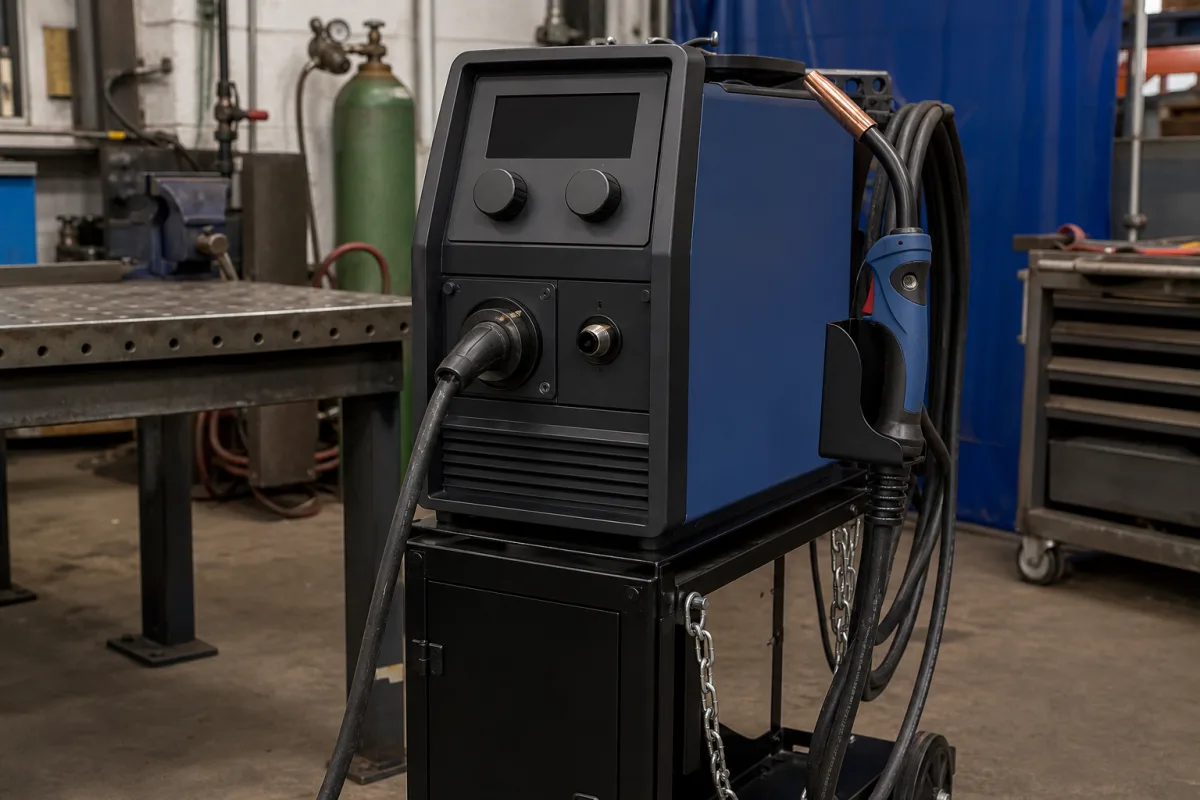
Representative product image. Confirm appearance and specifications with the manufacturer.

Product Specifications

Technical details and manufacturing context for Welding Power Source & Torch

Definition
Within a Frame Welding Station, the Welding Power Source & Torch is the core operational component responsible for generating and controlling the electrical arc used to join metal frame components. The power source converts input power to the appropriate voltage, current, and waveform for the welding process (e.g., MIG/MAG, TIG), while the torch directs the arc, delivers shielding gas, and feeds consumable electrode wire to the weld joint. This component is classified as a part within the fabricated metal product manufacturing industry, specifically for arc welding applications. The power source accepts three-phase AC input at 380 V ±10% (IEC 60974-1) and draws 20–60 A at rated output. It provides a rated output current of 50–500 A, depending on duty cycle, with a 60% duty cycle at 40°C ambient. Open circuit voltage is limited to 50–70 V DC for safety. The unit supports wire feed speeds of 1.5–15 m/min for MIG/MAG and accommodates wire diameters from 0.8 to 1.6 mm (ISO 544). Cooling is forced air (F), insulation class H (180°C, IEC 60085), and protection rating IP23S (IEC 60529). Operating temperature range is -10 to 40°C, with derating above 40°C. The power source alone weighs 35–60 kg, with typical dimensions of 600×300×500 mm (L×W×H). Materials include copper for conductors and contact tips, thermoplastic/composite for the torch body, and steel for internal components and casing. All listed standards (IEC 60974-1, ISO 544, IEC 60085, IEC 60529) serve as procurement references; actual compliance must be verified with the manufacturer. For any specific model, confirm rated values, duty cycle, and environmental limits with the supplier.
Working Principle
The power source takes primary AC power, rectifies and conditions it to produce a stable DC or AC output with precise control over amperage and voltage. When the trigger on the torch is activated, this electrical potential is applied between the torch's contact tip/electrode and the workpiece, creating a sustained electric arc. The intense heat of the arc melts the base metals and the filler wire (if used), forming a molten weld pool. Shielding gas expelled from the torch nozzle protects the pool from atmospheric contamination as it solidifies.
Common Materials
Copper (conductors, contact tips), Thermoplastic/Composite (torch body), Steel (internal components, casing)
Technical Parameters
ParameterTypical rangeNotes & selection driver
Rated Input Voltage380 ±10% V ACThree-phase; other voltages on requestIEC 60974-1
Rated Input Current20–60 AAt rated outputIEC 60974-1
Rated Output Current50–500 ADuty cycle dependentIEC 60974-1
Duty Cycle60 %At 60% duty cycle, 40°C ambientIEC 60974-1
Open Circuit Voltage50–70 V DCSafety limit per standardIEC 60974-1
Wire Feed Speed1.5–15 m/minAdjustable for MIG/MAG
Wire Diameter0.8–1.6 mmCompatible with standard spoolsISO 544
Cooling MethodFF = forced air; W = water optionalIEC 60974-1
Insulation ClassHClass H (180°C)IEC 60085
Protection RatingIP23SProtected against spraying waterIEC 60529
Operating Temperature-10–40 °CDerate above 40°CIEC 60974-1
Weight35–60 kgPower source only, torch excluded
Dimensions (L×W×H)600×300×500 mmTypical; varies by model

Ranges are indicative industry figures for RFQ preparation, not a supplier commitment. Confirm every value and standard with the legal manufacturer before ordering.

Components / BOM
  • Power Source Unit
    Converts input power to controlled welding output; houses controls, wire feeder, and gas solenoid.
    Material: Steel sheet (enclosure), Copper (transformers/rectifiers)
  • Welding Torch (Gun)
    Handheld device for directing the arc, feeding wire, and delivering shielding gas to the weld zone.
    Material: Thermoplastic (handle/body), Copper alloy (contact tip, nozzle)
  • Work Clamp (Ground Clamp)
    Completes the electrical circuit by connecting the power source's negative terminal to the workpiece.
    Material: Copper alloy (jaws), Steel (spring, handle)

Applied To / Applications

This component is essential for the following industrial systems and equipment:

Industrial Ecosystem & Supply Chain Structure

Complementary Systems
Downstream Applications
Specialized Tooling

Application Fit & Sizing Matrix

Operational Limits
pressure: N/A (electrical device, not pressure-rated)
other spec: Duty cycle: 60% at rated output, Input voltage: 200-600V AC 3-phase, Output current: 50-500A DC
temperature: -10°C to +40°C operating, -20°C to +55°C storage
Media Compatibility
✓ Carbon steel welding ✓ Stainless steel welding ✓ Aluminum welding (with appropriate filler/wire)
Unsuitable: Underwater or submerged environments (requires dry conditions for electrical safety)
Sizing Data Required
  • Required welding current (A) for material thickness
  • Duty cycle needed for production volume
  • Available input power supply (voltage/phase)

Reliability & Engineering Risk Analysis

Failure Mode & Root Cause
Overheating and thermal degradation
Cause: Inadequate cooling due to blocked air filters, excessive duty cycle beyond rated capacity, or ambient temperature exceeding operational limits, leading to insulation breakdown in transformers and electronic components.
Arc instability and erratic welding performance
Cause: Contaminated or oxidized electrical contacts in the torch and cable connections, worn consumables (nozzles, contact tips), or internal power regulation circuit failures causing inconsistent current output.
Maintenance Indicators
  • Unusual buzzing, humming, or crackling sounds from the power source or torch, indicating electrical arcing, loose connections, or failing components.
  • Visible discoloration, melting, or excessive spatter on the torch body or cable insulation, signaling overheating, poor gas flow, or electrical faults.
Engineering Tips
  • Implement a routine cleaning and inspection schedule for cooling vents, filters, and internal dust accumulation to prevent overheating; use thermal imaging during preventive maintenance to identify hot spots early.
  • Establish a consumable replacement program based on welding hours or material throughput, and regularly torque-check all electrical connections to maintain low resistance and stable arc performance.

Indicative industry ranges for design and RFQ preparation. Confirm the exact figures and applicable standard with the manufacturer before specifying.

Compliance & Manufacturing Standards

Applicable Standards
ISO 17657-1:2017 (Resistance welding - Welding current measurement for resistance welding) ANSI/AWS D17.1/D17.1M:2017 (Specification for Fusion Welding for Aerospace Applications) DIN EN 60974-1:2017 (Arc welding equipment - Part 1: Welding power sources)

Quoted from the published standard.

Manufacturing Precision
  • Torch nozzle concentricity: +/-0.05mm
  • Power source output current stability: +/-1.5% of set value
Quality Inspection
  • High-potential (hipot) dielectric strength test
  • Thermal imaging inspection for heat dissipation consistency

Manufacturers of Welding Power Source & Torch

Manufacturer profiles associated with Welding Power Source & Torch.

Sourcing Welding Power Source & Torch from China?
Tell us your specification and target quantity — we will match it against manufacturer records and come back with the factories that fit.
Request manufacturers We manufacture this

Manufacturer listings support early research and capability understanding. They are not certification, ranking, or transaction guarantees.

Technical documentation
Request current drawings, revision history, and a signed specification sheet.
Manufacturing capability
Verify equipment lists, process limits, capacity, and representative production evidence.
Inspection readiness
Confirm test methods, calibrated equipment, sampling plans, and traceable reports.
Supplier transparency
Check the legal entity, factory address, ownership, certifications, and direct contacts.

CNFX does not score or rank suppliers. Buyers must verify all claims and documents with the legal manufacturer before ordering.

Supply Chain Compatible Machinery & Devices

Hydraulic Cylinder Piston Rod

A hydraulic cylinder piston rod is a precision-machined, load-bearing component that converts hydraulic pressure into linear mechanical force.

Explore Specs →
Industrial Tube Bending Machine

An industrial tube bending machine is a CNC-controlled device designed to precisely bend metal tubes and pipes to specific angles and radii.

Explore Specs →
Precision Linear Motion Guide Rail

Precision linear guide component for smooth, accurate motion in industrial machinery

Explore Specs →
Precision Aluminum Extrusion Profile

Precision aluminum extrusion profiles are semi-finished structural components produced by forcing heated aluminum alloy through a shaped die.

Explore Specs →

Frequently Asked Questions

What is the rated input voltage for this welding power source?

The rated input voltage is 380 V AC ±10%, three-phase, as listed in the directory. Other voltages may be available on request, but you must confirm with the manufacturer for your specific model.

What is the duty cycle and what does it mean?

The duty cycle is 60% at 40°C ambient, meaning the unit can operate at rated output for 6 minutes out of a 10-minute cycle without overheating. For continuous operation, you may need to reduce the output current or improve cooling.

What wire diameters and feed speeds are supported?

The unit supports wire diameters from 0.8 to 1.6 mm (ISO 544) and wire feed speeds adjustable from 1.5 to 15 m/min for MIG/MAG processes. These values are typical; check the manual for exact ranges.

What safety standards apply to this equipment?

The directory lists IEC 60974-1 for arc welding equipment, IEC 60085 for insulation class H, and IEC 60529 for protection rating IP23S. These are reference standards; actual compliance must be verified with the manufacturer or supplier.

Data Basis

Editorial classification, named public sources where available, and source-reviewed manufacturer records.

Preliminary Technical Classification
This page supports structured research, RFQ preparation, and supplier evaluation. It does not replace buyer-led supplier qualification, standards review, or technical approval.
Buyer enquiry

Request manufacturing insight for Welding Power Source & Torch

Ask for use case, specification boundaries, supplier type, and RFQ preparation information for this product.

Where it goes
Straight to the CNFX editorial desk, and to the manufacturer if this product is linked to a claimed profile. Nothing is broadcast to a supplier list.
Your details stay here
We do not sell or rent enquiry data, and we do not add you to a mailing list. Used only to answer this request.
No commission, no middleman
CNFX is a directory. We take no cut of any order and never negotiate on a supplier's behalf.
What we don't claim
A listing is not an endorsement. Qualify every supplier and verify every figure yourself before ordering.

Your business information is used only to process this request.

Thank you! Your message has been sent. We'll respond within 1–3 business days.
Sorry, we couldn't send your message. Please try again, or email us at contact@cnfx.com.

Need to Manufacture Welding Power Source & Torch?

Compare manufacturer profiles with relevant product and process capability.

Previous Product
Welding Positioner
Last Product
Get QuotesChat