Arc welding · Amperage and duty cycle, shielding gas basis, air or water cooling, consumables and connectors
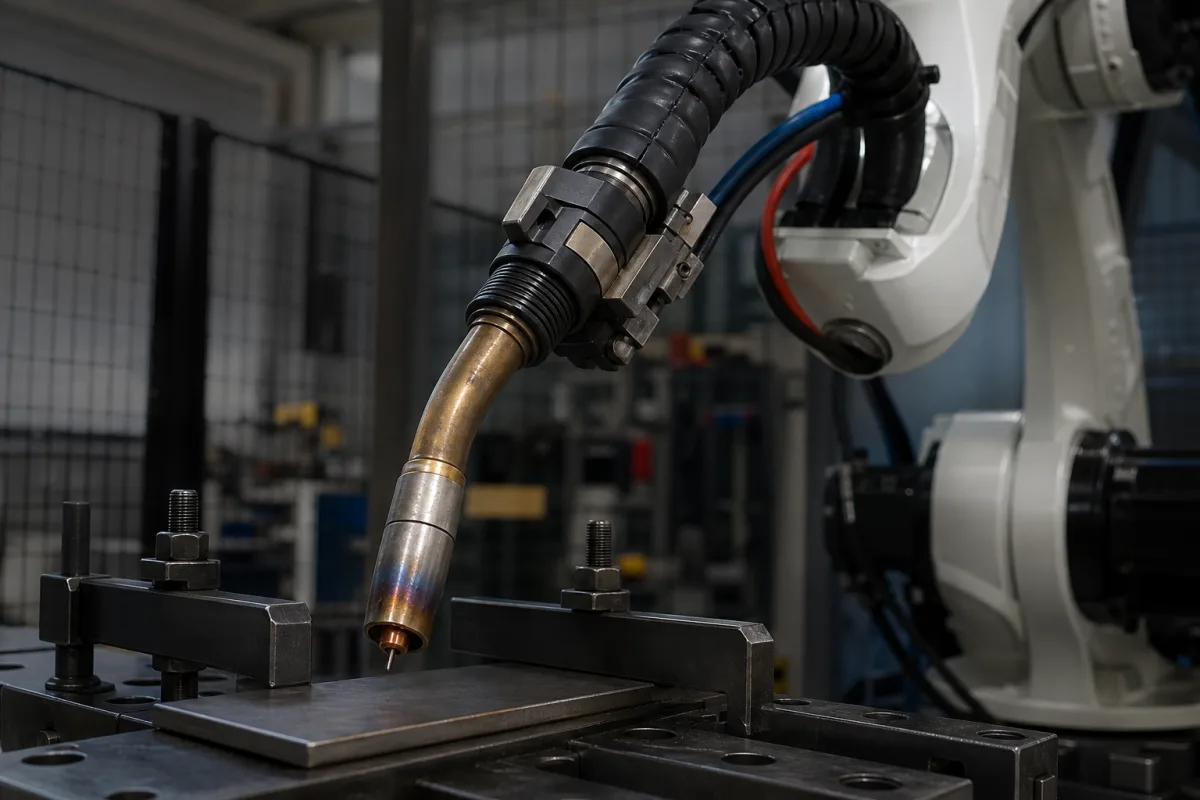
A MIG/MAG welding torch carries wire, current and shielding gas to the arc. Ask three things first: what current and how much arc-on time the job needs, which shielding gas, and whether a manual or robotic torch must fit your feeder and robot.
Manual and robotic MIG/MAG welding torches with their cables, consumables and cooling; TIG and plasma torches are noted where suppliers list them. Laser welding heads, welding machines and robots are outside this page.
CNFX editorial research · Sources checked October 12, 2026 · 4 sources
Bernard, a MIG gun maker, defines duty cycle as the number of minutes in a 10-minute period that a gun can run at full capacity without overheating, so 60% means six minutes of arc-on time. "Most guns in the industry are tested and rated for duty cycle according to their performance with 100 percent CO2", which keeps them cooler; a mix such as 75% argon and 25% CO₂ makes the arc and gun hotter and lowers the duty cycle. Because "most welding operators don't weld 100 percent of the time, it is often possible to use a lower amperage gun for a welding procedure that calls for a higher-amperage one". [1]
ABICOR BINZEL, a torch maker, gives the same basis: a 350 A gun rated on CO₂ can weld 10 minutes at 350 A at its maximum, while argon-based mixes do not cool the gun like 100% CO₂. [2]
Editorial calculation: at a 60% duty cycle the torch can weld 6 minutes in every 10, or up to 36 minutes per hour at its rating; check this against your real arc-on time, and ask for the rating on your gas, not only on CO₂. [1]
Give the supplier the process (MIG/MAG, manual or robotic), wire type and diameter, current range, arc-on time, shielding gas, cable length, feeder connector or robot mounting, and consumables in use.
02
Choose air or water cooling and check fit
Bernard says the choice between air and water cooling depends on amperage, application, operator preference and cost: sheet-metal welding for a few minutes an hour has little need for water cooling, while stationary equipment repeatedly welding at 600 A will likely need it. A water-cooled system pumps coolant from a radiator through hoses in the cable to the handle and neck. [1]
ABICOR BINZEL notes that poorly maintained or set-up cooling systems can damage water-cooled guns, and that water-cooled guns reach currents air-cooled guns cannot. [2]
Torch ranges list cable sizes by cooling type: Langmei lists air-cooled MIG torches from MK-14 with 12 mm² cable to MB-40 with 50 mm² cable and a MAXI-450 with 60 mm² cable, and water-cooled MB-401D/501D torches with 16 mm² cable. [3] Ask for the rated current, duty cycle and gas for each model.
03
Compare what suppliers offer
Suppliers linked to this page list MIG/MAG torches, some alongside TIG and plasma torches and consumables; each card links to the page reviewed.
CNAWELD lists OEM-compatible MIG/MAG, TIG, plasma and robotic torches; EDAWELD, Huarui, Intej, Gaoyi, Getstar and Xinfa list MIG and TIG torches and parts; Langmei lists air- and water-cooled MIG torches; Longren lists MIG and TIG torch parts and plasma consumables; Xionggu lists torches with welding machines and robots.
04
Read the load capacity on mixed gas and the test conditions
Kemppi, a welding equipment maker, publishes the load capacity of its Flexlite GX 400 A gas-cooled guns against both duty cycle and gas, with rows for 35%, 60% and 100% on Ar + 18% CO₂ and on CO₂. The 403G/405G (Euro connection) is rated 400 A at 35% on Ar + 18% CO₂ and the 408GMN (Kemppi connection, changeable neck) 400 A at 60% on the same gas; the CO₂ rows are left blank. The load capacity test used 20 l/min gas flow, 1.6 mm filler wire and a 22 mm stick-out. Both guns take 0.8–1.6 mm wire and M10x1 contact tips, are rated for −20 to +40 °C operation, come in 3.5 or 5 m lengths and list IEC 60974-7. [4]
Editorial calculation: on the 10-minute basis Bernard uses for duty cycle [1], 35% at 400 A means 3.5 minutes of welding in every 10 and 60% means 6 minutes. A rating on Ar + 18% CO₂ cannot be compared directly with a rating on 100% CO₂, such as the 350 A example above; ask each supplier for the duty cycle, gas, wire diameter, gas flow and stick-out behind its rating, and for its IEC 60974-7 declaration.
Power, gas and wire liner; coolant hoses if water-cooled. [1][3]
Cable size and length.
Connector
Joins the feeder.
Euro or other connector.
06
Fill the specification fields with values for your welding
A welding torch quotation needs values for your process. The table explains each field, gives published values where a reviewed source states them, and says what to obtain from the supplier.
Explore company information and manufacturing capabilities, then discuss the scope of your project with a relevant supplier.
Share this page
Compiled and source-reviewed by the CNFX editorial team.
Published product pages show what a company offers, not tested performance. Confirm the legal seller, factory and scope for your order. How we source and review
· Page last updated 13 October 2026
Buyer questions
What does 60% duty cycle mean on a MIG torch?
The torch can weld 6 minutes in every 10 at its rated current without overheating. [1]
Why is a torch's mixed-gas rating lower?
Bernard says "most guns in the industry are tested and rated for duty cycle" on 100% CO₂, which runs cooler; argon-rich mixes make the arc and torch hotter, lowering duty cycle. [1][2]
When do I need a water-cooled welding torch?
For sustained high current, such as repeated welding around 600 A; short sheet-metal work rarely needs it. [1]
Are MIG torch ratings always given on CO₂?
No. Kemppi rates its Flexlite GX 400 A gas-cooled guns on Ar + 18% CO₂, at 400 A and 35% duty cycle for the 403G/405G and 400 A and 60% for the 408GMN, with the CO₂ rows left blank. [4]
Sources and what still needs a direct check
Sources checked 2026-10-12. Bernard and ABICOR BINZEL are welding torch makers; their guidance describes industry rating practice. Langmei is a supplier listed on this page.