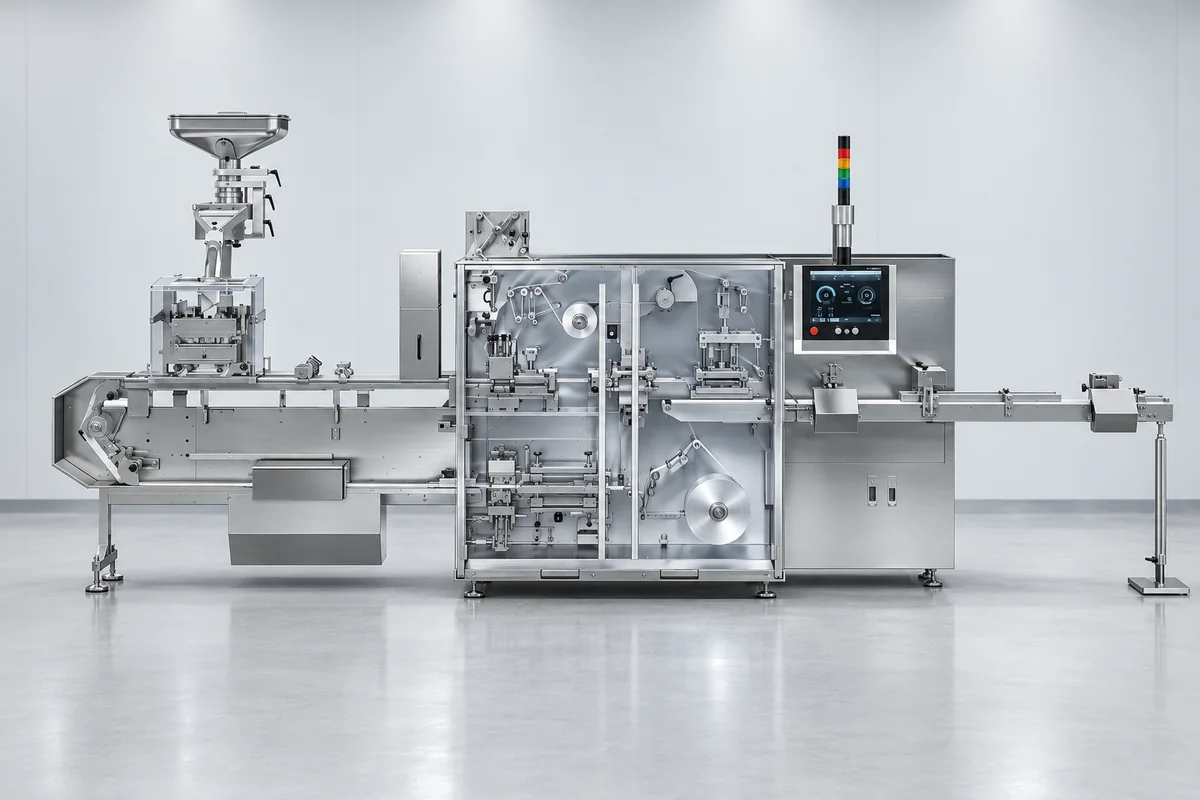
Blister packaging machines · thermoformed PVC and cold-formed Alu-Alu blisters, forming area and depth, speed in cycles or sheets per minute, lidding and forming materials, moisture protection, inspection and leak testing
A blister packaging machine forms pockets in a plastic or aluminium forming film, places tablets, capsules or other products into them, heat-seals a lidding foil over the top and cuts the web into blister cards. Ask three things first: whether your product needs thermoformed plastic or cold-formed aluminium (Alu-Alu) blisters, what blister size, pocket depth and output you need, and how filling, sealing and leaks are inspected.
Flat-plate and roller blister packaging machines for pharmaceutical, food, cosmetic and hardware unit packs, including Alu-PVC thermoforming, Alu-Alu cold forming and blister card machines. Strip packaging, bottle filling lines, cartoners and blister materials sold alone are outside this page except where compared.
CNFX editorial research · Sources checked October 12, 2026 · 4 sources
FDA's guidance on container closure systems for human drugs describes a blister package made of a lidding material and a forming film, with a lidding laminate that has a barrier layer such as aluminium foil, a print primer on one side and a heat-seal lacquer on the other, and the forming film may be a single film, a coated film or a laminate. It names protection from water vapour, and in some cases from light and reactive gases, as a need of solid oral dosage forms, so the package should have a low water-vapour permeation rate and an effective seal, with USP <671> setting tests and classes for single-unit and unit-dose containers. [1]
Jochamp, a blister machine maker, lists machines for PVC thermoforming and Alu-Alu cold forming. Its compact JCDP-120 forms up to 120 × 90 mm at 20 mm depth; the JCDP-180 and JCDP-260 form 160 × 110 mm and 250 × 130 mm at 25 mm depth; and its blister card machines (JCB-350, JCB-600) form 330 × 180 mm or 550 × 220 mm at 40 mm depth in PVC, PET or PS for toothbrushes, batteries and hardware. [2]
Editorial note: choose Alu-Alu cold forming or a high-barrier forming film when your product's stability data call for it; ask the supplier for the forming and lidding material specifications the machine is set up to run.
The forming film the machine runs decides moisture protection. A 2025 TU Dortmund, INVITE and Bayer study modelled permeation into the cavity, sorption by the tablet and moisture-driven degradation, using the water vapour transmission rate (WVTR) of the formed film; its case study took films 100 µm thick after thermoforming, a 0.41 ml cavity gas volume, 40% initial relative humidity in the cavity and 70% ambient at 40 °C, and predicted drug content over about 3 years for the moisture-sensitive drug cilazapril. A higher barrier such as PVC/Aclar slowed water uptake and degradation, but the authors found that a low-barrier PVC blister gave no substantial slowdown against an unpacked tablet for that formulation, while even the higher barrier differed from the unpacked tablet by about 3% in drug content after 2 years. They state that WVTR can be measured on thermoformed blister cavities, not only on flat film, and propose the model to justify reducing barrier material where stability allows. [4]
Editorial note: since WVTR depends on the film after forming, ask the machine supplier for formed-pocket wall thickness at your pocket depth and run stability or permeation tests on cavities made on the offered machine, not only on supplier film data. [4][1]
Give the supplier the product (tablet, capsule, ampoule, other) with dimensions and samples, blister layout and card size, forming material (PVC, PVC/PVDC, Alu-Alu) and lidding foil, required output, batch coding and perforation, inspection needs (empty pocket, broken tablet, print), change parts per format, cleanroom or GMP requirements, power and compressed air available, and downstream cartoner.
02
Plan output, inspection and leak testing
Jochamp gives speeds in the units makers use: 10–80 sheets/min for the JCDP-120, 6,000–14,000 sheets per hour for the JCDP-180 with servo traction and positive-pressure forming, 25–50 cycles/min on Al-PVC and 20–35 on Al-Al for the JCDP-260 with servo conveying, photoelectric indexing, independent temperature control and optional vision inspection for empty cavities and broken tablets, and up to 360 pieces/min for its high-speed roller-sealing JCDH-260. [2] FDA lists leak testing of flexible packages among in-process controls. [1]
Editorial calculation: 14,000 sheets per hour is about 14,000 / 60 ≈ 233 blister cards per minute; at 10 tablets per card that is 140,000 tablets per hour at full speed. Cards per sheet and tablets per card are assumed examples; ask the supplier for the rated speed with your blister layout and materials.
03
Compare a high-output rotary-sealing blister line
Romaco lists its Noack blister machines by maximum output: Unity 200, 300, 500 and 600 at 200, 300, 500 and 600 blisters per minute, NBL 400 at 400, NBP 950 at 500, N 623 at 420 and N 760 at 200. Its Unity 600 line combines a rotary-sealing blister machine with a continuous-motion cartoner; the maker gives a maximum forming area of 240 × 294 mm, a maximum forming depth of 12 mm, blister sizes from 30 × 3 × 60 mm to 90 × 12 × 145 mm, and carton output of 10–350 per minute. [3]
Romaco also lists an energy monitor for air, power and CO₂, and a transfer unit that lets blisters be traced back to the primary packaging unit. [3] Compare these with the compact flat-plate models above and with the packaging-material and leak-test points from FDA. [2][1]
Editorial calculation: 600 blisters per minute is 36,000 per hour, about 2.6 times the 14,000 sheets per hour of the JCDP-180 above; a 240 × 294 mm forming area is about 70,600 mm² per stroke.
Unity 600 parameter (Romaco)
Value
Maximum output
600 blisters/min
Maximum forming area
240 × 294 mm
Maximum forming depth
12 mm
Blister size, min.–max.
30 × 3 × 60 mm to 90 × 12 × 145 mm
Cartoner output
10–350 cartons/min
Carton size, min.–max.
35 × 15 × 65 mm to 95 × 100 × 150 mm
Ask for output with your blister size and material, the forming area and depth, and changeover time, not only the maximum rating.
04
Compare what suppliers offer
Suppliers linked to this page list blister packaging machines; each card links to the page reviewed.
Listings include compact, high-speed and Alu-Alu blister machines, blister card machines, and blister machines from pharmaceutical and liquid-filling equipment makers. Companies whose pages did not confirm blister machines are hidden here. Ask each for forming area and depth, speed in your format, materials, inspection and GMP documentation.
05
Trace the machine stations
This is a functional reference built from the sources cited; it is not one maker's specification.
Station
Role
Fix in the order
Forming
Thermo- or cold-forms pockets; formed wall sets moisture barrier. [2][4]
Fill the specification fields with values for your product
A blister machine quotation needs values for your product. The table explains each field, gives published values where a reviewed source states them, and says what to obtain from the supplier.
Explore company information and manufacturing capabilities, then discuss the scope of your project with a relevant supplier.
Compiled and source-reviewed by the CNFX editorial team.
Published product pages show what a company offers, not tested performance. Confirm the legal seller, factory and scope for your order. How we source and review
· Page last updated 12 October 2026
What is the difference between PVC and Alu-Alu blisters?
PVC blisters are thermoformed plastic; Alu-Alu are cold-formed aluminium. Jochamp's JCDP-260 runs 25–50 cycles/min on Al-PVC and 20–35 on Al-Al. [2]
What is a blister pack made of?
FDA describes a forming film sealed to a lidding laminate with a barrier layer such as aluminium foil and a heat-seal lacquer. [1]
How are blister packs tested?
FDA notes leak testing in process and USP <671> water-vapour permeation tests for unit-dose containers. [1]
How fast can a blister packaging line run?
Romaco lists its Noack Unity 600 at up to 600 blisters per minute with a cartoner at up to 350 cartons per minute; the compact models above run at tens of sheets per minute. [3][2]
Is a PVC blister enough for a moisture-sensitive tablet?
Not always: in a TU Dortmund/Bayer model of cilazapril tablets at 40 °C and 70% RH, a low-barrier PVC blister gave no substantial slowdown in degradation, while a higher barrier such as PVC/Aclar slowed moisture uptake. [4]
Sources and what still needs a direct check
Sources checked 2026-10-12. FDA's container closure guidance is US regulatory guidance on drug packaging; Jochamp and Romaco are blister machine makers describing their own ranges, whose figures are examples; the TU Dortmund and Bayer paper in Pharmaceutics (2025, open access in PMC) models how blister film barrier affects tablet moisture and stability.