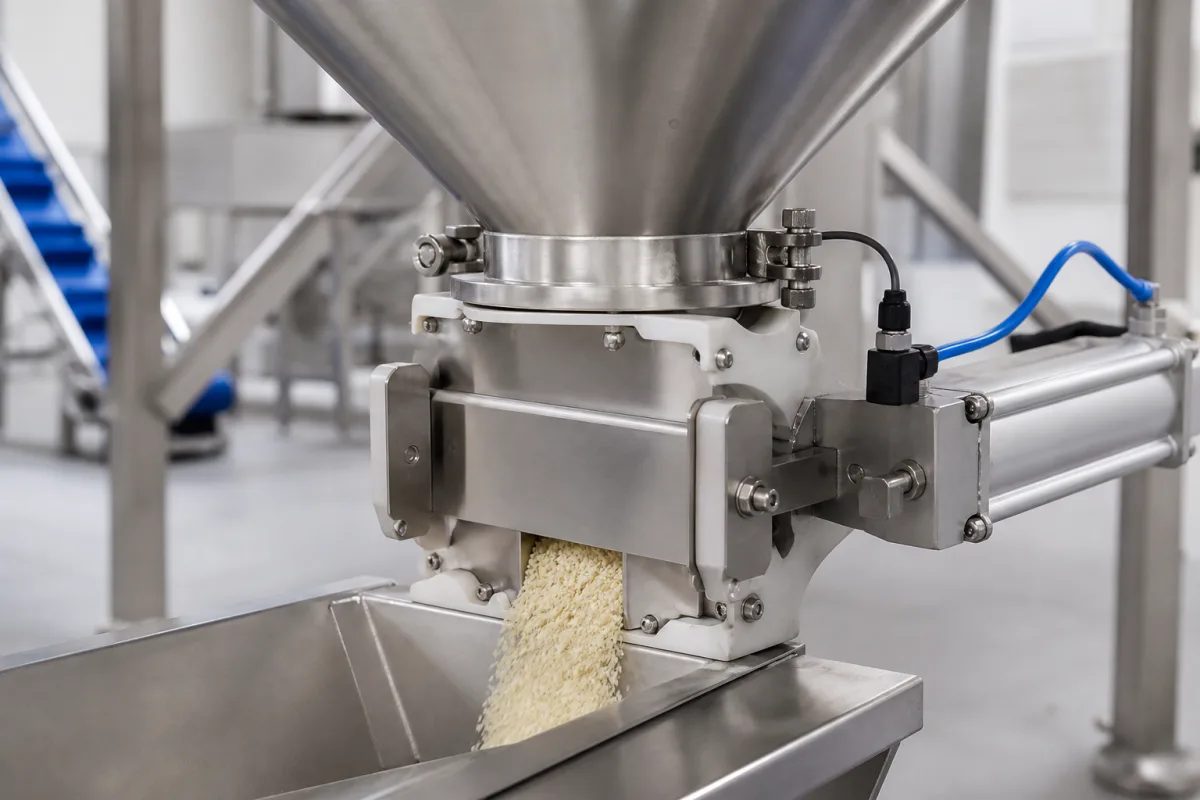
Hopper discharge gate (pneumatic slide gate for food-ingredient hoppers)
Pneumatic slide gate at a food-ingredient hopper outlet · seal and roller materials in the product path, cylinder stroke, air and closing time, partial opening for weigh batching, food-contact rules for rubber seals
A hopper discharge gate is a flat blade that a pneumatic cylinder slides across the outlet of a hopper, bin or chute to start, stop or throttle the gravity flow of a dry ingredient into a weigh hopper, mixer or conveyor. In food plants the gate sits in the product path, so its seals, rollers and frame are food-contact parts that must be cleaned and must not shed metal or rubber into the product. Settle three things first: which materials touch the product and whether the rubber parts meet food-contact rules, what stroke, air supply and closing time the actuator needs, and whether the gate only opens and shuts or must also hold intermediate positions to meter into a weigh hopper.
Pneumatically or manually actuated slide gates (flat-blade discharge gates) at the outlets of food-ingredient hoppers, bins and chutes in gravity flow: product-contact materials, seals and rollers, actuation, positioning and food-contact compliance. Hoppers, bins and silos themselves are covered on the Bulk storage hopper (bins and silos) page; the choice among butterfly valves, rotary airlocks and rotary dosing valves on the Powder hopper valve page; wafer knife gate valves for slurry on the Knife gate valve page. Flood-control gates for dams and spillways are outside this page.
CNFX editorial research · Sources checked October 12, 2026 · 3 sources
What touches the ingredient: blade, seals, rollers and frame materials
Vortex's Quantum Roller Gate lists 304 or 316L stainless steel for the material-contact parts and a body of 6061-T6 aluminium or 304/316L stainless; bonnet and side seals in nylon, PET, 25% glass-filled PTFE or felt, live-loaded by silicone rubber; rollers in PET, glass-filled PTFE, hardened or stainless steel and bronze; and end seals in UHMW-PE, polyurethane, PET or glass-filled PTFE. It is rated 80 °C as standard and up to 205 °C with modifications, and lists FDA among its compliance options. [1]
Vortex argues that slide gates in which metal slides on metal gall, seize and can shed metal fragments into the product, and that open cavities let material wedge and spoil; its hard-polymer seals avoid metal-on-metal contact and the blade wipes its side seals on each closing stroke. [1] NORO's stainless (1.4301) outlet gates use a silicone sealing strip of 60 ± 5 Shore A, while its powder-coated carbon-steel version uses white felt, and the stainless surface is shot-blasted to Ra 1.3 µm. [2]
For rubber seals that touch food repeatedly, 21 CFR 177.2600 limits total extractives in distilled water at reflux to 20 mg per square inch in the first 7 hours and 1 mg/in² in the next 2 hours; for fatty foods, extraction in n-hexane may yield at most 175 mg/in² and then 4 mg/in². [3] Editorial calculation: 20 mg/in² ÷ 6.4516 cm²/in² ≈ 3.1 mg/cm². Ask which compound each rubber part is made of and for its compliance statement; a gate listed as FDA-compliant may still need the fatty-food test if it handles fat-containing powders.
Give the supplier the ingredient (name, particle size, bulk density, fat content, stickiness), the temperature, the cleaning method (dry, wet wash-down, caustic), and the materials you require for blade, frame, seals and rollers.
02
Cylinder stroke, 5 bar air and under 3 seconds per stroke
NORO's pneumatically operated outlet gates for trough chain conveyors use a double-acting Festo DSBC cylinder with a 63 mm piston at 5 bar: 250 mm stroke and 8.76 L of air per double stroke for DN 150–175, 300 mm and 10.5 L for DN 200, 320 mm and 11.2 L for DN 250, and 400 mm and 14.0 L for DN 300, each with an actuation time under 3 seconds per stroke. A 24 V DC monostable 5/2-way solenoid valve rated IP65 switches the cylinder. [2]
Editorial calculation: a DN 300 gate cycling once a minute uses 60 × 14.0 L = 840 L of air per hour by NORO's per-stroke figure. [2] The gate is longer than its opening because the blade has to travel the full stroke; Vortex's Roller Gate keeps a 75–100 mm overall height and offers dual-cylinder actuators that it says reduce the gate's footprint by 30%. [1]
Vortex recommends a vented ball valve ahead of the air control valve, within arm's reach, to bring the gate to a zero-mechanical state by releasing residual pressure in the air lines feeding the cylinder. Its Roller Gate is for gravity flow only; low-pressure or vacuum service needs the maker's agreement. [1]
03
Holding the blade part-open to meter into a weigh hopper
Vortex notes that a slide gate mounted below a surge hopper may need a variable positioning assembly to meter material into a weigh hopper. Its options are relay control with manual adjustability (VPO/VPC), PLC control with manual adjustability (AVP) and infinite positioning from a 4–20 mA signal (IVP), with magnetic reed, proximity or mechanical limit switches for position confirmation. [1]
Editorial note: a two-speed fill (fully open until the batch nears its target weight, then part-open for the dribble feed) needs a positioner and a gate that seals reliably at the final close; ask the supplier which positioning option suits your batch size, scale resolution and cycle time.
Vortex's selection checklist asks whether the gate will close on a standing or flowing column of material, how often it cycles, whether actuation speed matters, and whether flow aids such as aeration or vibration run before or during opening. [1]
04
Signs of seal wear and in-line seal replacement
On the Vortex Roller Gate, material collecting in the bonnet indicates that the bonnet seals have partly worn, and material leaking past the closed blade indicates worn side seals. Bonnet seals can be pushed out and replaced through side access slots with the gate in line, and the cam-adjustable rollers can lift the blade back against the side seals to restore the seal before the side seals need replacing. [1]
NORO advises insulating the manual control or drive on site against heat conduction when product temperature exceeds 50 °C. [2] Under 21 CFR 177.2600, rubber articles for repeated food contact must be thoroughly cleaned before first use. [3]
05
Send the ingredient, the outlet and the control duty
Paste it into your enquiry below or into an email to a maker, then replace every bracket.
Ingredient: [name; particle size; bulk density; fat content; sticky or abrasive]
Outlet: [square, rectangular or round; size; flange or bolt pattern; space available]
Service: [gravity, low pressure or vacuum; temperature]
Cleaning: [dry or wet wash-down; agents]
Materials: [blade and contact parts; seals; rollers; compliance statements]
Drive: [air pressure; solenoid voltage; closing time; manual option]
Control: [open/close only or positioning; 4–20 mA; position switches]
ATEX: [zone inside and outside the gate]
Explore company information and manufacturing capabilities, then discuss the scope of your project with a relevant supplier.
Share this page
Compiled and source-reviewed by the CNFX editorial team.
Each manufacturer above links to the page on that company's own website where the product is listed, with the date we checked it. How we source and review
· Page last updated 13 October 2026
Buyer questions
What seal materials do food slide gates use?
Vortex lists nylon, PET, 25% glass-filled PTFE or felt seals backed by silicone rubber; NORO uses 60 Shore A silicone strips on its stainless gates. [1][2]
How fast does a pneumatic discharge gate close?
NORO gives under 3 seconds per stroke for its DN 150–300 outlet gates with a 63 mm cylinder at 5 bar. [2]
Can a slide gate meter ingredients into a weigh hopper?
Yes with a positioning assembly; Vortex offers relay, PLC and 4–20 mA infinite positioning options for this. [1]
Sources and what still needs a direct check
Sources checked 2026-10-12. Vortex and NORO describe their own gates (the Vortex brochure is hosted by its distributor SYCSA); the NORO data are for outlet gates on trough chain conveyors, used here for actuator and seal data. The food-contact limits come from the US FDA regulation in the eCFR.