Industry-Verified Manufacturing Data (2026)

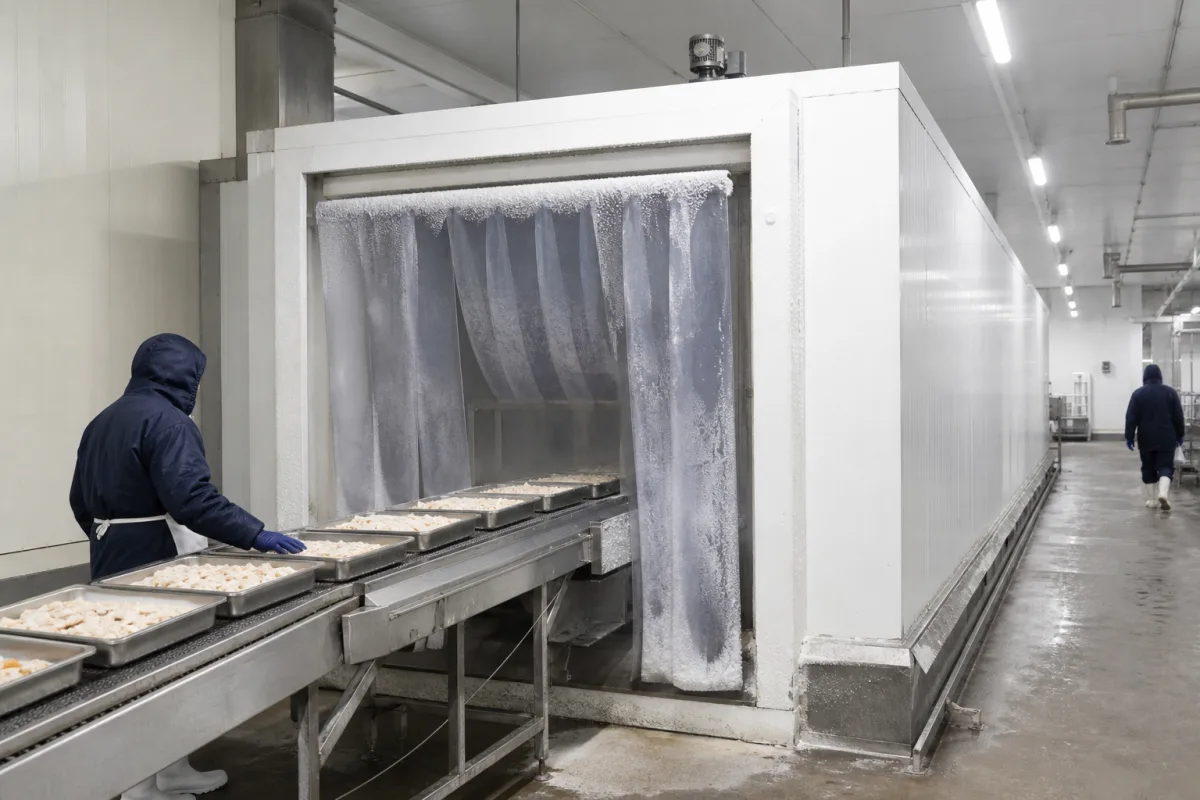
Insulated Freezing Tunnel

Based on aggregated insights from multiple verified factory profiles within the CNFX directory, the standard Insulated Freezing Tunnel used in the Food Manufacturing sector typically supports operational capacities ranging from standard industrial configurations to heavy-duty production requirements.

Technical Definition & Core Assembly

A canonical Insulated Freezing Tunnel is characterized by the integration of Insulated Wall Panels and Access Doors. In industrial production environments, manufacturers listed on CNFX commonly emphasize Stainless steel (inner lining) construction to support stable, high-cycle operation across diverse manufacturing scenarios.

The insulated enclosure that houses the cryogenic freezing process within an automated fish freezing system.
Product Specifications

Technical details and manufacturing context for Insulated Freezing Tunnel

Definition
A critical component of the Automated Cryogenic Fish Freezing Tunnel System, the Insulated Freezing Tunnel is a thermally insulated enclosure designed to maintain extremely low temperatures required for rapid cryogenic freezing of fish products. It provides a controlled environment where fish are exposed to cryogenic gases (typically liquid nitrogen or carbon dioxide) while being transported on a conveyor system, ensuring uniform freezing and preservation of product quality.
Working Principle
The tunnel utilizes high-performance insulation materials to minimize thermal transfer between the internal cryogenic environment and the external surroundings. As fish enter the tunnel on a conveyor, they are exposed to cryogenic gases that rapidly extract heat through direct contact and convection. The insulated walls maintain the low temperature gradient, allowing for efficient freezing with minimal energy loss.
Common Materials
Stainless steel (inner lining), Polyurethane foam insulation, Galvanized steel (outer casing)
Technical Parameters
  • Tunnel wall thickness including insulation layers (mm) Per Request
Components / BOM
  • Insulated Wall Panels
    Form the primary thermal barrier of the tunnel structure
    Material: Stainless steel with polyurethane core
  • Access Doors
    Provide entry points for maintenance and inspection while maintaining thermal integrity
    Material: Insulated stainless steel
  • Observation Windows
    Allow visual monitoring of the freezing process without thermal compromise
    Material: Multi-layer insulated glass
  • Sealing Gaskets
    Ensure airtight seals at panel joints and access points to prevent thermal leakage
    Material: Silicone rubber
Engineering Reasoning
-50°C to -196°C (cryogenic LN2 range), 0.1-1.5 bar internal pressure differential
Insulation thermal conductivity exceeds 0.025 W/m·K, internal temperature rises above -30°C for >30 minutes
Design Rationale: Thermal bridging through insulation gaps causes heat ingress exceeding 500 W/m², violating phase-change thermodynamics of fish tissue crystallization
Risk Mitigation (FMEA)
Trigger Polyurethane foam insulation degradation from moisture absorption (0.5% weight gain)
Mode: Thermal conductivity increases from 0.022 to 0.035 W/m·K, causing 15°C temperature rise in freezing zone
Strategy: Vacuum-sealed multilayer insulation with aluminum foil barriers (0.018 W/m·K guaranteed)
Trigger Door seal compression loss at -60°C (EPDM rubber glass transition temperature)
Mode: Air infiltration rate exceeds 5 m³/hr, forming 2 cm frost layer on evaporator coils
Strategy: Dual silicone-graphite seals with pneumatic actuators maintaining 2.5 N/mm sealing pressure

Industry Taxonomies & Aliases

Commonly used trade names and technical identifiers for Insulated Freezing Tunnel.

Industrial Ecosystem & Supply Chain DNA

Complementary Systems
Downstream Applications
Specialized Tooling

Application Fit & Sizing Matrix

Operational Limits
pressure: Atmospheric to 0.5 bar gauge (positive pressure for inert gas purge)
other spec: Slurry concentration: 10-40% solids by weight, Flow rate: 0.5-5 m/s belt velocity
temperature: -196°C to -40°C (LN2 or CO2 cryogenic range)
Media Compatibility
✓ Marine water with salt content up to 3.5% ✓ Food-grade stainless steel (316L) contact surfaces ✓ Polyurethane foam insulation with vapor barrier
Unsuitable: Chlorinated water or high-acid environments (pH <4.0)
Sizing Data Required
  • Maximum product throughput (kg/hour)
  • Initial product temperature and target core temperature
  • Available floor space and ceiling height constraints

Reliability & Engineering Risk Analysis

Failure Mode & Root Cause
Insulation Degradation
Cause: Thermal cycling and moisture ingress leading to reduced thermal efficiency, increased energy consumption, and potential ice formation on external surfaces.
Compressor System Failure
Cause: Refrigerant contamination, oil breakdown, or mechanical wear in the refrigeration circuit due to improper maintenance, leading to loss of cooling capacity.
Maintenance Indicators
  • Unusual increase in energy consumption or extended freezing times
  • Audible compressor strain, excessive vibration, or frost accumulation on non-insulated surfaces
Engineering Tips
  • Implement regular thermal imaging inspections to detect insulation gaps and moisture ingress early
  • Establish a preventive maintenance schedule for refrigerant purity analysis and compressor lubrication system checks

Compliance & Manufacturing Standards

Reference Standards
ISO 23953-2: Refrigerated display cabinets - Part 2: Classification, requirements and test conditions ANSI/ASHRAE 15: Safety Standard for Refrigeration Systems EN 378: Refrigerating systems and heat pumps - Safety and environmental requirements (CE marking basis)
Manufacturing Precision
  • Insulation thickness: +/- 5% of specified dimension
  • Temperature uniformity: +/- 1.5°C across tunnel length
Quality Inspection
  • Leak testing of refrigerant circuits (pressure decay or bubble test)
  • Thermal performance verification (temperature mapping test)

Factories Producing Insulated Freezing Tunnel

Verified manufacturers with capability to produce this product in China

✓ 95% Supplier Capability Match Found

P Project Engineer from Brazil Feb 06, 2026
★★★★★
"Standard OEM quality for Food Manufacturing applications. The Insulated Freezing Tunnel arrived with full certification."
Technical Specifications Verified
S Sourcing Manager from Canada Feb 03, 2026
★★★★★
"Great transparency on the Insulated Freezing Tunnel components. Essential for our Food Manufacturing supply chain."
Technical Specifications Verified
P Procurement Specialist from United States Jan 31, 2026
★★★★★
"The Insulated Freezing Tunnel we sourced perfectly fits our Food Manufacturing production line requirements."
Technical Specifications Verified
Verification Protocol

“Feedback is collected from verified sourcing managers during RFQ (Request for Quote) and factory evaluation processes on CNFX. These reports represent historical performance data and technical audit summaries from our B2B manufacturing network.”

16 sourcing managers are analyzing this specification now. Last inquiry for Insulated Freezing Tunnel from UAE (26m ago).

Supply Chain Compatible Machinery & Devices

Automated Food Moisture Analyzer

Automated system for precise moisture content measurement in food products

Explore Specs →
Automated Food Color Consistency Analyzer

Automated inline system for real-time color measurement and consistency control in food processing.

Explore Specs →
Control Panel

A centralized interface for monitoring and controlling industrial equipment and processes

Explore Specs →
Industrial Vacuum Tumbler

Industrial machine for massaging and marinating meat under vacuum to enhance texture and flavor.

Explore Specs →

Frequently Asked Questions

What materials are used in the insulated freezing tunnel construction?

The tunnel features a stainless steel inner lining for hygiene, polyurethane foam insulation for thermal efficiency, and galvanized steel outer casing for durability and corrosion resistance.

How does the insulated freezing tunnel integrate with automated fish freezing systems?

The tunnel serves as the insulated enclosure housing the cryogenic freezing process, designed with access doors, observation windows, and sealing gaskets to maintain temperature integrity within automated production lines.

What are the key components included in the freezing tunnel BOM?

The bill of materials includes insulated wall panels, access doors for maintenance, observation windows for process monitoring, and sealing gaskets to ensure thermal efficiency and prevent cold loss.

Can I contact factories directly on CNFX?

CNFX is an open directory, not a transaction platform. Each factory profile provides direct contact information and production details to help you initiate direct inquiries with Chinese suppliers.

Get Quote for Insulated Freezing Tunnel

Request technical pricing, lead times, or customized specifications for Insulated Freezing Tunnel directly from verified manufacturing units.

Your business information is encrypted and only shared with verified Insulated Freezing Tunnel suppliers.

Thank you! Your message has been sent. We'll respond within 1–3 business days.

Need to Manufacture Insulated Freezing Tunnel?

Connect with verified factories specializing in this product category

Add Your Factory Contact Us
Previous Product
Inspection Sensor Array
Next Product
Integrated Aseptic Fruit and Vegetable Processing Line