Industry-Verified Manufacturing Data (2026)

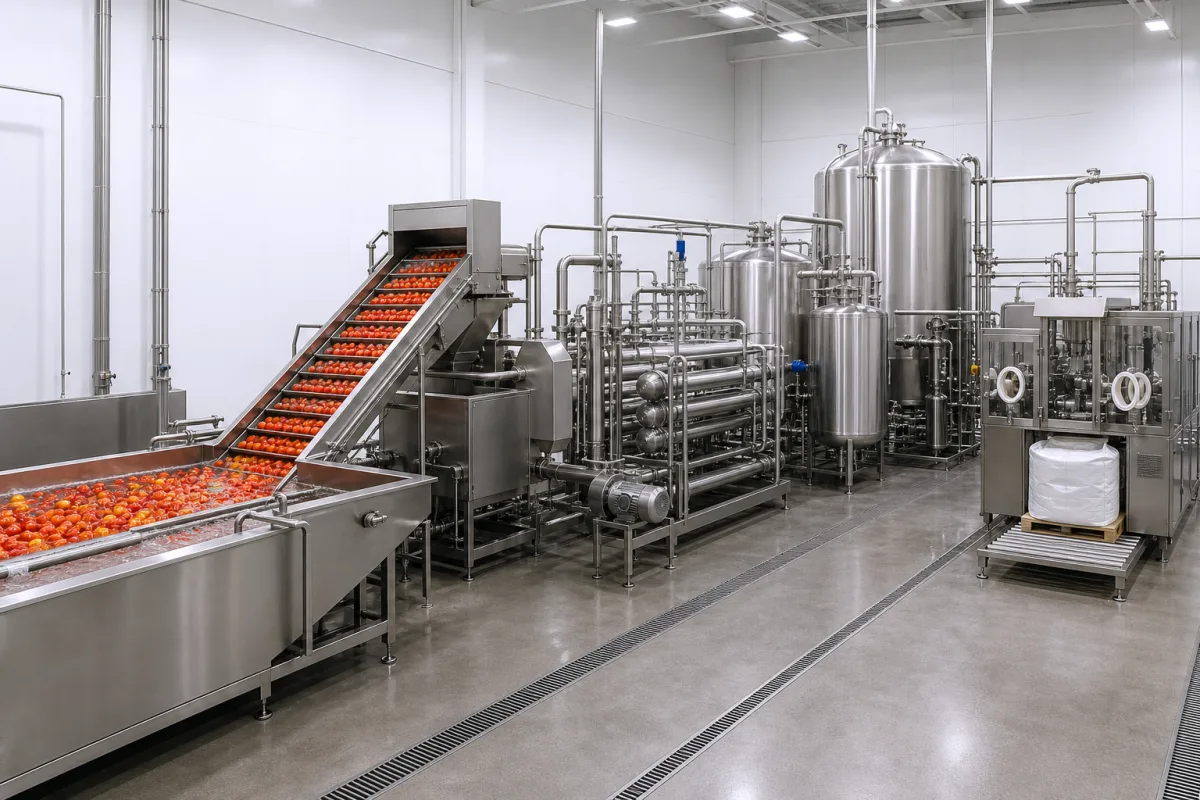
Integrated Aseptic Fruit and Vegetable Processing Line

Based on aggregated insights from multiple verified factory profiles within the CNFX directory, the standard Integrated Aseptic Fruit and Vegetable Processing Line used in the Food Manufacturing sector typically supports operational capacities ranging from standard industrial configurations to heavy-duty production requirements.

Technical Definition & Core Assembly

A canonical Integrated Aseptic Fruit and Vegetable Processing Line is characterized by the integration of Aseptic Surge Tank and Tubular Heat Exchanger. In industrial production environments, manufacturers listed on CNFX commonly emphasize Stainless Steel (AISI 316L) construction to support stable, high-cycle operation across diverse manufacturing scenarios.

Complete industrial system for sterile processing, filling, and packaging of fruit and vegetable products.
Product Specifications

Technical details and manufacturing context for Integrated Aseptic Fruit and Vegetable Processing Line

Definition
A coordinated multi-module industrial solution designed for the continuous, high-volume processing of fruit and vegetable purees, juices, and diced products under aseptic conditions. It integrates washing, sorting, thermal treatment, homogenization, aseptic filling, and final packaging into a single, automated production line. This system is critical for B2B supply chains, enabling manufacturers to produce shelf-stable products with extended preservation, minimal nutrient degradation, and reduced need for refrigeration during distribution. It serves large-scale food processors supplying retail, food service, and industrial ingredient markets.
Working Principle
Raw produce is cleaned and sorted, then thermally processed (e.g., via tubular or plate heat exchangers) to sterilize the product. It is then cooled and transferred under sterile, pressurized conditions to aseptic surge tanks. Finally, the product is filled into pre-sterilized containers (bags-in-box, pouches, or cans) within a sterile chamber before being hermetically sealed.
Common Materials
Stainless Steel (AISI 316L), Food-Grade Elastomers, High-Temperature Plastics
Technical Parameters
  • Nominal system throughput capacity (liters/hour) Standard Spec
  • Product hold time at sterilization temperature (seconds) Standard Spec
Components / BOM
  • Aseptic Surge Tank
    Holds sterilized product under sterile, pressurized conditions before filling
    Material: Stainless Steel (AISI 316L)
  • Tubular Heat Exchanger
    Raises product to sterilization temperature and then cools it rapidly
    Material: Stainless Steel (AISI 316L)
  • Aseptic Filling Valve
    Dispenses sterile product into pre-sterilized containers within a sterile chamber
    Material: Stainless Steel with food-grade seals
  • CIP (Clean-in-Place) System
    Automated cleaning and sterilization circuit for the entire product contact path
    Material: Stainless Steel piping and pumps
  • Programmable Logic Controller (PLC)
    Central control unit for automating and monitoring all line processes
    Material: Industrial electronics enclosure
Engineering Reasoning
0.5-6.0 bar (sterilization steam pressure), 70-95°C (processing temperature), 0.1-0.5 m/s (conveyor speed)
Sterilization pressure below 0.3 bar for >30 seconds, temperature below 70°C for >60 seconds, HEPA filter differential pressure exceeding 250 Pa
Design Rationale: Microbial survival due to insufficient thermal lethality (D-value >30s at 70°C for common pathogens), laminar airflow disruption from filter clogging causing particle contamination
Risk Mitigation (FMEA)
Trigger Steam trap failure causing condensate accumulation
Mode: Incomplete sterilization with surviving microorganisms (≥10 CFU/100ml)
Strategy: Dual redundant steam traps with differential pressure monitoring and automatic bypass
Trigger Servo motor encoder feedback loss during aseptic filling
Mode: Volume deviation exceeding ±2% specification with container overfill/underfill
Strategy: Triple-redundant absolute encoders with majority voting logic and mechanical hard stops

Industry Taxonomies & Aliases

Commonly used trade names and technical identifiers for Integrated Aseptic Fruit and Vegetable Processing Line.

Industrial Ecosystem & Supply Chain DNA

Complementary Systems
Downstream Applications
Specialized Tooling

Application Fit & Sizing Matrix

Operational Limits
pressure: 0-6 bar (operating), up to 10 bar for CIP/SIP
flow rate: 2,000-20,000 L/hr (configurable)
temperature: 20-130°C (sterilization at 121°C typical)
sterility class: Class A/B environment for filling zone
slurry concentration: Up to 40% solids by weight
Media Compatibility
✓ fruit purees (e.g., apple, mango) ✓ vegetable sauces (e.g., tomato, carrot) ✓ chunky vegetable mixtures (e.g., salsa, ratatouille)
Unsuitable: highly abrasive or corrosive media (e.g., citrus juices with pulp >40%, acidic brines with pH <3.5)
Sizing Data Required
  • Required production capacity (kg/hr or L/hr)
  • Product viscosity and particle size distribution
  • Packaging format and container size (e.g., pouches, bottles, aseptic bags)

Reliability & Engineering Risk Analysis

Failure Mode & Root Cause
Corrosion and pitting in stainless steel components
Cause: Exposure to acidic fruit/vegetable juices, chlorine-based sanitizers, and high humidity environments leading to localized breakdown of passive oxide layer
Seal and gasket degradation in aseptic zones
Cause: Thermal cycling from sterilization processes (CIP/SIP), chemical attack from cleaning agents, and mechanical stress from pressure fluctuations compromising barrier integrity
Maintenance Indicators
  • Visible product residue buildup or discoloration on normally clean surfaces indicating inadequate cleaning or seal failure
  • Audible hissing or pressure drop alarms in sterile zones suggesting compromised air barriers or leak paths
Engineering Tips
  • Implement routine eddy current testing on critical stainless steel surfaces to detect early-stage pitting before through-wall penetration occurs
  • Establish predictive maintenance program using vibration analysis on rotary equipment and thermal imaging on heat exchangers to identify degradation before catastrophic failure

Compliance & Manufacturing Standards

Reference Standards
ISO 22000:2018 - Food safety management systems ANSI/NSF 2-2020 - Food equipment DIN EN 1672-2:2020 - Food processing machinery - Safety and hygiene requirements
Manufacturing Precision
  • Conveyor alignment: +/-0.5mm over 10m length
  • Sealing surface flatness: 0.1mm maximum deviation
Quality Inspection
  • Microbiological surface swab testing for aseptic validation
  • Pressure decay leak testing of sterile barrier systems

Factories Producing Integrated Aseptic Fruit and Vegetable Processing Line

Verified manufacturers with capability to produce this product in China

✓ 98% Supplier Capability Match Found

T Technical Director from Singapore Feb 19, 2026
★★★★★
"Impressive build quality. Especially the Throughput Capacity (liters/hour) is very stable during long-term operation."
Technical Specifications Verified
P Project Engineer from Germany Feb 16, 2026
★★★★☆
"As a professional in the Food Manufacturing sector, I confirm this Integrated Aseptic Fruit and Vegetable Processing Line meets all ISO standards. (Delivery took slightly longer than expected, but technical support was excellent.)"
Technical Specifications Verified
S Sourcing Manager from Brazil Feb 13, 2026
★★★★★
"Standard OEM quality for Food Manufacturing applications. The Integrated Aseptic Fruit and Vegetable Processing Line arrived with full certification."
Technical Specifications Verified
Verification Protocol

“Feedback is collected from verified sourcing managers during RFQ (Request for Quote) and factory evaluation processes on CNFX. These reports represent historical performance data and technical audit summaries from our B2B manufacturing network.”

19 sourcing managers are analyzing this specification now. Last inquiry for Integrated Aseptic Fruit and Vegetable Processing Line from Poland (1h ago).

Supply Chain Commonly Integrated Components

Temperature Control Module

A precision electronic component that regulates and maintains optimal temperature conditions within fermentation vessels.

Explore Specs →
Pressure Regulation Unit

A specialized component within fermentation systems that maintains precise pressure levels during microbial growth processes.

Explore Specs →
Sensor Array Network

A network of multiple sensors distributed throughout a fermentation system to monitor and collect real-time data on critical parameters.

Explore Specs →
Agitation System

A mechanical subsystem within an automated fermentation control system designed to mix and homogenize fermentation media through controlled agitation.

Explore Specs →

Frequently Asked Questions

What materials are used in this aseptic processing line to ensure food safety?

The line is constructed with AISI 316L stainless steel for corrosion resistance, food-grade elastomers for seals, and high-temperature plastics for components requiring thermal stability, all meeting food safety standards.

How does the CIP system maintain hygiene in this processing line?

The integrated Clean-in-Place system automates cleaning and sterilization without disassembly, using validated cycles to eliminate microbial contamination between production runs, ensuring consistent hygiene.

What is the typical throughput capacity for this aseptic fruit and vegetable processing line?

The line is designed for high-volume production with throughput capacities measured in liters per hour, scalable to meet industrial demands while maintaining aseptic integrity throughout processing.

Can I contact factories directly on CNFX?

CNFX is an open directory, not a transaction platform. Each factory profile provides direct contact information and production details to help you initiate direct inquiries with Chinese suppliers.

Get Quote for Integrated Aseptic Fruit and Vegetable Processing Line

Request technical pricing, lead times, or customized specifications for Integrated Aseptic Fruit and Vegetable Processing Line directly from verified manufacturing units.

Your business information is encrypted and only shared with verified Integrated Aseptic Fruit and Vegetable Processing Line suppliers.

Thank you! Your message has been sent. We'll respond within 1–3 business days.

Need to Manufacture Integrated Aseptic Fruit and Vegetable Processing Line?

Connect with verified factories specializing in this product category

Add Your Factory Contact Us
Previous Product
Insulated Freezing Tunnel
Next Product
Intelligent Food Grade Metal Detector