Industry-Verified Manufacturing Data (2026)

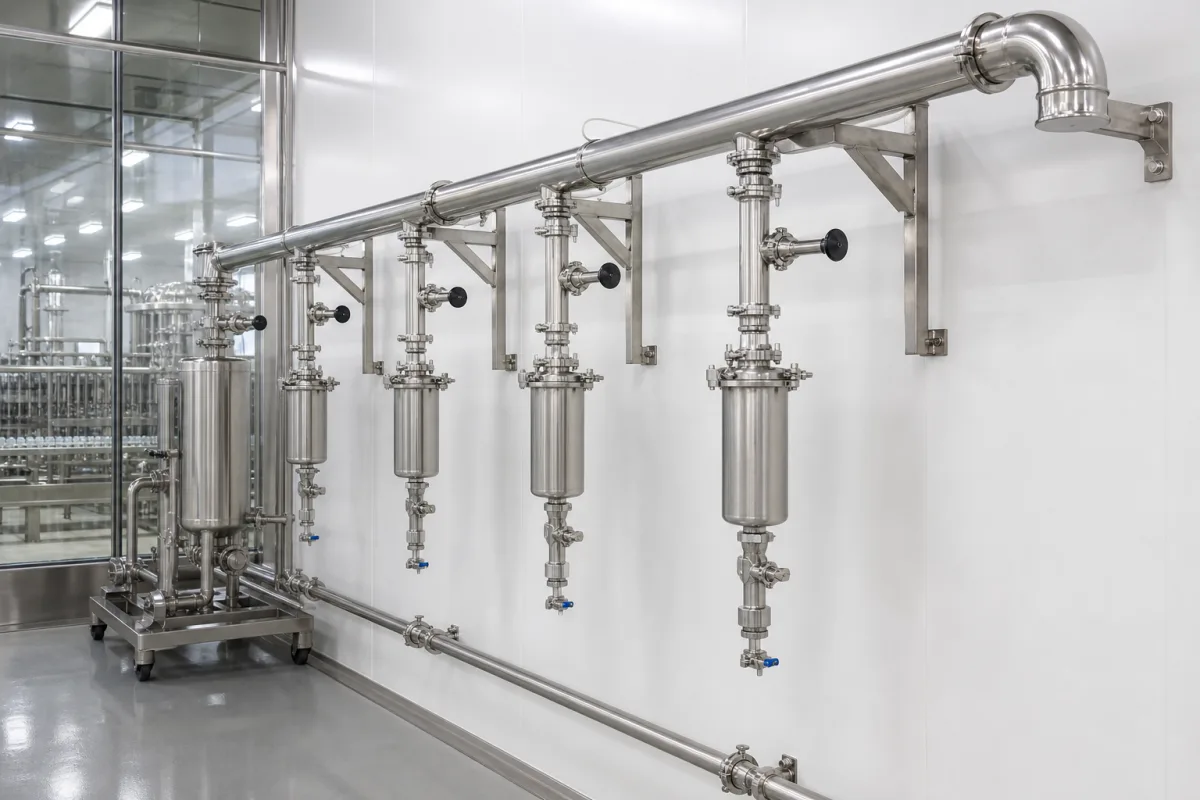
Sterile Air Distribution Piping

Based on aggregated insights from multiple verified factory profiles within the CNFX directory, the standard Sterile Air Distribution Piping used in the Food Manufacturing sector typically supports operational capacities ranging from standard industrial configurations to heavy-duty production requirements.

Technical Definition & Core Assembly

A canonical Sterile Air Distribution Piping is characterized by the integration of Sanitary Fittings and Pressure Relief Valves. In industrial production environments, manufacturers listed on CNFX commonly emphasize Stainless Steel 316L construction to support stable, high-cycle operation across diverse manufacturing scenarios.

Piping system that transports sterile air from generation units to point-of-use locations while maintaining sterility.
Product Specifications

Technical details and manufacturing context for Sterile Air Distribution Piping

Definition
A critical component of Sterile Air Generation Systems that distributes filtered, sterile air through a network of pipes to various process points in manufacturing environments. It ensures contamination-free air delivery by maintaining positive pressure, preventing backflow, and using materials that resist microbial growth and particle shedding.
Working Principle
Sterile air flows from generation units (filters, compressors) through sealed piping under controlled pressure. The system maintains sterility through smooth interior surfaces, proper slope for drainage, sanitary connections, and regular sterilization cycles (SIP/CIP). Positive pressure prevents ingress of contaminants.
Common Materials
Stainless Steel 316L, Electropolished Stainless Steel, Sanitary-grade plastics
Technical Parameters
  • Pipe diameter (typically 25-150mm), wall thickness, and surface roughness (Ra ≤ 0.8μm) (mm) Per Request
Components / BOM
  • Sanitary Fittings
    Connect pipe sections with smooth, crevice-free joints
    Material: Stainless Steel 316L
  • Pressure Relief Valves
    Prevent overpressure and maintain system safety
    Material: Stainless Steel
  • Condensate Traps
    Remove moisture from air stream to prevent contamination
    Material: Stainless Steel
  • Sampling Ports
    Allow periodic testing of air quality without compromising sterility
    Material: Stainless Steel
Engineering Reasoning
0.5-7.0 bar
8.3 bar (120 psi) at 20°C for 316L stainless steel with 1.5 mm wall thickness
Design Rationale: Yield strength exceedance of 316L stainless steel (205 MPa at 20°C) leading to plastic deformation and potential rupture
Risk Mitigation (FMEA)
Trigger Condensate accumulation due to dew point temperature drop below 2°C
Mode: Biofilm formation and microbial contamination exceeding 1 CFU/100L
Strategy: Steam-in-place (SIP) system with 121°C steam for 30 minutes at all low points
Trigger Electrochemical corrosion at welds due to chloride concentration exceeding 25 ppm
Mode: Pinhole leaks causing pressure drop below 0.3 bar at point-of-use
Strategy: Orbital welding with argon purge maintaining oxygen levels below 10 ppm during welding

Industry Taxonomies & Aliases

Commonly used trade names and technical identifiers for Sterile Air Distribution Piping.

Applied To / Applications

This component is essential for the following industrial systems and equipment:

Industrial Ecosystem & Supply Chain DNA

Complementary Systems
Downstream Applications
Specialized Tooling

Application Fit & Sizing Matrix

Operational Limits
pressure: Up to 10 bar (150 psi)
flow rate: 0.5 to 50 m³/min
temperature: -20°C to 120°C
sterility class: ISO Class 5 or better maintained
Media Compatibility
✓ Pharmaceutical grade compressed air ✓ Nitrogen for blanketing ✓ Process gases in biotech fermentation
Unsuitable: Corrosive chemical slurries or abrasive particulate media
Sizing Data Required
  • Required volumetric flow rate (SCFM or Nm³/h)
  • Maximum allowable pressure drop across system
  • Total equivalent length of piping runs including fittings

Reliability & Engineering Risk Analysis

Failure Mode & Root Cause
Corrosion-induced pinhole leaks
Cause: Moisture condensation in the air stream due to inadequate drying or temperature fluctuations, leading to internal corrosion of stainless steel or carbon steel piping, especially at welds or joints where protective passivation layers may be compromised.
Contamination from biofilm or particulate accumulation
Cause: Insufficient filtration (e.g., failing HEPA filters), low air velocity allowing stagnation, or improper sanitization procedures, resulting in microbial growth or debris buildup that compromises sterility and can clog or corrode piping.
Maintenance Indicators
  • Visible moisture droplets or rust stains at pipe joints, valves, or supports indicating condensation or leaks.
  • Audible hissing or whistling sounds from the piping system, suggesting air leaks or pressure irregularities that could introduce contaminants.
Engineering Tips
  • Implement rigorous moisture control: Ensure compressed air dryers (e.g., desiccant or refrigerated types) are maintained and monitored for dew point, and install condensate drains at low points in the piping with regular inspection schedules.
  • Adopt proactive sanitization and monitoring: Use clean-in-place (CIP) or steam-in-place (SIP) protocols validated for sterility, and install pressure and airflow sensors with alarms to detect deviations that signal contamination risks or flow issues.

Compliance & Manufacturing Standards

Reference Standards
ISO 14644-1:2015 (Cleanrooms and associated controlled environments) ASME BPE-2022 (Bioprocessing Equipment) DIN EN ISO 13408-1:2015 (Aseptic processing of health care products)
Manufacturing Precision
  • Bore diameter: +/-0.02mm
  • Surface roughness (Ra): ≤0.4μm
Quality Inspection
  • Helium Leak Test (ASTM E499/E499M)
  • Particle Count Test (ISO 14644-1)

Factories Producing Sterile Air Distribution Piping

Verified manufacturers with capability to produce this product in China

✓ 97% Supplier Capability Match Found

P Procurement Specialist from Canada Feb 24, 2026
★★★★★
"Found 15+ suppliers for Sterile Air Distribution Piping on CNFX, but this spec remains the most cost-effective."
Technical Specifications Verified
T Technical Director from United States Feb 21, 2026
★★★★★
"The technical documentation for this Sterile Air Distribution Piping is very thorough, especially regarding technical reliability."
Technical Specifications Verified
P Project Engineer from United Arab Emirates Feb 18, 2026
★★★★★
"Reliable performance in harsh Food Manufacturing environments. No issues with the Sterile Air Distribution Piping so far."
Technical Specifications Verified
Verification Protocol

“Feedback is collected from verified sourcing managers during RFQ (Request for Quote) and factory evaluation processes on CNFX. These reports represent historical performance data and technical audit summaries from our B2B manufacturing network.”

16 sourcing managers are analyzing this specification now. Last inquiry for Sterile Air Distribution Piping from Brazil (1h ago).

Supply Chain Compatible Machinery & Devices

Automated Food Moisture Analyzer

Automated system for precise moisture content measurement in food products

Explore Specs →
Automated Food Color Consistency Analyzer

Automated inline system for real-time color measurement and consistency control in food processing.

Explore Specs →
Control Panel

A centralized interface for monitoring and controlling industrial equipment and processes

Explore Specs →
Industrial Vacuum Tumbler

Industrial machine for massaging and marinating meat under vacuum to enhance texture and flavor.

Explore Specs →

Frequently Asked Questions

Why is stainless steel 316L preferred for sterile air piping in food manufacturing?

Stainless steel 316L offers superior corrosion resistance, especially against chlorides and cleaning chemicals, and its smooth surface minimizes microbial adhesion, ensuring long-term sterility in food processing environments.

How do condensate traps maintain sterility in air distribution systems?

Condensate traps automatically remove moisture from sterile air lines, preventing microbial growth and contamination, while maintaining system integrity through sanitary design that avoids dead legs where contaminants could accumulate.

What certifications should sterile air piping have for food manufacturing?

Look for 3-A Sanitary Standards compliance, FDA-approved materials, and EHEDG certification for hygienic design, ensuring the piping meets strict food safety requirements for sterile air distribution.

Can I contact factories directly on CNFX?

CNFX is an open directory, not a transaction platform. Each factory profile provides direct contact information and production details to help you initiate direct inquiries with Chinese suppliers.

Get Quote for Sterile Air Distribution Piping

Request technical pricing, lead times, or customized specifications for Sterile Air Distribution Piping directly from verified manufacturing units.

Your business information is encrypted and only shared with verified Sterile Air Distribution Piping suppliers.

Thank you! Your message has been sent. We'll respond within 1–3 business days.

Need to Manufacture Sterile Air Distribution Piping?

Connect with verified factories specializing in this product category

Add Your Factory Contact Us
Previous Product
Starch Slurry Pressure Control Valve
Next Product
Sterile Air Filter