Editorial Technical Reference

Sterile Air Generation System

This page explains how Sterile Air Generation System is classified within Beverage Manufacturing. Technical values and manufacturer relationships are research references; confirm the current specification and supplier evidence for each order.

Technical Definition & Core Assembly

A system that produces and supplies sterile, particle-free air for aseptic processing environments.

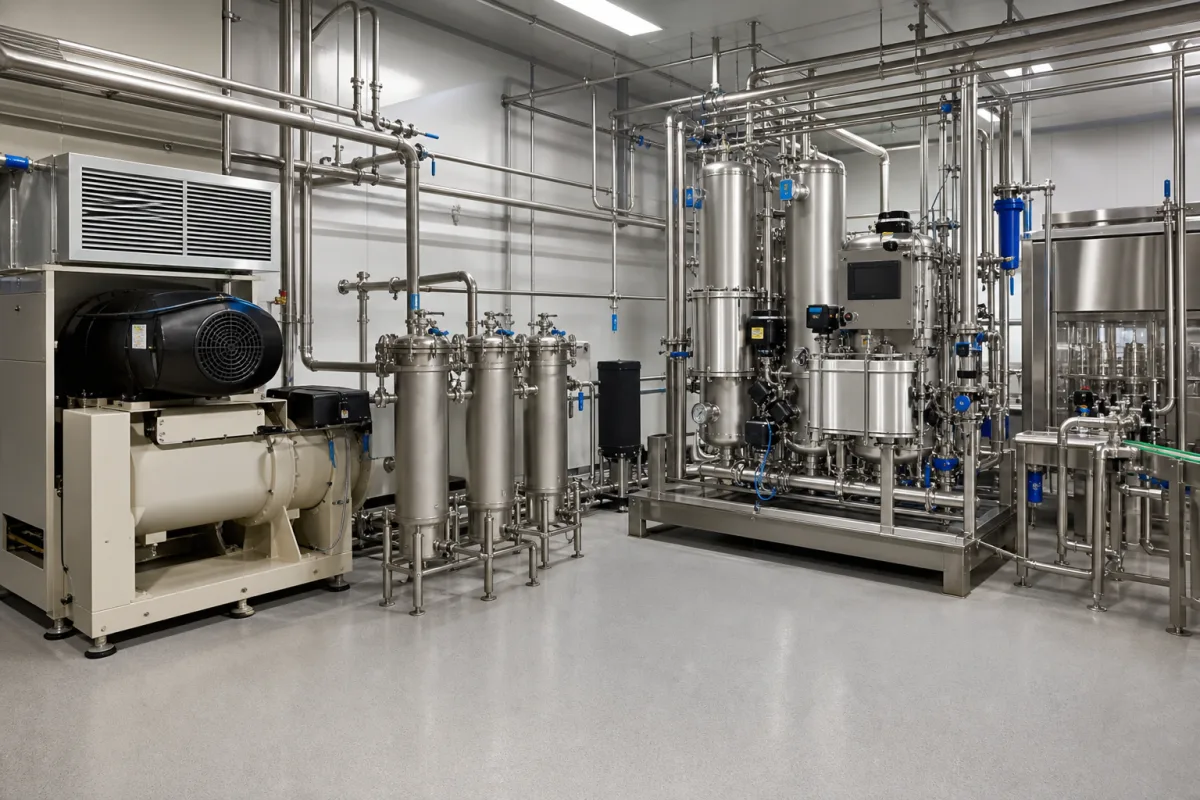
Representative product image. Confirm appearance and specifications with the manufacturer.

Product Specifications

Technical details and manufacturing context for Sterile Air Generation System

Definition
The Sterile Air Generation System is a component within an aseptic cold-fill beverage production line. Its function is to generate, filter, and distribute air that meets stringent sterility requirements for critical zones such as filling and packaging areas. The system ensures that the air introduced into these environments is free from microorganisms and contaminants that could compromise product safety and shelf life. Ambient air is drawn in, compressed, dried, and passed through a series of high-efficiency particulate air (HEPA) or ultra-low penetration air (ULPA) filters. Pre-filters remove coarse particles, coalescing filters eliminate oil and moisture, and final sterile-grade filters provide the required microbial barrier. The system may include heating elements for dry heat sterilization of the filter housing and maintains positive pressure to prevent ingress of non-sterile air. Key parameters to verify with the manufacturer include air flow rate (50–500 Nm³/h), operating pressure (1.0–1.6 MPa), sterility assurance level (SAL 10^-6), particle filtration efficiency (99.99% for particles ≥0.01 μm), microbial retention (10^7 CFU/cm² with Brevundimonas diminuta), operating temperature (10–60 °C), inlet air quality (ISO 8573-1 Class 2), power supply (220–240 V AC, single phase, 50/60 Hz), power consumption (1.5–5.5 kW), noise level (60–75 dB(A) at 1 m), material of wetted parts (SS316L), weight (200–800 kg), dimensions (1200×800×1600 mm), and ingress protection rating (IP54–IP65). These values are reference ranges and must be confirmed for the specific model and application. Standards such as ISO 8573-1, ISO 11137, ISO 8573-4, ASTM F838, IEC 60204-1, ISO 3746, ASTM A240, and IEC 60529 are listed as procurement references. Always verify compliance with the legal manufacturer or supplier.
Working Principle
Ambient air is drawn in, compressed, dried, and passed through a series of high-efficiency particulate air (HEPA) or ultra-low penetration air (ULPA) filters. The system often includes pre-filters for coarse particles, coalescing filters for oil and moisture removal, and final sterile-grade filters. It may incorporate heating elements for dry heat sterilization of the filter housing and maintain positive pressure to prevent ingress of non-sterile air.
Common Materials
Stainless Steel (housing, piping), PTFE (filter media), Silicone (gaskets)
Technical Parameters
ParameterTypical rangeNotes & selection driver
Air Flow Rate50–500 Nm³/hSelect based on required process air volume.ISO 8573-1
Sterility Assurance Level (SAL)10^-6Probability of a non-sterile unit.ISO 11137
Particle Filtration Efficiency99.99 %For particles ≥0.01 μm.ISO 8573-4
Microbial Retention10^7 CFU/cm²Challenge organism Brevundimonas diminuta.ASTM F838
Operating Temperature10–60 °CHigher temperatures may degrade filter media.
Inlet Air QualityISO 8573-1 Class 2Requires pre-filtration for oil and water.ISO 8573-1
Power Supply220–240 V ACSingle phase, 50/60 Hz.IEC 60204-1
Power Consumption1.5–5.5 kWDepends on flow rate and pressure.
Noise Level60–75 dB(A)At 1 m distance.ISO 3746
Material of Wetted PartsSS316LFor corrosion resistance and cleanability.ASTM A240
Weight200–800 kgSkid-mounted unit.
Dimensions (L×W×H)1200×800×1600 mmApproximate footprint.
Ingress Protection RatingIP54–IP65Protection against dust and water jets.IEC 60529

Ranges are indicative industry figures for RFQ preparation, not a supplier commitment. Confirm every value and standard with the legal manufacturer before ordering.

Components / BOM
  • Air Compressor
    Draws in and compresses ambient air to the required pressure
    Material: Cast Iron/Stainless Steel
  • Air Dryer
    Removes moisture from the compressed air to prevent microbial growth and filter damage
    Material: Stainless Steel (housing), Desiccant
  • Pre-Filter
    Removes large particles and contaminants to protect downstream HEPA/ULPA filters
    Material: Synthetic Fiber (media), Plastic/Steel (frame)
  • HEPA/ULPA Filter Housing
    Holds the final sterile-grade filter; may include heating elements for in-situ sterilization
    Material: Stainless Steel 316L
  • Sterile Air Distribution Piping
    Transports the sterile air to critical use points (e.g., filling nozzles, tank headspace)
    Material: Stainless Steel 316L (sanitary tubing)
  • Coalescing Filter
    Strips compressor oil and water aerosol before the air reaches the sterile filter.

Industrial Ecosystem & Supply Chain Structure

Complementary Systems
Downstream Applications
Specialized Tooling

Application Fit & Sizing Matrix

Operational Limits
pressure: Up to 7 bar (100 psi) system pressure, 0.5-1.0 bar differential
flow rate: 10-10,000 m³/h (configurable)
temperature: 10-40°C (operating ambient), 121°C (sterilization cycles)
particle removal: H14 HEPA or ISO Class 5 (≤0.3 μm at 99.995% efficiency)
sterility assurance: SAL ≤10⁻⁶
Media Compatibility
✓ Pharmaceutical cleanrooms (ISO Class 5-8) ✓ Biotech fermentation suites ✓ Medical device assembly areas
Unsuitable: Corrosive or explosive atmospheres (without specialized housing)
Sizing Data Required
  • Required volumetric flow rate (m³/h)
  • Room/zone pressure differential requirements (Pa)
  • Upstream air quality and pretreatment needs

Reliability & Engineering Risk Analysis

Failure Mode & Root Cause
Filter Media Degradation
Cause: Moisture accumulation and microbial growth due to inadequate pre-filtration or improper sterilization cycles, leading to compromised filtration efficiency and potential contamination.
Compressor/Blower Bearing Failure
Cause: Insufficient lubrication or contamination from ambient air particulates, resulting in increased friction, overheating, and eventual mechanical seizure or imbalance.
Maintenance Indicators
  • Audible: Unusual high-pitched whining or grinding noises from the compressor/blower unit, indicating bearing wear or misalignment.
  • Visual: Visible moisture droplets or condensation in downstream air lines or filter housings, suggesting filter saturation or cooling system malfunction.
Engineering Tips
  • Implement a predictive maintenance program using vibration analysis and thermal imaging on rotating components to detect early-stage mechanical wear before catastrophic failure.
  • Install and maintain redundant pre-filters with differential pressure monitoring to ensure optimal moisture and particulate removal, extending HEPA/ULPA filter life and maintaining sterility.

Indicative industry ranges for design and RFQ preparation. Confirm the exact figures and applicable standard with the manufacturer before specifying.

Compliance & Manufacturing Standards

Applicable Standards
ISO 14644-1:2015 Cleanrooms and associated controlled environments ANSI/ASME BPE-2019 Bioprocessing Equipment DIN EN 1822-1:2019 High efficiency air filters (EPA, HEPA and ULPA)

Quoted from the published standard.

Manufacturing Precision
  • Filter housing seal flatness: 0.05mm
  • Particle counter calibration accuracy: +/-5% of reading
Quality Inspection
  • HEPA/ULPA filter integrity testing (DOP/PAO challenge)
  • Sterility validation via microbial air sampling

Manufacturers of Sterile Air Generation System

Manufacturer profiles associated with Sterile Air Generation System.

Sourcing Sterile Air Generation System from China?
Tell us your specification and target quantity — we will match it against manufacturer records and come back with the factories that fit.
Request manufacturers We manufacture this

Manufacturer listings support early research and capability understanding. They are not certification, ranking, or transaction guarantees.

Technical documentation
Request current drawings, revision history, and a signed specification sheet.
Manufacturing capability
Verify equipment lists, process limits, capacity, and representative production evidence.
Inspection readiness
Confirm test methods, calibrated equipment, sampling plans, and traceable reports.
Supplier transparency
Check the legal entity, factory address, ownership, certifications, and direct contacts.

CNFX does not score or rank suppliers. Buyers must verify all claims and documents with the legal manufacturer before ordering.

Supply Chain Compatible Machinery & Devices

Automated Beverage Container Integrity Testing System

Automated system for non-destructive testing of beverage container seals and structural integrity.

Explore Specs →
Automated Beverage Container Pressure Testing System

Automated system for testing beverage container pressure resistance and seal integrity.

Explore Specs →
Automated Beverage Container Leak Detection System

The Automated Beverage Container Leak Detection System is an industrial device designed for integration into bottling or canning lines.

Explore Specs →
Automated Beverage Container Depalletizing Machine

Industrial machine that automatically removes beverage containers from pallets for production line feeding

Explore Specs →

Frequently Asked Questions

What is the purpose of the Sterile Air Generation System?

It supplies sterile, particle-free air to critical zones in aseptic beverage production, such as filling and packaging areas, to prevent microbial contamination and ensure product safety.

What filtration stages are typically used?

The system typically uses pre-filters for coarse particles, coalescing filters for oil and moisture removal, and final HEPA or ULPA filters for microbial and particulate removal.

How is sterility assured?

Sterility is assured through the use of sterile-grade filters, optional dry heat sterilization of the filter housing, and maintaining positive pressure. The sterility assurance level (SAL) is a key parameter, typically 10^-6.

What should be verified before procurement?

Verify model-specific values for air flow rate, operating pressure, filtration efficiency, microbial retention, and compliance with relevant standards such as ISO 8573-1 and ASTM F838. Confirm with the manufacturer or supplier.

Data Basis

Editorial classification, named public sources where available, and source-reviewed manufacturer records.

Preliminary Technical Classification
This page supports structured research, RFQ preparation, and supplier evaluation. It does not replace buyer-led supplier qualification, standards review, or technical approval.
Buyer enquiry

Request manufacturing insight for Sterile Air Generation System

Ask for use case, specification boundaries, supplier type, and RFQ preparation information for this product.

Where it goes
Straight to the CNFX editorial desk, and to the manufacturer if this product is linked to a claimed profile. Nothing is broadcast to a supplier list.
Your details stay here
We do not sell or rent enquiry data, and we do not add you to a mailing list. Used only to answer this request.
No commission, no middleman
CNFX is a directory. We take no cut of any order and never negotiate on a supplier's behalf.
What we don't claim
A listing is not an endorsement. Qualify every supplier and verify every figure yourself before ordering.

Your business information is used only to process this request.

Thank you! Your message has been sent. We'll respond within 1–3 business days.
Sorry, we couldn't send your message. Please try again, or email us at contact@cnfx.com.

Need to Manufacture Sterile Air Generation System?

Compare manufacturer profiles with relevant product and process capability.

Previous Product
Vacuum Gripper End-Effector
Last Product
Get QuotesChat