Industry-Verified Manufacturing Data (2026)

Sterile Air Filter

Based on aggregated insights from multiple verified factory profiles within the CNFX directory, the standard Sterile Air Filter used in the Food Manufacturing sector typically supports operational capacities ranging from standard industrial configurations to heavy-duty production requirements.

Technical Definition & Core Assembly

A canonical Sterile Air Filter is characterized by the integration of Filter Cartridge and Housing. In industrial production environments, manufacturers listed on CNFX commonly emphasize PTFE (Polytetrafluoroethylene) membrane construction to support stable, high-cycle operation across diverse manufacturing scenarios.

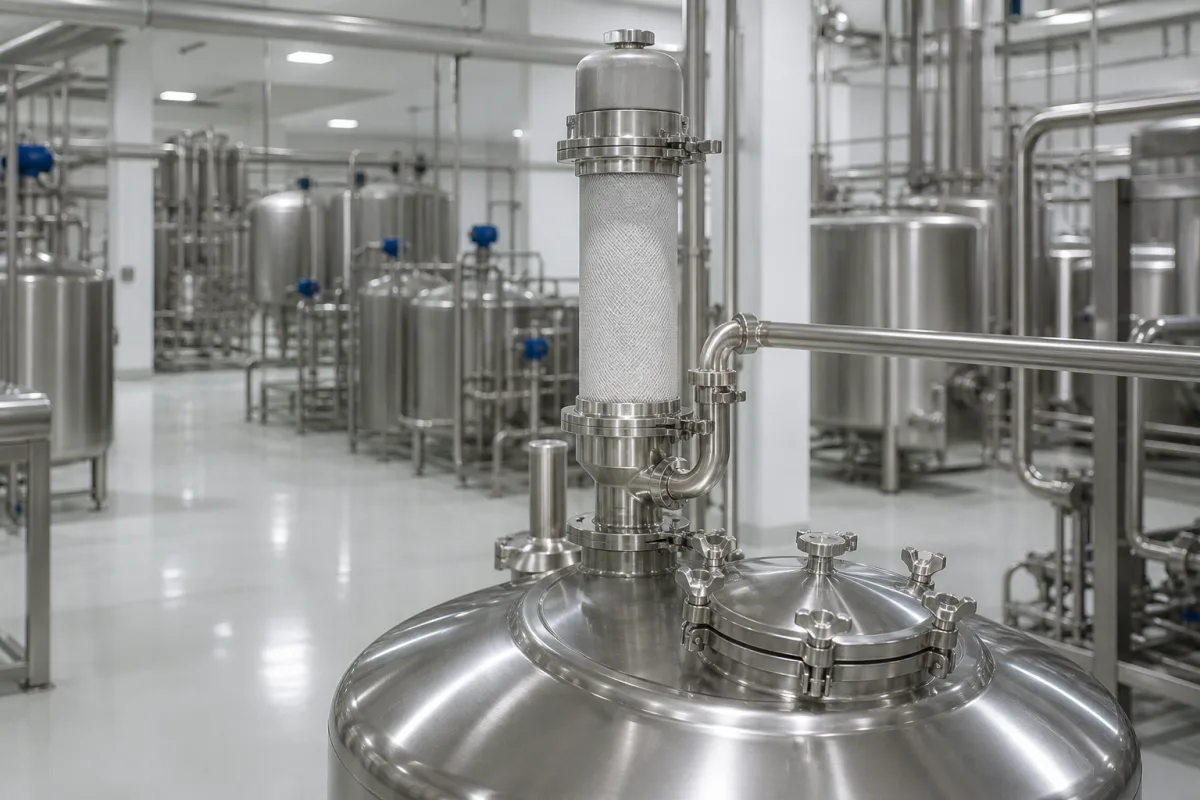
A filtration device that removes microorganisms and particulates from air entering an aseptic surge tank to maintain sterility.
Product Specifications

Technical details and manufacturing context for Sterile Air Filter

Definition
A critical component of an aseptic surge tank system, the sterile air filter ensures that the air introduced into the tank for pressure equalization, venting, or product transfer is free from viable microorganisms (bacteria, fungi, spores) and particulate contaminants. It prevents microbial ingress that could compromise the sterility of the tank's contents, which is essential in processes requiring an aseptic environment, such as in food, beverage, or pharmaceutical manufacturing.
Working Principle
Air is forced through a porous filter medium (e.g., PTFE membrane, pleated cartridge) with a defined pore size, typically 0.2 or 0.22 micrometers. This physical barrier traps and retains airborne microorganisms and particles larger than the pore rating, while allowing clean, sterile air to pass through. The filter housing is designed for integrity testing (e.g., bubble point, diffusion test) to verify it has no defects or leaks.
Common Materials
PTFE (Polytetrafluoroethylene) membrane, Polypropylene housing/cage, Silicone or EPDM gaskets
Technical Parameters
  • Filter pore size rating, typically 0.2 μm for sterile filtration (μm) Standard Spec
Components / BOM
  • Filter Cartridge
    The core filtration element containing the pleated membrane media that traps contaminants.
    Material: PTFE membrane, polypropylene support
  • Housing
    Stainless steel or polypropylene enclosure that holds the cartridge and provides sanitary connections to the tank.
    Material: 316L stainless steel or polypropylene
  • Gasket/O-ring
    Provides a sterile seal between the housing and cartridge, and at connection points.
    Material: Silicone or EPDM
Engineering Reasoning
0.5-2.0 bar differential pressure, 0.1-1.0 m/s face velocity
3.5 bar differential pressure, 2.5 m/s face velocity, 125°C temperature
Design Rationale: Filter media rupture due to exceeding tensile strength (HDPE membrane: 25-30 MPa yield strength), particle breakthrough from velocity exceeding Stokes' law settling velocity (0.001 m/s for 0.3 μm particles)
Risk Mitigation (FMEA)
Trigger Moisture condensation on hydrophobic filter media (contact angle <90°)
Mode: Increased differential pressure (ΔP > 2.5 bar), microbial growth penetration
Strategy: Integral electric heating element maintaining media temperature 5°C above dew point
Trigger Vibration-induced media fatigue at 85-120 Hz resonance frequency
Mode: Media pleat separation, bypass leakage exceeding 0.01% of rated flow
Strategy: Anti-vibration mounting with natural frequency <40 Hz, reinforced pleat design with 316L stainless steel support mesh

Industry Taxonomies & Aliases

Commonly used trade names and technical identifiers for Sterile Air Filter.

Applied To / Applications

This component is essential for the following industrial systems and equipment:

Industrial Ecosystem & Supply Chain DNA

Complementary Systems
Downstream Applications
Specialized Tooling

Application Fit & Sizing Matrix

Operational Limits
pressure: 0-10 bar (g)
flow rate: Up to 500 m³/h
temperature: -20°C to 150°C
particle retention: ≥ 99.999% at 0.2 μm
sterility requirement: Log Reduction Value (LRV) ≥ 7 for bacteria, ≥ 4 for viruses
Media Compatibility
✓ Clean steam condensate ✓ Purified water vapor ✓ Sterile nitrogen overlay
Unsuitable: Oil-laden compressed air or corrosive gas streams
Sizing Data Required
  • Maximum air flow rate (m³/h)
  • Required sterility assurance level (SAL)
  • Tank operating pressure (bar)

Reliability & Engineering Risk Analysis

Failure Mode & Root Cause
Filter media degradation
Cause: Exposure to incompatible chemicals or excessive moisture causing delamination, swelling, or chemical attack of filter media, compromising sterility and particle retention.
Seal/gasket failure
Cause: Improper installation torque, thermal cycling, or material incompatibility leading to bypass leakage, allowing unfiltered air to contaminate the sterile system.
Maintenance Indicators
  • Visible particulate matter downstream of filter housing or in sterile air lines
  • Abnormally high pressure drop across filter (>80% of initial clean differential pressure)
Engineering Tips
  • Implement strict moisture control with pre-filtration (coalescing filters) and maintain air dew point below -40°C to prevent microbial growth and media damage
  • Use calibrated torque wrenches for installation and perform regular integrity testing (bubble point or diffusion test) per manufacturer specifications to detect early seal failures

Compliance & Manufacturing Standards

Reference Standards
ISO 14644-1:2015 Cleanrooms and associated controlled environments ASTM F838-15a Standard Test Method for Determining Bacterial Retention of Membrane Filters EN 1822-1:2019 High efficiency air filters (EPA, HEPA and ULPA)
Manufacturing Precision
  • Filter media thickness: +/-0.1mm
  • Frame squareness: 0.5mm per meter
Quality Inspection
  • Integrity Test (DOP/PAO challenge)
  • Particle Count Efficiency Test

Factories Producing Sterile Air Filter

Verified manufacturers with capability to produce this product in China

✓ 94% Supplier Capability Match Found

S Sourcing Manager from United Arab Emirates Jan 08, 2026
★★★★★
"Great transparency on the Sterile Air Filter components. Essential for our Food Manufacturing supply chain."
Technical Specifications Verified
P Procurement Specialist from Australia Jan 05, 2026
★★★★☆
"The Sterile Air Filter we sourced perfectly fits our Food Manufacturing production line requirements. (Delivery took slightly longer than expected, but technical support was excellent.)"
Technical Specifications Verified
T Technical Director from Singapore Jan 02, 2026
★★★★★
"Found 12+ suppliers for Sterile Air Filter on CNFX, but this spec remains the most cost-effective."
Technical Specifications Verified
Verification Protocol

“Feedback is collected from verified sourcing managers during RFQ (Request for Quote) and factory evaluation processes on CNFX. These reports represent historical performance data and technical audit summaries from our B2B manufacturing network.”

15 sourcing managers are analyzing this specification now. Last inquiry for Sterile Air Filter from Germany (1h ago).

Supply Chain Compatible Machinery & Devices

Automated Food Packaging Integrity Tester

Automated system for non-destructive testing of food package seals and integrity.

Explore Specs →
Automated Food Moisture Analyzer

Automated system for precise moisture content measurement in food products

Explore Specs →
Automated Food Color Consistency Analyzer

Automated inline system for real-time color measurement and consistency control in food processing.

Explore Specs →
Control Panel

A centralized interface for monitoring and controlling industrial equipment and processes

Explore Specs →

Frequently Asked Questions

How does this sterile air filter maintain sterility in food manufacturing?

The PTFE membrane effectively removes microorganisms and particulates from air entering aseptic surge tanks, preventing contamination and maintaining the sterile environment required for food safety compliance.

What materials are used in this sterile air filter and why?

It features a PTFE membrane for superior microbial filtration, polypropylene housing for chemical resistance and durability, and silicone/EPDM gaskets for reliable sealing in food processing environments.

How often should sterile air filters be replaced in food manufacturing?

Replacement frequency depends on operating conditions and manufacturer recommendations, typically based on pressure drop indicators or scheduled maintenance intervals to ensure continuous sterility protection.

Can I contact factories directly on CNFX?

CNFX is an open directory, not a transaction platform. Each factory profile provides direct contact information and production details to help you initiate direct inquiries with Chinese suppliers.

Get Quote for Sterile Air Filter

Request technical pricing, lead times, or customized specifications for Sterile Air Filter directly from verified manufacturing units.

Your business information is encrypted and only shared with verified Sterile Air Filter suppliers.

Thank you! Your message has been sent. We'll respond within 1–3 business days.

Need to Manufacture Sterile Air Filter?

Connect with verified factories specializing in this product category

Add Your Factory Contact Us
Previous Product
Sterile Air Distribution Piping
Next Product
Sterile Air Purge