Industry-Verified Manufacturing Data (2026)

Conveyor Belt/Roller Assembly

Based on aggregated insights from multiple verified factory profiles within the CNFX directory, the standard Conveyor Belt/Roller Assembly used in the Machinery and Equipment Manufacturing sector typically supports operational capacities ranging from standard industrial configurations to heavy-duty production requirements.

Technical Definition & Core Assembly

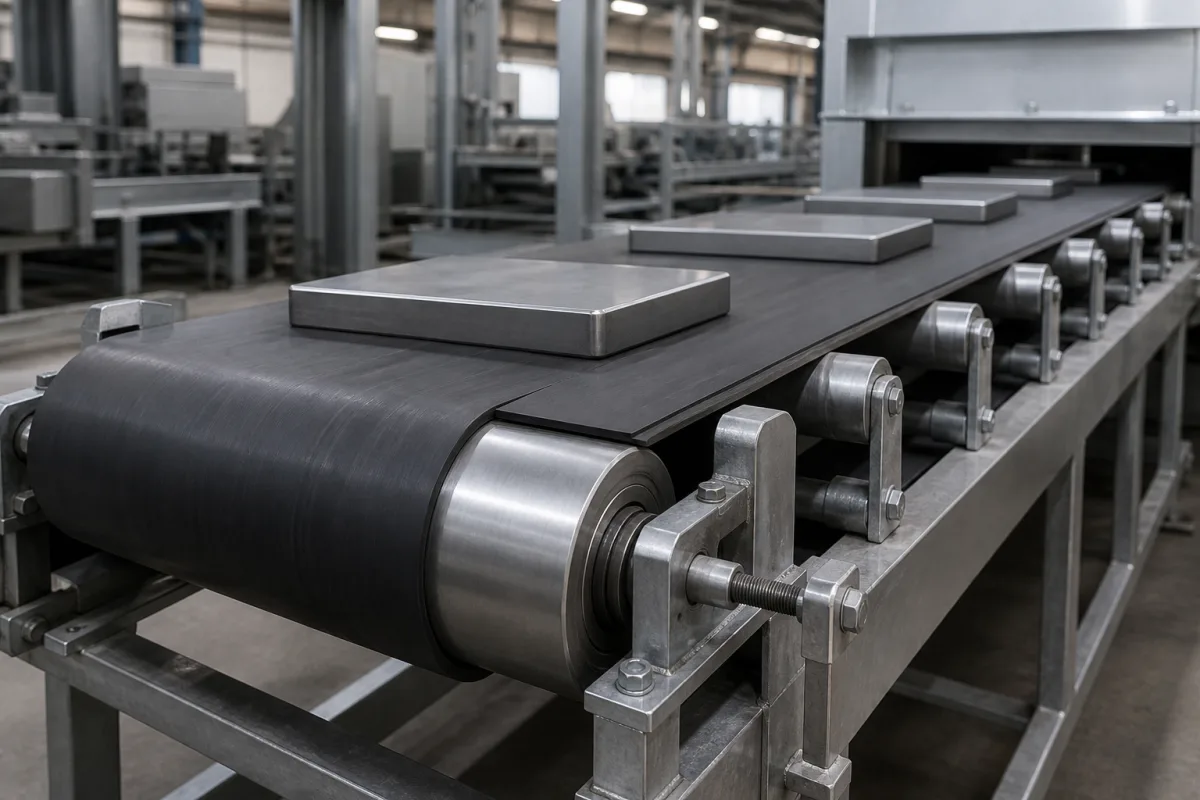
A canonical Conveyor Belt/Roller Assembly is characterized by the integration of Conveyor Belt and Support Rollers. In industrial production environments, manufacturers listed on CNFX commonly emphasize Rubber construction to support stable, high-cycle operation across diverse manufacturing scenarios.

A mechanical assembly consisting of conveyor belts supported by rollers that facilitates material movement within a conveyor transfer system.

Product Specifications

Technical details and manufacturing context for Conveyor Belt/Roller Assembly

Definition
The Conveyor Belt/Roller Assembly is a critical component of the Conveyor Transfer System that provides the physical interface for transporting materials between different sections or processes. It combines the continuous belt surface with supporting rollers to create a stable, low-friction pathway for items of various sizes and weights, enabling efficient material handling and transfer operations.
Working Principle
The assembly operates by using motor-driven rollers or pulleys to move the conveyor belt continuously. The belt rests on and is supported by multiple rollers that reduce friction and maintain proper belt tension. As the belt moves, materials placed on its surface are transported from one point to another. The rollers ensure smooth belt movement, prevent sagging, and distribute weight evenly across the assembly.
Common Materials
Rubber, Steel, Polymer composites
Technical Parameters
  • Belt width and roller diameter specifications (mm) Standard Spec
Components / BOM
  • Conveyor Belt
    Provides the continuous surface for material transport
    Material: Rubber or polymer composite
  • Support Rollers
    Support the belt, reduce friction, and maintain proper tension
    Material: Steel or aluminum
  • Roller Bearings
    Enable smooth rotation of rollers with minimal friction
    Material: Steel with lubricant
  • Mounting Brackets
    Secure rollers to the conveyor frame structure
    Material: Steel
  • Tensioning Mechanism
    Maintains proper belt tension to prevent slippage
    Material: Steel with adjustment components
Engineering Reasoning
0.5-3.0 m/s belt speed, 0-150 kg/m linear load density, -20°C to 80°C ambient temperature
Belt tensile stress exceeding 10 MPa (polyester-nylon blend) or roller bearing L10 life < 1000 hours at 1000 rpm with 5 kN radial load
Design Rationale: Progressive material fatigue due to cyclic bending stress exceeding 2 MPa at pulley contact points, governed by Miner's rule cumulative damage > 1.0
Risk Mitigation (FMEA)
Trigger Misalignment exceeding 0.5 mm/m between roller axes
Mode: Edge wear rate > 0.1 mm/hour causing belt tracking failure
Strategy: Laser-aligned roller mounting with 0.1 mm/m tolerance and crowned rollers (0.5% crown height)
Trigger Material accumulation exceeding 5 kg/m² on return belt section
Mode: Roller bearing seizure due to contamination ingress past IP65 sealing
Strategy: Automatic belt cleaning system with 99% particulate removal at 50 μm particle size

Industry Taxonomies & Aliases

Commonly used trade names and technical identifiers for Conveyor Belt/Roller Assembly.

Applied To / Applications

This component is essential for the following industrial systems and equipment:

Industrial Ecosystem & Supply Chain DNA

Complementary Systems
Downstream Applications
Specialized Tooling

Application Fit & Sizing Matrix

Operational Limits
pressure: Max 5 bar (belt tension dependent)
other spec: Max belt speed: 5 m/s, Max load capacity: 150 kg/m
temperature: -20°C to 80°C
Media Compatibility
✓ Packaged goods (boxes, bags) ✓ Bulk granular materials (grains, sand) ✓ General industrial components (metal parts, plastic items)
Unsuitable: Highly corrosive chemical slurries or molten materials
Sizing Data Required
  • Required throughput (tons/hour or units/hour)
  • Material characteristics (size, shape, abrasiveness)
  • Conveyor length and incline/decline angle

Reliability & Engineering Risk Analysis

Failure Mode & Root Cause
Belt misalignment and tracking failure
Cause: Improper tensioning, worn or damaged rollers, accumulation of material on rollers, or structural misalignment of the conveyor frame leading to edge wear, belt damage, and potential catastrophic failure.
Roller bearing seizure or excessive wear
Cause: Inadequate lubrication, ingress of contaminants (dust, moisture, debris), excessive belt tension causing overload, or improper bearing installation leading to increased friction, heat generation, and eventual roller failure.
Maintenance Indicators
  • Audible grinding, squealing, or rumbling noises from roller assemblies indicating bearing failure or misalignment.
  • Visual observation of belt tracking off-center, frayed edges, or visible material buildup on rollers or pulleys.
Engineering Tips
  • Implement a routine infrared thermography program to monitor roller bearing temperatures; abnormal heat signatures indicate early-stage lubrication failure or bearing wear before catastrophic failure occurs.
  • Establish and enforce strict belt tensioning protocols using proper tension gauges, and perform regular laser alignment checks on the conveyor structure to prevent misalignment-induced wear.

Compliance & Manufacturing Standards

Reference Standards
ISO 15236-1:2016 (Steel cord conveyor belts) ANSI/CEMA 401-2003 (Belt conveyors for bulk materials) DIN 22101:2011 (Continuous conveyors - Belt conveyors for loose bulk materials)
Manufacturing Precision
  • Roller bore diameter: +/-0.02mm
  • Belt tracking alignment: +/-2mm per 10m length
Quality Inspection
  • Non-destructive testing (NDT) for roller welds and bearings
  • Belt tensile strength and elongation verification per ISO 283

Factories Producing Conveyor Belt/Roller Assembly

Verified manufacturers with capability to produce this product in China

✓ 93% Supplier Capability Match Found

P Procurement Specialist from Germany Feb 16, 2026
★★★★★
"Impressive build quality. Especially the technical reliability is very stable during long-term operation."
Technical Specifications Verified
T Technical Director from Brazil Feb 13, 2026
★★★★★
"As a professional in the Machinery and Equipment Manufacturing sector, I confirm this Conveyor Belt/Roller Assembly meets all ISO standards."
Technical Specifications Verified
P Project Engineer from Canada Feb 10, 2026
★★★★★
"Standard OEM quality for Machinery and Equipment Manufacturing applications. The Conveyor Belt/Roller Assembly arrived with full certification."
Technical Specifications Verified
Verification Protocol

“Feedback is collected from verified sourcing managers during RFQ (Request for Quote) and factory evaluation processes on CNFX. These reports represent historical performance data and technical audit summaries from our B2B manufacturing network.”

6 sourcing managers are analyzing this specification now. Last inquiry for Conveyor Belt/Roller Assembly from UAE (36m ago).

Supply Chain Compatible Machinery & Devices

Heavy-Duty CNC Plasma Cutting Machine

Industrial machine for precision metal cutting using plasma arc technology

Explore Specs →
Automated Assembly Line System

Integrated production system for sequential component assembly operations

Explore Specs →
Automated Powder Coating System

Integrated industrial system for applying dry powder coatings to metal substrates.

Explore Specs →
Centrifugal Pump Impeller

Rotating component that transfers energy to fluid in centrifugal pumps.

Explore Specs →

Frequently Asked Questions

What materials are used in your conveyor belt/roller assemblies?

Our assemblies use premium rubber for belts, steel for structural components and rollers, and polymer composites for wear-resistant parts, ensuring durability in industrial environments.

How does the tensioning mechanism work in this assembly?

The tensioning mechanism maintains optimal belt tension through adjustable brackets or spring-loaded components, preventing slippage and ensuring smooth material transfer throughout the conveyor system.

What industries are these conveyor assemblies suitable for?

These assemblies are designed for machinery and equipment manufacturing, material handling, packaging, and any industrial application requiring reliable conveyor transfer systems for moving goods or materials.

Can I contact factories directly on CNFX?

CNFX is an open directory, not a transaction platform. Each factory profile provides direct contact information and production details to help you initiate direct inquiries with Chinese suppliers.

Get Quote for Conveyor Belt/Roller Assembly

Request technical pricing, lead times, or customized specifications for Conveyor Belt/Roller Assembly directly from verified manufacturing units.

Your business information is encrypted and only shared with verified Conveyor Belt/Roller Assembly suppliers.

Thank you! Your message has been sent. We'll respond within 1–3 business days.

Need to Manufacture Conveyor Belt/Roller Assembly?

Connect with verified factories specializing in this product category

Add Your Factory Contact Us
Previous Product
Conveyor Belt/Roller
Next Product
Conveyor Belt/Roller Bed