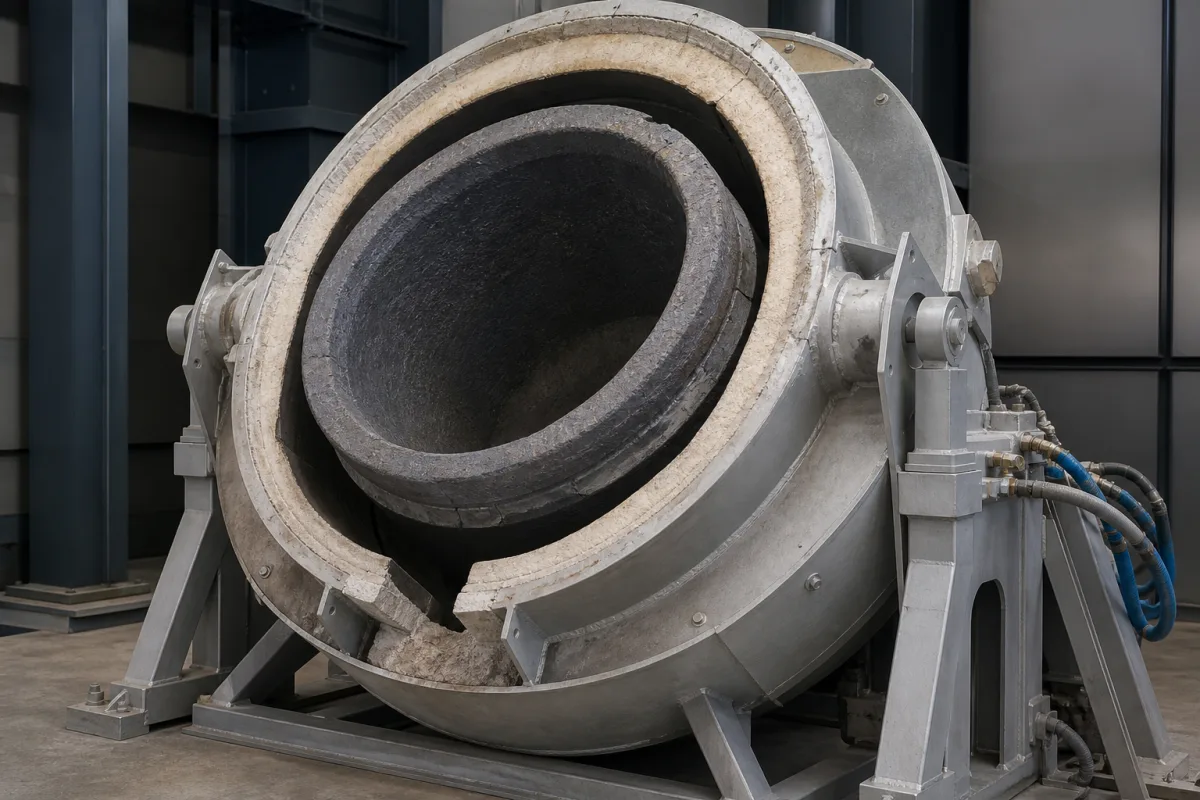
Crucibles for induction and other melting furnaces · matching the crucible's electrical resistivity to furnace frequency, graphite-based crucibles with high silicon carbide or high clay content, shape and size, alloy and temperature, energy efficiency, and handling, storage and installation
A melting crucible is the refractory vessel that holds the metal charge while it is melted or held molten. In an induction furnace the crucible either lets the coil's field pass through to heat the metal directly, or heats in the field itself and passes the heat to the charge. Ask three things first: which furnace (type, frequency, coil shape and capacity) it must fit, which alloys and temperatures it will see, and how it will be charged, fluxed, cleaned and emptied.
Graphite-based melting and holding crucibles for induction furnaces, with notes on resistance and fuel-fired furnaces. Furnace linings, ladles and complete crucible furnaces are outside this page except where compared.
CNFX editorial research · Sources checked October 11, 2026 · 5 sources
Morgan Molten Metal Systems, a crucible maker, describes the modern crucible as a heterogeneous, graphite-based composite whose performance depends on its composition and on how its graphite structure is aligned. It calls crucible selection for induction furnaces more complex than for other furnace types. For refining precious metals, for example, crucibles that heat in the furnace's inductive field melt the charge; in other applications, crucibles that let the field pass through and heat the metal directly are used. [1]
Morgan therefore advises matching the crucible's electrical characteristics to the furnace's operating frequency and to the melting application. In some designs, lower-frequency induction furnaces need crucibles with high silicon carbide content, and in other applications higher-frequency furnaces need crucibles with high clay content. Matching the crucible's electrical resistivity to the furnace is key to preventing crucible overheating. [1]
Morgan writes that "most crucibles designed for induction furnaces are cylindrical to provide a uniform distance between the crucible and the furnace coil". Some small furnaces built for removable crucibles have a tapered coil to match bilge-shaped crucibles, which are lifted out with tongs for pouring. Morgan adds that the furnace's capacity and the space available set the crucible's capacity, dimensions and shape, and whether it needs a pouring spout. [1]
Give the supplier the furnace type, make and model, operating frequency, coil shape and internal dimensions, metal capacity, the alloys melted or held and their temperatures, the heating and cooling rate, how the crucible is charged, the fluxes and treatments used, how dross is removed, how the crucible is emptied, and any need to avoid cross-contamination between alloys.
02
List the operating factors before choosing
Morgan lists nine operating factors to document before choosing a crucible: the furnace's capacity, dimensions and type; the alloy or alloys melted; the melting and holding temperatures; the rate of temperature change; how the crucible is charged; the fluxes or additions used; degassing or refining processes; how slag or dross is removed; and how the crucible is emptied. It warns that "crucible performance characteristics often involve trade-offs"; the crucible with the best thermal conductivity, for example, may not give the best thermal-shock protection. [1]
Foseco, the foundry technology brand of Vesuvius, argues that crucibles should be chosen on thermal performance rather than price or life alone. It reports that one aluminium foundry cut energy use by 13.4% and carbon emissions by almost 8,000 kg a year after switching to its energy-efficient crucibles. This is the maker's own case figure. [3]
03
Know the two crucible body families before reading a quotation
Two patents give published compositions for the clay-bonded graphite and graphite–silicon carbide crucible bodies a supplier may quote. US4931415A, filed by Ferro Corp with a 1986 priority date, addresses clay-bonded graphite crucibles for high-frequency induction furnaces, which it puts at 1,000 to 3,000 Hz. It states that crucibles with too low electrical conductivity "have a low susceptibility to the induction field, therefore tend to crack as a result of thermal gradients in the crucible" and heat up "at too slow a rate", and claims a fired body of 3–41% fused silica, 18–36% carbon, 19–26% crystalline silica, 9–13% alumina and 0–10% each of silicon carbide and silicon, fired at 1,250–1,550 °C (1,400 °C preferred), with an oxidised inner layer 0.06–0.25 in deep from an engobe of 30–50% silicon metal and 20–60% ball clay applied 0.005–0.040 in thick. [4]
CN103964875A, filed by crucible maker Qingdao Bai Dun with a 2014 priority date, claims a graphite–silicon carbide crucible raw mix of 40–50% flake graphite (carbon above 90%), 20–50% silicon carbide (purity above 90%), 4–10% silicon powder, 1–5% boron carbide and 5–15% clay, isostatically pressed at 50–100 MPa and fired at 1,000–1,200 °C; one example uses 47% graphite, 36% silicon carbide, 8% silicon, 2% boron carbide and 7% kaolin, pressed at 70 MPa and fired at 1,050 °C. [5]
Editorial note: these are patent compositions, not a given supplier's product. They show why Morgan ties silicon carbide or clay content to furnace frequency: ask the supplier which body family the quoted crucible uses, its silicon carbide and carbon content, and the furnace frequency range it is rated for. [4][5][1]
Protect service life with handling, storage and installation
Morgan's service-life guidance says to inspect each crucible for shipping damage on arrival and never to put a damaged crucible into service. Crucibles must never be rolled, stacked inside one another, stood directly on the floor or banded without padding. They must be stored dry at above 0 °C (32 °F), and cold or wet crucibles must not be placed in service because they could cause dangerous water and molten metal explosions. [2]
Before installation, Morgan says to check that the crucible is above freezing and undamaged, and that the base block is level, centred, at the correct height and larger than the crucible bottom. [2]
05
Frequency, heating mode, shape, alloy and handling for the quotation
Furnace frequency, coil shape and alloys come from your melt shop. Morgan and Foseco supply the guidance in the middle column; the grade itself must come from the supplier.
Field
What it means and published guidance
Ask the supplier for
Furnace frequency
Lower frequency may need high SiC content; higher frequency high clay content. [1]
Recommended grade for your frequency.
Heating mode
Crucible heats in the field, or the field passes through to the metal. [1]
Which one applies.
Shape and size
Cylindrical for uniform coil distance; bilge shape for removable crucibles. [1]
1 company lists this product among what they make. Company figures are quoted from each
company's own website; every card states where the relationship came from.
Shandong Zichuan Special Refractory
Manufacturing site to be confirmed for the order
Lists silicon carbide graphite crucibles, including a crucible with spout, for melting non-ferrous and precious metals.
Explore company information and manufacturing capabilities, then discuss the scope of your project with a relevant supplier.
Share this page
Compiled and source-reviewed by the CNFX editorial team.
Each manufacturer above links to the page on that company's own website where the product is listed, with the date we checked it. How we source and review
· Page last updated 13 October 2026
Buyer questions
Does any crucible work in an induction furnace?
No. Morgan advises matching the crucible's electrical resistivity to the furnace frequency to prevent overheating. [1]
Which crucible type suits which frequency?
Morgan gives examples where lower-frequency furnaces need high silicon carbide content and higher-frequency furnaces high clay content. [1]
How should crucibles be stored?
Morgan says to store them dry at above 0 °C and never to use cold or wet crucibles, which could cause water and molten metal explosions. [2]
What is a graphite–silicon carbide crucible made of?
One Chinese patent (CN103964875A) claims 40–50% flake graphite, 20–50% silicon carbide, 4–10% silicon, 1–5% boron carbide and 5–15% clay, isostatically pressed at 50–100 MPa and fired at 1,000–1,200 °C; ask your supplier for its own composition. [5]
Sources and what still needs a direct check
Sources checked 2026-10-11. Morgan Molten Metal Systems' technical articles (archived copies) and Foseco's article describe crucible selection and use from the makers' side; two patents (US4931415A and CN103964875A) give published crucible body compositions. Their figures are examples, not limits.