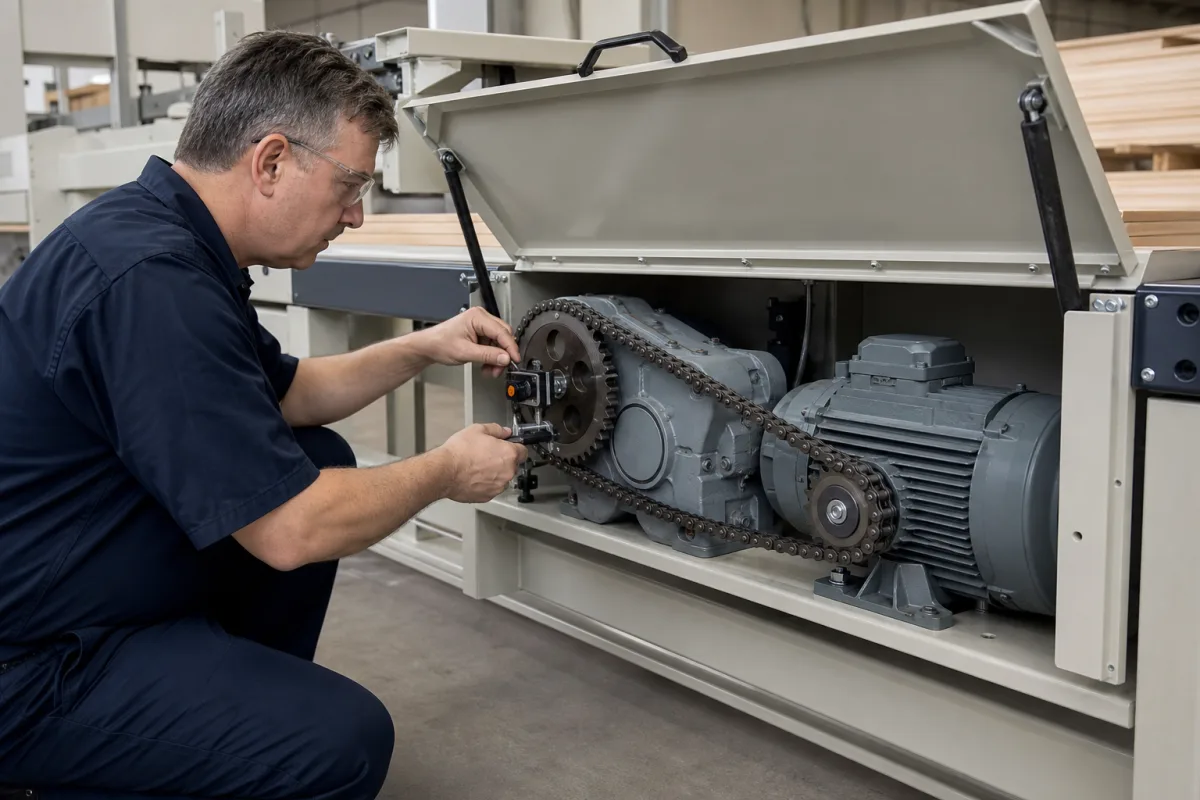
Power transmission by roller chain and sprockets for machines and conveyors
Roller chain and sprocket drives · Service factor and design power, sprocket teeth and strands, chain speed and tension, wear limit and guarding
Power transmission, as used on this page, means the roller chain and sprocket drive that carries power from a motor or gear unit to the shaft of a conveyor, saw, feeder or other machine on a production line, such as a furniture or woodworking line. It sits between the drive unit and the driven machine. Ask three things first: the power, speeds and shock the drive must carry, which sets the chain size and sprockets, how wear will be measured and when chain will be replaced, and how the drive will be guarded.
Roller chain drives for machines and conveyors: roller chains, sprockets, idlers and tensioners, and their guards. Gear motors and motor–coupling–reducer drive assemblies are covered on the Gear motor drive assembly page. Electrical power transmission and distribution equipment, transmission towers, vehicle drive shafts, slip rings and hoses are outside this page.
CNFX editorial research · Sources checked October 12, 2026 · 3 sources
U.S. Tsubaki's chain drive selection procedure starts from the machine type, power, shaft speeds and diameters and centre distance, then multiplies the power by a service factor to get design power. Its Table I gives 1.0 for smooth loads such as belt conveyors with small load fluctuation, 1.3 for some impact such as general machine tools and dryers, and 1.5 for large impact such as presses, all with an electric motor; internal combustion engines take 1.0–1.7 depending on load and hydraulic drive. [1]
The large sprocket's teeth equal the small sprocket's teeth times the speed ratio; Tsubaki prefers more than 15 teeth on the small sprocket and suggests no more than 120 on the large one. Where one strand is not enough or space is short, a multi-strand chain is used, with multiple-strand factors of 1.7 for double strand and 2.5 for triple strand. Chain speed is S = P·N·n/12 ft/min and chain tension T = 33,000·HP/S lb. Its selection table assumes ambient temperatures of 15–140 °F, horizontal shafts and proper lubrication. [1]
Editorial calculation: a 5 hp drive with some impact needs 5 × 1.3 = 6.5 hp design power. With 3/4 in pitch chain on a 17-tooth sprocket at 300 rpm, S = 0.75 × 17 × 300 ÷ 12 ≈ 319 ft/min and T = 33,000 × 5 ÷ 319 ≈ 517 lb. These pitch, tooth and speed values are assumptions for illustration. [1]
Give the supplier the motor or gear unit power and speed, the driven speed (or ratio), the machine and its shock level, shaft diameters and keyways, centre distance and any space limit, number of strands allowed, ambient conditions such as wood dust, lubrication method, and the guard required.
02
Plan wear checks and guard the drive
Tsubaki's chain wear indicator literature marks 0.7% elongation as the point to start planning chain replacement and 1.5% as the limit at which sprocket wear starts and the chain should be replaced as soon as possible; it advises replacing chains before 1.5–2% elongation to avoid significant sprocket wear, and measuring at more than one point along the chain because wear is uneven. Its ANSI kit covers sizes 35 to 80 and its British Standard kit sizes 06B to 16B. [2]
OSHA's 29 CFR 1910.219 requires all sprocket wheels and chains to be enclosed unless more than 7 ft above the floor or platform, with protection against falling where the drive extends over other work areas; where frequent oiling is needed, openings with hinged or sliding self-closing covers are required. Overhead roller-chain drive guards must be at least 6 in wider than the drive on each side. [3]
Editorial note: a hinged guard gives access to the tensioner and lubrication points; ask the supplier how the guard is interlocked or secured and where the oiling openings are. [3]
Design power, service factor, tooth ratio and strand count for a roller chain drive
Start from design power, not motor nameplate power: Tsubaki multiplies by 1.0, 1.3 or 1.5 with an electric motor depending on the impact in the driven machine. [1]
Field
What it means and published values
Ask the supplier for
Rated Power (kW)
Multiply by the service factor for design power. [1]
12 companies list this product among what they make. Company figures are quoted from each
company's own website; every card states where the relationship came from.
HUZHOU DURA MACHINERY SPROCKET CO., LTD.
Manufacturing site to be confirmed for the order
Lists ASA, double, finished-bore, taper-bore, idler and EN sprockets with gears.
Explore company information and manufacturing capabilities, then discuss the scope of your project with a relevant supplier.
Share this page
Compiled and source-reviewed by the CNFX editorial team.
Each manufacturer above links to the page on that company's own website where the product is listed, with the date we checked it. How we source and review
· Page last updated 13 October 2026
Buyer questions
What service factor applies to a chain drive?
Tsubaki gives 1.0 for smooth loads, 1.3 for some impact and 1.5 for large impact with an electric motor. [1]
When should roller chain be replaced?
Tsubaki advises replacing chain before 1.5–2% elongation; its gauge marks 1.5% as replace as soon as possible. [2]
Must chain drives be guarded?
OSHA 29 CFR 1910.219 requires sprockets and chains to be enclosed unless more than 7 ft above the floor or platform. [3]
Sources and what still needs a direct check
Sources checked 2026-10-12. U.S. Tsubaki is a chain maker publishing its selection procedure and wear guidance; 29 CFR 1910.219 is the US OSHA rule on mechanical power-transmission guarding.