Industry-Verified Manufacturing Data (2026)

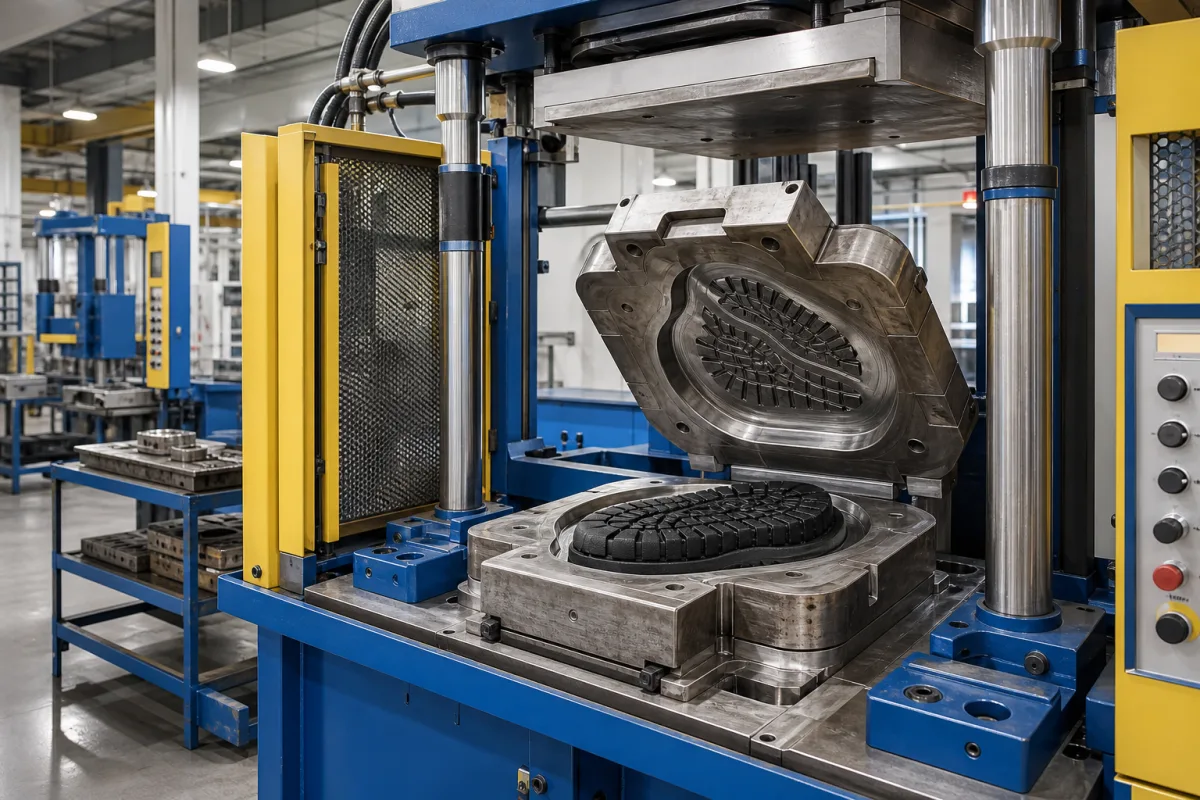
Industrial Footwear Sole Molding Press

Based on aggregated insights from multiple verified factory profiles within the CNFX directory, the standard Industrial Footwear Sole Molding Press used in the Leather and Related Product Manufacturing sector typically supports operational capacities ranging from standard industrial configurations to heavy-duty production requirements.

Technical Definition & Core Assembly

A canonical Industrial Footwear Sole Molding Press is characterized by the integration of Hydraulic Power Unit and Heated Platens. In industrial production environments, manufacturers listed on CNFX commonly emphasize High-strength steel construction to support stable, high-cycle operation across diverse manufacturing scenarios.

Hydraulic press for molding and bonding shoe soles to uppers

Product Specifications

Technical details and manufacturing context for Industrial Footwear Sole Molding Press

Definition
An industrial hydraulic press specifically designed for footwear manufacturing that applies precise pressure and heat to mold rubber, polyurethane, or thermoplastic soles and bond them to shoe uppers. This machine ensures consistent sole thickness, proper adhesion, and accurate shape reproduction across production batches. It operates as a standalone unit that can be integrated into various footwear assembly lines for athletic shoes, dress shoes, or work boots.
Working Principle
Hydraulic cylinders apply controlled pressure to heated platens that compress sole material against shoe lasts, with temperature regulation for material curing and bonding
Common Materials
High-strength steel, Heat-resistant platens, Hydraulic seals
Technical Parameters
  • Maximum hydraulic pressing force (ton) Standard Spec
  • Heated platen operating range (°C) Standard Spec
Components / BOM
  • Hydraulic Power Unit
    Generates and regulates hydraulic pressure
    Material: Steel housing with brass fittings
  • Heated Platens
    Apply heat and pressure to sole materials
    Material: Aluminum alloy with heating elements
  • Control Panel
    Machine operation and parameter setting
    Material: Stainless steel with touchscreen
  • Safety Light Curtain Optional
    Operator protection during press operation
    Material: Infrared sensors with aluminum housing
Engineering Reasoning
15-80 bar hydraulic pressure, 150-220°C mold temperature, 30-120 second cycle time
Hydraulic pressure exceeding 95 bar causes seal rupture, mold temperature below 140°C results in incomplete polymer cross-linking, temperature above 250°C initiates thermal degradation of polyurethane compounds
Design Rationale: Seal failure occurs via extrusion damage when pressure exceeds material yield strength (EPDM rubber: 15 MPa ultimate tensile strength). Incomplete bonding results from insufficient activation energy for polyurethane polymerization (activation energy: 60-80 kJ/mol). Thermal degradation follows Arrhenius kinetics with activation energy of 120 kJ/mol for polyurethane decomposition.
Risk Mitigation (FMEA)
Trigger Hydraulic fluid contamination exceeding ISO 4406 18/16/13 cleanliness level
Mode: Servo valve spool sticking causing pressure oscillations ±10 bar from setpoint
Strategy: Install 3 μm absolute filtration with differential pressure monitoring and automatic bypass at 2 bar ΔP
Trigger Heater band insulation breakdown creating 30°C thermal gradient across mold surface
Mode: Differential thermal expansion causing 0.2 mm mold plate warpage
Strategy: Implement distributed PID control with 8-zone temperature regulation and 0.5°C tolerance per zone

Industry Taxonomies & Aliases

Commonly used trade names and technical identifiers for Industrial Footwear Sole Molding Press.

Industrial Ecosystem & Supply Chain DNA

Complementary Systems
Downstream Applications
Specialized Tooling

Application Fit & Sizing Matrix

Operational Limits
pressure: Up to 300 bar (adjustable via hydraulic system)
flow rate: Hydraulic pump flow: 10-50 L/min (depending on model)
cycle time: 15-90 seconds (depends on adhesive curing profile)
platen size: Standard sizes: 400x600mm to 800x1200mm
temperature: Ambient to 180°C (typical for thermoset adhesives)
slurry concentration: Not applicable (solid adhesive films or liquid adhesives applied separately)
Media Compatibility
✓ Polyurethane (PU) sole bonding ✓ Thermoplastic rubber (TPR) molding ✓ EVA foam sole attachment
Unsuitable: Continuous high-moisture environments without corrosion protection
Sizing Data Required
  • Maximum sole dimensions (length x width)
  • Required production rate (pairs per hour)
  • Adhesive type and curing requirements

Reliability & Engineering Risk Analysis

Failure Mode & Root Cause
Hydraulic cylinder seal degradation
Cause: Thermal cycling and chemical exposure to hydraulic fluids during high-temperature molding cycles, leading to hardening, cracking, and leaks.
Heating element burnout or uneven heating
Cause: Insufficient maintenance of heating platens, accumulation of polymer residues causing hotspots, or electrical connection corrosion from moisture and contaminants.
Maintenance Indicators
  • Unusual hissing or knocking sounds from hydraulic system indicating air entrapment or valve malfunction
  • Visible hydraulic fluid leaks around cylinder seals or fittings, or inconsistent sole thickness in molded products
Engineering Tips
  • Implement a predictive maintenance schedule using infrared thermography to monitor platen temperature uniformity and detect heating element failures early.
  • Use high-temperature, chemically compatible hydraulic seals and fluids, and establish regular seal inspection and replacement intervals based on operating cycles.

Compliance & Manufacturing Standards

Reference Standards
ISO 9001:2015 - Quality Management Systems ASTM F2413-18 - Standard Specification for Performance Requirements for Protective (Safety) Toe Cap Footwear CE Marking - Machinery Directive 2006/42/EC
Manufacturing Precision
  • Platen Parallelism: +/- 0.05mm across full surface
  • Heating Zone Temperature Uniformity: +/- 3°C
Quality Inspection
  • Hydraulic Pressure Leak Test at 1.5x Operating Pressure
  • Platen Surface Hardness Test (Rockwell C Scale)

Factories Producing Industrial Footwear Sole Molding Press

Verified manufacturers with capability to produce this product in China

✓ 95% Supplier Capability Match Found

P Project Engineer from Brazil Jan 29, 2026
★★★★★
"Impressive build quality. Especially the Maximum Clamping Force (ton) is very stable during long-term operation."
Technical Specifications Verified
S Sourcing Manager from Canada Jan 26, 2026
★★★★★
"As a professional in the Leather and Related Product Manufacturing sector, I confirm this Industrial Footwear Sole Molding Press meets all ISO standards."
Technical Specifications Verified
P Procurement Specialist from United States Jan 23, 2026
★★★★★
"Standard OEM quality for Leather and Related Product Manufacturing applications. The Industrial Footwear Sole Molding Press arrived with full certification."
Technical Specifications Verified
Verification Protocol

“Feedback is collected from verified sourcing managers during RFQ (Request for Quote) and factory evaluation processes on CNFX. These reports represent historical performance data and technical audit summaries from our B2B manufacturing network.”

14 sourcing managers are analyzing this specification now. Last inquiry for Industrial Footwear Sole Molding Press from USA (58m ago).

Supply Chain Commonly Integrated Components

Tanning Drum System

A rotating drum system used for the tanning process in leather production, where hides are treated with chemicals to convert them into durable leather.

Explore Specs →
Sammying and Setting Machine

A leather processing machine that stretches and sets the hide to achieve uniform thickness and proper grain orientation.

Explore Specs →
Drying Tunnel

A controlled-environment chamber within leather processing systems that removes moisture from leather through heated airflow.

Explore Specs →
Finishing Line

Final processing stage in leather manufacturing that applies surface treatments and enhancements

Explore Specs →

Frequently Asked Questions

What is the typical cycle time for this sole molding press?

The cycle time is optimized for efficient production, typically ranging from seconds to minutes depending on material and sole design, with precise hydraulic control ensuring consistent bonding quality.

What safety features are included with this press?

This press includes a safety light curtain to protect operators, along with robust hydraulic seals and a secure control panel, ensuring compliance with industrial safety standards in footwear manufacturing.

Can this press handle different sole materials and sizes?

Yes, with adjustable platen temperature up to °C, customizable platen sizes in mm, and clamping force up to tons, it accommodates various materials like rubber, PU, and EVA for diverse footwear production.

Can I contact factories directly on CNFX?

CNFX is an open directory, not a transaction platform. Each factory profile provides direct contact information and production details to help you initiate direct inquiries with Chinese suppliers.

Get Quote for Industrial Footwear Sole Molding Press

Request technical pricing, lead times, or customized specifications for Industrial Footwear Sole Molding Press directly from verified manufacturing units.

Your business information is encrypted and only shared with verified Industrial Footwear Sole Molding Press suppliers.

Thank you! Your message has been sent. We'll respond within 1–3 business days.

Need to Manufacture Industrial Footwear Sole Molding Press?

Connect with verified factories specializing in this product category

Add Your Factory Contact Us
Previous Product
Heat Transfer Assembly
Next Product
Industrial Footwear Upper Stretching Machine