Industry-Verified Manufacturing Data (2026)

Sorting Hopper

Based on aggregated insights from multiple verified factory profiles within the CNFX directory, the standard Sorting Hopper used in the Machinery and Equipment Manufacturing sector typically supports operational capacities ranging from standard industrial configurations to heavy-duty production requirements.

Technical Definition & Core Assembly

A canonical Sorting Hopper is characterized by the integration of Hopper Body and Agitator/Feeder Mechanism. In industrial production environments, manufacturers listed on CNFX commonly emphasize Stainless Steel (AISI 304/316) construction to support stable, high-cycle operation across diverse manufacturing scenarios.

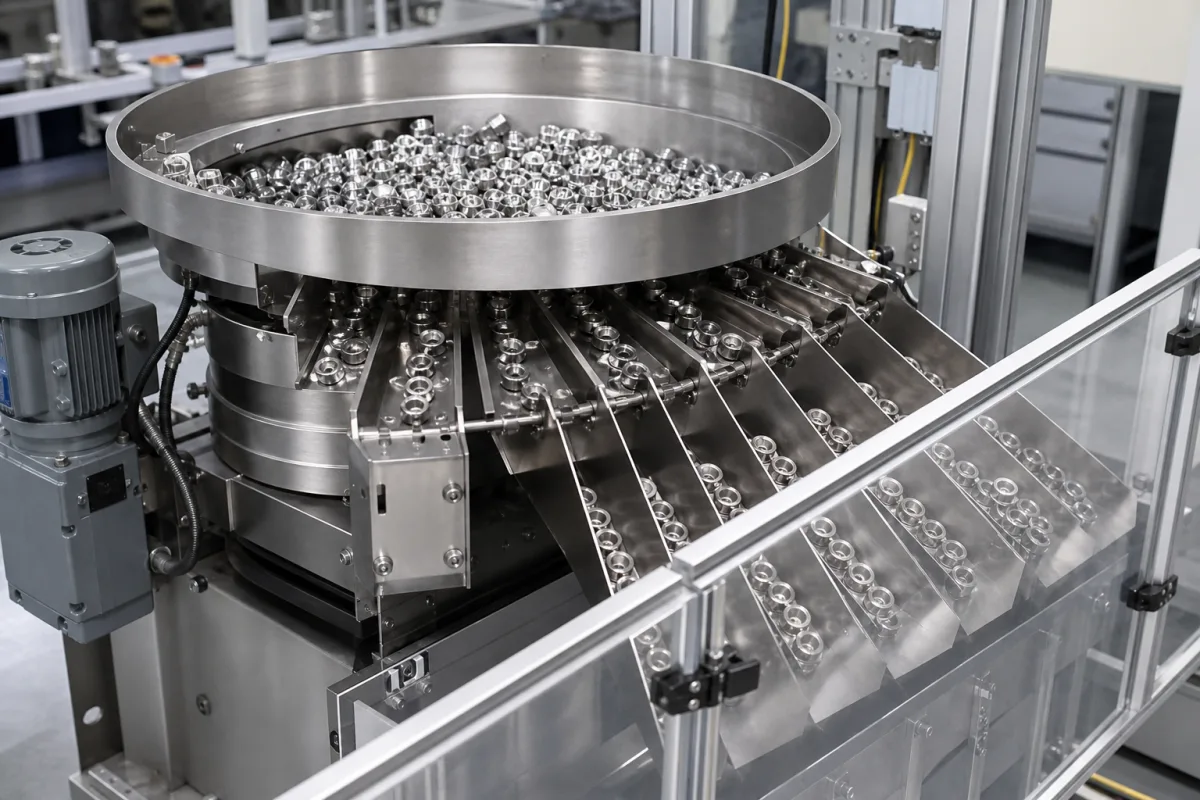
A hopper component within a cap sorter/elevator system that receives, temporarily stores, and feeds caps into the sorting mechanism.
Product Specifications

Technical details and manufacturing context for Sorting Hopper

Definition
The Sorting Hopper is a critical component of Cap Sorter/Elevator systems, designed to receive a batch of caps from upstream processes. It acts as a buffer and controlled feed point, ensuring a steady, organized supply of caps to the subsequent sorting mechanism (e.g., orienting discs, vision systems, or mechanical selectors) for proper alignment, inspection, and direction onto the elevator or conveyor.
Working Principle
Caps are deposited into the hopper, typically via a chute or conveyor. The hopper's internal geometry (often conical or V-shaped) funnels the caps toward a controlled outlet. Vibration, agitation, or a mechanical feeder (like a rotating disc or auger) at the base of the hopper gently moves the caps to prevent jamming and ensures a consistent, singular flow out of the outlet and into the sorting stage of the machine.
Common Materials
Stainless Steel (AISI 304/316), Food-Grade Plastic (e.g., UHMW-PE, Acetal)
Technical Parameters
  • Hopper inlet diameter, outlet diameter, and overall height/capacity dimensions. (mm) Customizable
Components / BOM
  • Hopper Body
    Main containment vessel that receives and funnels caps.
    Material: Stainless Steel or Food-Grade Plastic
  • Agitator/Feeder Mechanism
    Prevents cap bridging and ensures consistent flow from the outlet.
    Material: Stainless Steel or Engineering Plastic
  • Mounting Flange
    Interface for securely attaching the hopper to the sorter/elevator frame.
    Material: Stainless Steel
Engineering Reasoning
0.5-2.0 m³ capacity, 0.1-0.5 m/s feed rate, 0.05-0.15 MPa internal pressure
Material yield strength exceeded at 235 MPa (S235 steel), flow rate drops below 0.05 m/s, internal pressure exceeds 0.2 MPa
Design Rationale: Plastic deformation from impact loading exceeding yield strength, particle bridging causing arching at 45° hopper angle, wall friction coefficient exceeding 0.4 causing flow stoppage
Risk Mitigation (FMEA)
Trigger Cap jamming at discharge throat due to dimensional variation exceeding ±0.5 mm tolerance
Mode: Flow stoppage and hopper overflow
Strategy: Install tapered discharge with 60° included angle and 304 stainless steel lining with 0.2 μm surface roughness
Trigger Vibratory feeder amplitude reduction below 1.5 mm due to spring fatigue
Mode: Inconsistent feed rate causing downstream starvation
Strategy: Implement piezoelectric vibration sensors with 0.1 mm resolution and automatic amplitude compensation

Industry Taxonomies & Aliases

Commonly used trade names and technical identifiers for Sorting Hopper.

Applied To / Applications

This component is essential for the following industrial systems and equipment:

Industrial Ecosystem & Supply Chain DNA

Complementary Systems
Downstream Applications
Specialized Tooling

Application Fit & Sizing Matrix

Operational Limits
pressure: Atmospheric to 0.5 bar gauge
flow rate: Up to 5000 caps/hour
temperature: -20°C to 80°C
material handling: Plastic/metal caps up to 50mm diameter
slurry concentration: Not applicable (dry caps only)
Media Compatibility
✓ PET bottle caps ✓ Metal crown caps ✓ Plastic screw caps
Unsuitable: Wet or liquid-containing caps (causes jamming and corrosion)
Sizing Data Required
  • Cap dimensions (diameter, height)
  • Required throughput (caps/hour)
  • Available installation footprint (length × width × height)

Reliability & Engineering Risk Analysis

Failure Mode & Root Cause
Material buildup and bridging
Cause: Accumulation of sticky or cohesive materials (e.g., moist powders, clays) on hopper walls, leading to flow obstruction, uneven discharge, and potential structural overload from asymmetric loading.
Wear and abrasion at critical contact points
Cause: Continuous friction from granular or abrasive materials (e.g., sand, minerals) against hopper walls, discharge gates, or liners, exacerbated by high flow rates, angular particle shapes, or lack of protective coatings.
Maintenance Indicators
  • Audible rattling or grinding noises from the discharge area, indicating loose components, worn liners, or foreign object interference.
  • Visible material leakage or dust emission from seams, welds, or gate seals, signaling structural fatigue, seal degradation, or misalignment.
Engineering Tips
  • Install and maintain vibrators or air cannons at strategic points to prevent material buildup, ensuring they are correctly tuned to avoid excessive structural stress.
  • Apply and routinely inspect wear-resistant liners (e.g., polyurethane, ceramic tiles) at high-abrasion zones, and implement a material flow analysis to optimize hopper angles and surface finishes for reduced friction.

Compliance & Manufacturing Standards

Reference Standards
ISO 9001:2015 - Quality management systems ANSI/ASME B46.1-2019 - Surface Texture CE Marking - Machinery Directive 2006/42/EC
Manufacturing Precision
  • Hopper wall thickness: +/-0.5mm
  • Welding seam alignment: +/-1.0mm
Quality Inspection
  • Dimensional verification with CMM
  • Visual and dye penetrant testing for weld integrity

Factories Producing Sorting Hopper

Verified manufacturers with capability to produce this product in China

✓ 92% Supplier Capability Match Found

P Procurement Specialist from United States Feb 08, 2026
★★★★★
"Reliable performance in harsh Machinery and Equipment Manufacturing environments. No issues with the Sorting Hopper so far."
Technical Specifications Verified
T Technical Director from United Arab Emirates Feb 05, 2026
★★★★★
"Testing the Sorting Hopper now; the technical reliability results are within 1% of the laboratory datasheet."
Technical Specifications Verified
P Project Engineer from Australia Feb 02, 2026
★★★★★
"Impressive build quality. Especially the technical reliability is very stable during long-term operation."
Technical Specifications Verified
Verification Protocol

“Feedback is collected from verified sourcing managers during RFQ (Request for Quote) and factory evaluation processes on CNFX. These reports represent historical performance data and technical audit summaries from our B2B manufacturing network.”

15 sourcing managers are analyzing this specification now. Last inquiry for Sorting Hopper from USA (36m ago).

Supply Chain Compatible Machinery & Devices

Hydraulic Press

Industrial machine using hydraulic pressure to compress, form, or assemble materials

Explore Specs →
Heavy-Duty CNC Plasma Cutting Machine

Industrial machine for precision metal cutting using plasma arc technology

Explore Specs →
Automated Assembly Line System

Integrated production system for sequential component assembly operations

Explore Specs →
Automated Powder Coating System

Integrated industrial system for applying dry powder coatings to metal substrates.

Explore Specs →

Frequently Asked Questions

What materials are available for the sorting hopper?

Our sorting hoppers are available in food-grade stainless steel (AISI 304 or 316) for durability and corrosion resistance, or food-grade plastics like UHMW-PE and Acetal for lightweight, non-contaminating applications in food and pharmaceutical industries.

How does the agitator/feeder mechanism work in the hopper?

The integrated agitator/feeder mechanism prevents cap jamming and ensures consistent flow into the sorting system. It gently moves caps toward the discharge point, maintaining optimal feed rates for downstream sorting equipment.

Can this hopper be integrated with existing cap sorting systems?

Yes, our sorting hoppers feature standardized mounting flanges and adjustable configurations for seamless integration with most cap sorter/elevator systems. Custom modifications are available for specific equipment requirements.

Can I contact factories directly on CNFX?

CNFX is an open directory, not a transaction platform. Each factory profile provides direct contact information and production details to help you initiate direct inquiries with Chinese suppliers.

Get Quote for Sorting Hopper

Request technical pricing, lead times, or customized specifications for Sorting Hopper directly from verified manufacturing units.

Your business information is encrypted and only shared with verified Sorting Hopper suppliers.

Thank you! Your message has been sent. We'll respond within 1–3 business days.

Need to Manufacture Sorting Hopper?

Connect with verified factories specializing in this product category

Add Your Factory Contact Us
Previous Product
Solution Validator
Next Product
Sorting Mechanism