Industry-Verified Manufacturing Data (2026)

Air Bearing System

Based on aggregated insights from multiple verified factory profiles within the CNFX directory, the standard Air Bearing System used in the Machinery and Equipment Manufacturing sector typically supports operational capacities ranging from standard industrial configurations to heavy-duty production requirements.

Technical Definition & Core Assembly

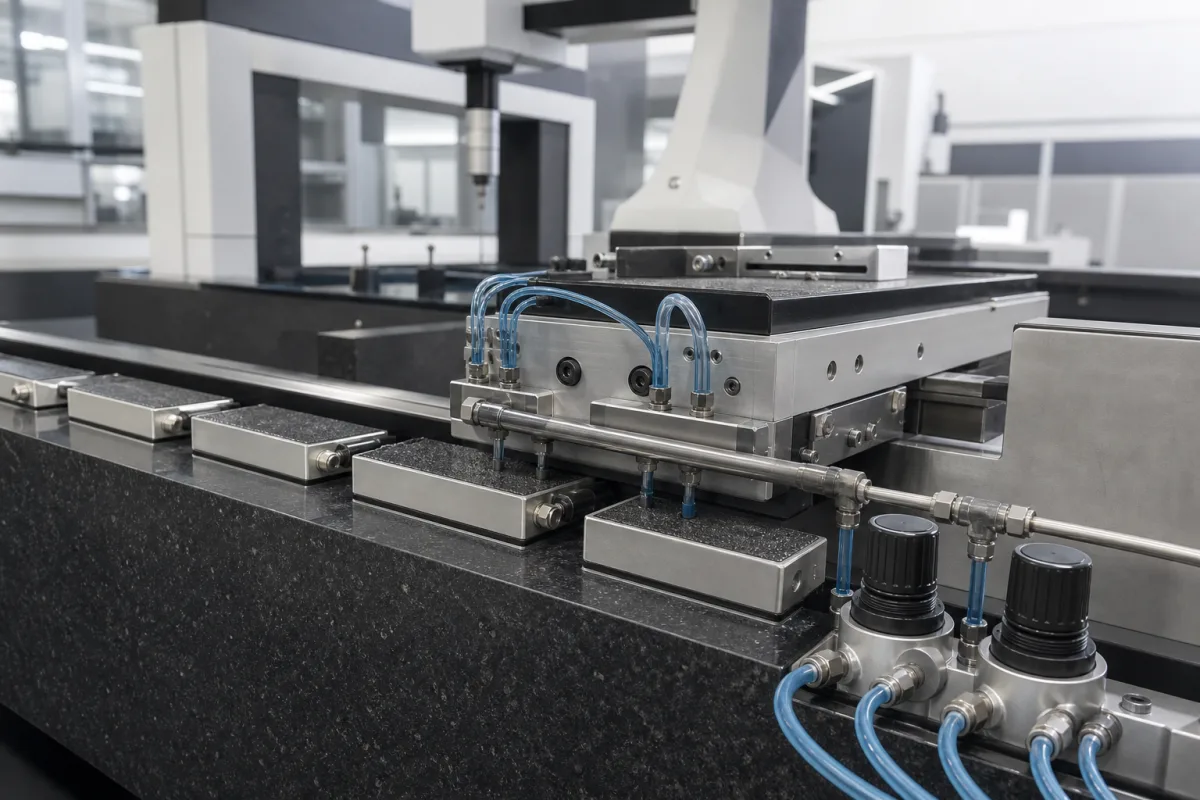
A canonical Air Bearing System is characterized by the integration of Bearing Pad/Orifice Plate and Guideway/Rail. In industrial production environments, manufacturers listed on CNFX commonly emphasize Granite construction to support stable, high-cycle operation across diverse manufacturing scenarios.

A precision motion system that uses compressed air to create a frictionless bearing surface for ultra-smooth linear or rotational movement.

Product Specifications

Technical details and manufacturing context for Air Bearing System

Definition
The Air Bearing System is a critical component of Precision Industrial Coordinate Measuring Machines (CMMs) that enables the probe or measuring head to move with near-zero friction and vibration. It functions by emitting a thin film of compressed air between the moving element (such as a carriage or spindle) and its guide surface, creating a non-contact, frictionless bearing. This eliminates mechanical wear, stick-slip motion, and thermal deformation, which are essential for achieving the micron- or sub-micron level accuracy and repeatability required in high-precision dimensional metrology.
Working Principle
Compressed, filtered air is supplied to the bearing pads or orifices. As the air escapes through small gaps, it creates a pressurized film that lifts and separates the moving component from the stationary guideway (e.g., granite base or guide rail). This air gap, typically a few microns thick, supports the load and allows for smooth, frictionless motion in multiple axes (X, Y, Z). The system's stiffness and load capacity are determined by air pressure, bearing surface area, and the design of the air flow channels.
Common Materials
Granite, Ceramic, Stainless Steel, Aluminum Alloy
Technical Parameters
  • Flatness and straightness of the guide surface critical for bearing performance. (μm) Customizable
Components / BOM
  • Bearing Pad/Orifice Plate
    Distributes compressed air to create the lifting film. Contains precisely machined orifices or porous media.
    Material: Stainless Steel or Ceramic
  • Guideway/Rail
    Provides the ultra-flat, smooth reference surface against which the air bearing operates.
    Material: Granite or Ceramic-coated Steel
  • Air Supply Manifold
    Distributes filtered, regulated compressed air from the source to multiple bearing pads.
    Material: Aluminum Alloy or Stainless Steel
  • Precision Air Filter/Regulator
    Removes contaminants and moisture from the compressed air and maintains constant pressure.
    Material: Stainless Steel, Synthetic Filter Media
Engineering Reasoning
0.5-10 bar (50-1000 kPa) with 0.1 bar resolution
0.3 bar minimum supply pressure for film formation, 12 bar maximum before structural deformation
Design Rationale: Aerostatic bearing failure occurs when air film thickness drops below 5 μm, causing asperity contact and adhesive wear (Stribeck curve transition from hydrodynamic to boundary lubrication)
Risk Mitigation (FMEA)
Trigger Particulate contamination > ISO 4406 Class 14/12/9 in supply air
Mode: Orifice clogging leading to pressure drop below 0.3 bar
Strategy: Install 0.3 μm absolute filtration with differential pressure monitoring at 0.1 bar threshold
Trigger Thermal expansion mismatch between granite base (α=8×10⁻⁶/K) and aluminum carriage (α=23×10⁻⁶/K)
Mode: Geometric error accumulation exceeding 2 μm/300 mm travel at ΔT>5°C
Strategy: Material pairing with matched CTE (e.g., ceramic-coated steel at α=11×10⁻⁶/K) and active thermal control to ±0.5°C

Industry Taxonomies & Aliases

Commonly used trade names and technical identifiers for Air Bearing System.

Industrial Ecosystem & Supply Chain DNA

Complementary Systems
Downstream Applications
Specialized Tooling

Application Fit & Sizing Matrix

Operational Limits
pressure: 0.2 to 0.8 MPa (2 to 8 bar)
flow rate: 10 to 100 L/min per bearing
temperature: -20°C to +80°C
slurry concentration: Not applicable - clean, dry air required
Media Compatibility
✓ Clean, dry compressed air ✓ Inert gases (N2, Argon) ✓ Clean laboratory environments
Unsuitable: Abrasive particle-laden or corrosive atmospheres
Sizing Data Required
  • Load capacity (N)
  • Required travel/rotation range (mm or degrees)
  • Positioning accuracy/repeatability (μm or arc-sec)

Reliability & Engineering Risk Analysis

Failure Mode & Root Cause
Air film instability
Cause: Contaminated air supply (particles, oil, moisture) or insufficient air pressure/flow causing uneven air film distribution and direct surface contact.
Surface degradation
Cause: Abrasive wear from particulate ingress or chemical attack from incompatible lubricants/cleaners, leading to loss of surface flatness and permeability.
Maintenance Indicators
  • Audible scraping or grinding noise during operation indicating direct contact
  • Visible vibration or irregular motion of the supported load
Engineering Tips
  • Implement triple filtration (coalescing, particulate, adsorption) with dew point monitoring for compressed air supply
  • Establish regular surface flatness verification using precision straightedges and non-contact profilometry

Compliance & Manufacturing Standards

Reference Standards
ISO 1217:2009 (Displacement compressors - Acceptance tests) ANSI/ASME B46.1-2019 (Surface Texture) DIN 31699-1:2016 (Hydrostatic bearings - Part 1: Terms and definitions)
Manufacturing Precision
  • Flatness: ≤0.005 mm per 100 mm
  • Bore diameter: H6 tolerance class (±0.008 mm for 50 mm bore)
Quality Inspection
  • Air film thickness uniformity test (using capacitance probes)
  • Leakage rate test (pressure decay method)

Factories Producing Air Bearing System

Verified manufacturers with capability to produce this product in China

✓ 97% Supplier Capability Match Found

P Procurement Specialist from Canada Feb 08, 2026
★★★★★
"Reliable performance in harsh Machinery and Equipment Manufacturing environments. No issues with the Air Bearing System so far."
Technical Specifications Verified
T Technical Director from United States Feb 05, 2026
★★★★★
"Testing the Air Bearing System now; the technical reliability results are within 1% of the laboratory datasheet."
Technical Specifications Verified
P Project Engineer from United Arab Emirates Feb 02, 2026
★★★★★
"Impressive build quality. Especially the technical reliability is very stable during long-term operation."
Technical Specifications Verified
Verification Protocol

“Feedback is collected from verified sourcing managers during RFQ (Request for Quote) and factory evaluation processes on CNFX. These reports represent historical performance data and technical audit summaries from our B2B manufacturing network.”

19 sourcing managers are analyzing this specification now. Last inquiry for Air Bearing System from USA (1h ago).

Supply Chain Compatible Machinery & Devices

Hydraulic Press

Industrial machine using hydraulic pressure to compress, form, or assemble materials

Explore Specs →
Heavy-Duty CNC Plasma Cutting Machine

Industrial machine for precision metal cutting using plasma arc technology

Explore Specs →
Automated Assembly Line System

Integrated production system for sequential component assembly operations

Explore Specs →
Automated Powder Coating System

Integrated industrial system for applying dry powder coatings to metal substrates.

Explore Specs →

Frequently Asked Questions

What materials are used in air bearing systems for maximum precision?

Our air bearing systems utilize granite bases for stability, ceramic or stainless steel bearing surfaces for durability, and aluminum alloy structural components, ensuring vibration-free operation with sub-micron accuracy.

How does the air supply system maintain consistent bearing performance?

A precision air filter/regulator maintains clean, stable air pressure to the manifold and bearing pads, while the orifice plate design ensures even air distribution for consistent frictionless motion across all operating conditions.

What maintenance is required for industrial air bearing systems?

Minimal maintenance is needed: regular inspection of air filters, cleaning of guideway surfaces, and monitoring of air pressure. The non-contact design eliminates mechanical wear, significantly reducing downtime compared to traditional bearings.

Can I contact factories directly on CNFX?

CNFX is an open directory, not a transaction platform. Each factory profile provides direct contact information and production details to help you initiate direct inquiries with Chinese suppliers.

Get Quote for Air Bearing System

Request technical pricing, lead times, or customized specifications for Air Bearing System directly from verified manufacturing units.

Your business information is encrypted and only shared with verified Air Bearing System suppliers.

Thank you! Your message has been sent. We'll respond within 1–3 business days.

Need to Manufacture Air Bearing System?

Connect with verified factories specializing in this product category

Add Your Factory Contact Us
Previous Product
Air Bearing Pads/Mechanical Guideways
Next Product
Air Blower