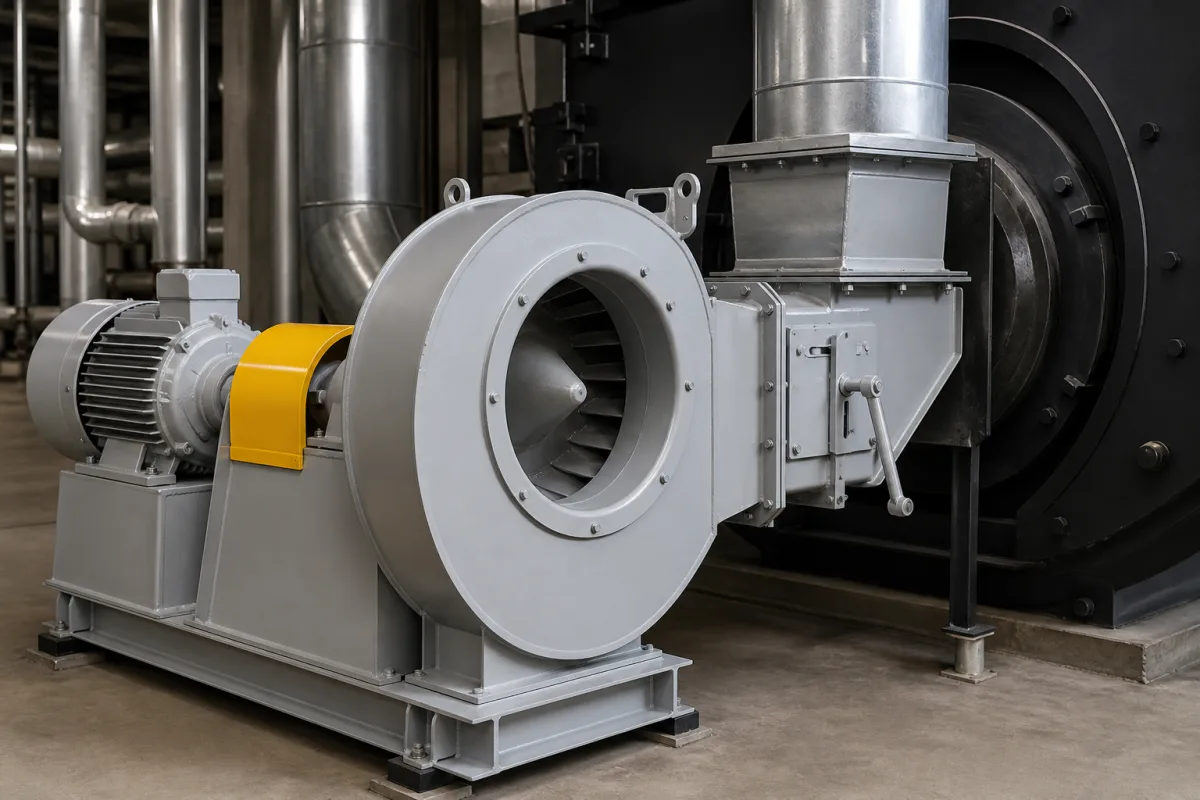
Air blower for wastewater aeration and low-pressure process air (rotary lobe, multistage and single-stage centrifugal)
Aeration and process air blowers · rotary lobe, multistage, integrally geared and turbo designs, discharge pressure from basin depth, turndown and wire-to-air efficiency
An air blower in this sense supplies large volumes of oil-free air at well under 1 bar gauge: to the diffusers of an activated-sludge basin, to flotation cells, or to pneumatic conveying lines. Aeration is where its electricity bill shows, because US EPA puts the aeration process at 25 to as much as 60 percent of total energy use in a wastewater plant. The decisions that set that bill are the blower type, the discharge pressure the basin depth and pipework impose, and how far the blower can reduce its flow at night and in low-load seasons without wasting power.
Positive-displacement (rotary lobe and screw) blowers and multistage, integrally geared and high-speed turbo centrifugal blowers that supply low-pressure process air, chiefly for wastewater aeration, with their packages, flow control and efficiency. General-purpose centrifugal ventilation fans, their fan laws and field tests are covered on the Centrifugal fan (industrial centrifugal blower) page; blowers supplying combustion air to furnace burners are covered on the Combustion air blower for industrial furnace burners page. Diffusers, dissolved-oxygen control systems, handheld and floor-drying blowers, hot-air guns and air knives are outside this page.
CNFX editorial research · Sources checked October 12, 2026 · 3 sources
Rotary lobe, multistage, integrally geared or turbo: what each blower type delivers
US EPA's review of aeration energy measures divides blowers into positive displacement machines, which give a fixed volume of air per shaft revolution over a wide range of discharge pressures, and centrifugal machines, which give a wide range of flow over a narrow range of pressure. It adds that aeration blowers deliver air at a typical pressure of 5 to 14 psi. [1]
Editorial calculation: 5 to 14 psi is about 345 to 965 mbar (1 psi ≈ 68.95 mbar), which is the band both maker ranges below are built around. [1]
Aerzen lists its Delta Blower Generation 5 rotary lobe units at volume flows of 30 to 15,000 m³/h and differential pressures from −500 to 1,000 mbar, oil-free to ISO 8573-1 class 0, with IE3 motors as standard. [2] Atlas Copco gives its ZM 4-6 oil-free multistage centrifugal blowers a range up to 1.1 bar(g) (16 psig) and 9,200 m³/h, with a choice of fixed speed with an inlet throttling valve or variable speed drive, and names aeration in large wastewater treatment sites as one use. [3]
Air or magnetic bearings, about 40,000 rpm typical [1]
Small footprint; good efficiency at turndown; more units needed for large plants [1]
Give the supplier the design air flow at stated inlet conditions (for example 1.0 bar, 20 °C, 0% humidity, the basis Aerzen uses), minimum and maximum flow, discharge pressure at the blower flange, site altitude and summer air temperature, number of duty and standby units, and whether the air is for aeration, flotation or conveying.
02
Discharge pressure from diffuser depth, and what each extra 300 mbar costs in motor power
For a diffused-air basin the blower has to overcome the water depth above the diffusers plus losses in the diffusers and pipework, so pressure is fixed by the plant before the blower is chosen.
Editorial calculation: one metre of water exerts about 98 mbar, so diffusers 5 m below the surface need about 490 mbar of static pressure before diffuser and pipe losses are added; obtain those losses from the diffuser supplier and the pipework design.
Aerzen's positive-pressure table shows how pressure drives power in one frame size range: the GM 50 L delivers 3,288 m³/h at 700 mbar with a 90 kW motor, while the GM 60 S delivers 3,528 m³/h at 1,000 mbar with 132 kW. [2] Editorial calculation: 132 ÷ 90 ≈ 1.47, so about 47% more installed motor power for about 7% more flow at 300 mbar higher pressure. The same table runs from the GM 3 S (240 m³/h at 1,000 mbar, 11 kW) to the GM 240 S (14,640 m³/h at 800 mbar, 500 kW). [2]
Aerzen quotes flows converted to suction conditions of 1.0 bar, 20 °C and 0% relative humidity, and sound pressure up to 86 dB(A) for its largest positive-pressure unit with an acoustic enclosure. [2] Ask each supplier to state flow on the same suction basis, because a figure quoted at different inlet conditions does not compare directly.
03
Turndown and efficiency: VFD, inlet throttling, guide vanes and diffuser vanes
EPA's Table 5-3 gives rule-of-thumb nominal efficiencies and turndown for each blower type, noting significant variation from small to large blowers and that the values may vary with the application. [1]
EPA notes that positive displacement blowers cannot be throttled and are controlled by VFD or by running units in parallel, and cites WEF (2009) that VFD operation of multistage centrifugal blowers is 15 to 20 percent more efficient than throttling. Inlet guide vanes on a single-stage blower pre-rotate the intake air, which reduces flow more efficiently than throttling, and variable outlet diffuser vanes let flow and pressure be managed independently. [1]
For the system as a whole EPA states that blower systems should be designed, as a general rule, for a minimum 5:1 turndown, meaning operation at one fifth of full capacity, which a single blower in the table cannot reach on its own. [1] Editorial calculation: a 5:1 system turndown is 20% of full capacity, so with single blowers turning down to 45–60% of their rating the remaining range has to come from the number and size of units installed. Atlas Copco states that its VSD follows air demand with energy savings of up to 35%, and that energy takes over 80% of a blower's life-cycle cost. [3]
Capital cost against energy: one plant's five-way blower comparison
EPA reports how the City of Oneida, New York, chose blowers for its 2.5 mgd activated sludge plant on a 10-year life-cycle cost analysis (2003 dollars, 4% inflation), replacing 20-year-old multistage centrifugal blowers. [1]
Editorial calculation: the single-stage offer cost about 2.7 to 4 times as much to buy but its annual energy cost was 58,000 ÷ 93,800 ≈ 0.62 of the cheapest multistage offer, about 38% lower, which is what gave it the lowest net present value. These are 2003 figures for one plant; use them to see how the comparison is built, and ask suppliers for guaranteed power at your own duty points.
Send the air demand, pressure and duty profile together
Paste it into your enquiry below or into an email to a maker, then replace every bracket.
Use: [wastewater aeration; flotation; conveying; other]
Air flow: [design, minimum and maximum; inlet condition basis]
Pressure: [diffuser depth; diffuser and pipe losses; discharge pressure at flange]
Site: [altitude; maximum and minimum air temperature]
Units: [duty and standby; turndown needed for the system]
Type: [rotary lobe; screw; multistage; integrally geared; turbo]
Control: [VFD; inlet throttle; guide vanes; DO or pressure control interface]
Guarantees: [power at duty points; noise with enclosure; oil-free class]
7 companies list this product among what they make. Company figures are quoted from each
company's own website; every card states where the relationship came from.
IERS Machinery Technology (Shandong) Co., Ltd.
Manufacturing site to be confirmed for the order
Lists aeration blowers for wastewater treatment, with Roots air blowers and high-speed turbo blowers as separate categories.
Explore company information and manufacturing capabilities, then discuss the scope of your project with a relevant supplier.
Share this page
Compiled and source-reviewed by the CNFX editorial team.
Each manufacturer above links to the page on that company's own website where the product is listed, with the date we checked it. How we source and review
· Page last updated 13 October 2026
Buyer questions
Which aeration blower types have the highest nominal efficiency?
US EPA's 2010 table gives 70–80% nominal efficiency for single-stage integrally geared and turbo blowers, 50–70% for multistage centrifugal and 45–65% for variable-speed positive displacement, noting the values vary with application. [1]
What pressure does a wastewater aeration blower supply?
EPA gives a typical 5 to 14 psi; Aerzen's rotary lobe Delta Blower range goes to 1,000 mbar and Atlas Copco's ZM multistage to 1.1 bar(g). [1][2][3]
How far can an aeration blower turn down?
EPA lists nominal turndown to 45–60% of rated flow depending on type, and recommends designing the blower system as a whole for a minimum 5:1 turndown. [1]
Sources and what still needs a direct check
Sources checked 2026-10-12. US EPA's 2010 report (EPA 832-R-10-005) compiles blower data from WEF and Black & Veatch and plant case studies; Aerzen and Atlas Copco publish ratings for their own rotary lobe and multistage centrifugal blowers.