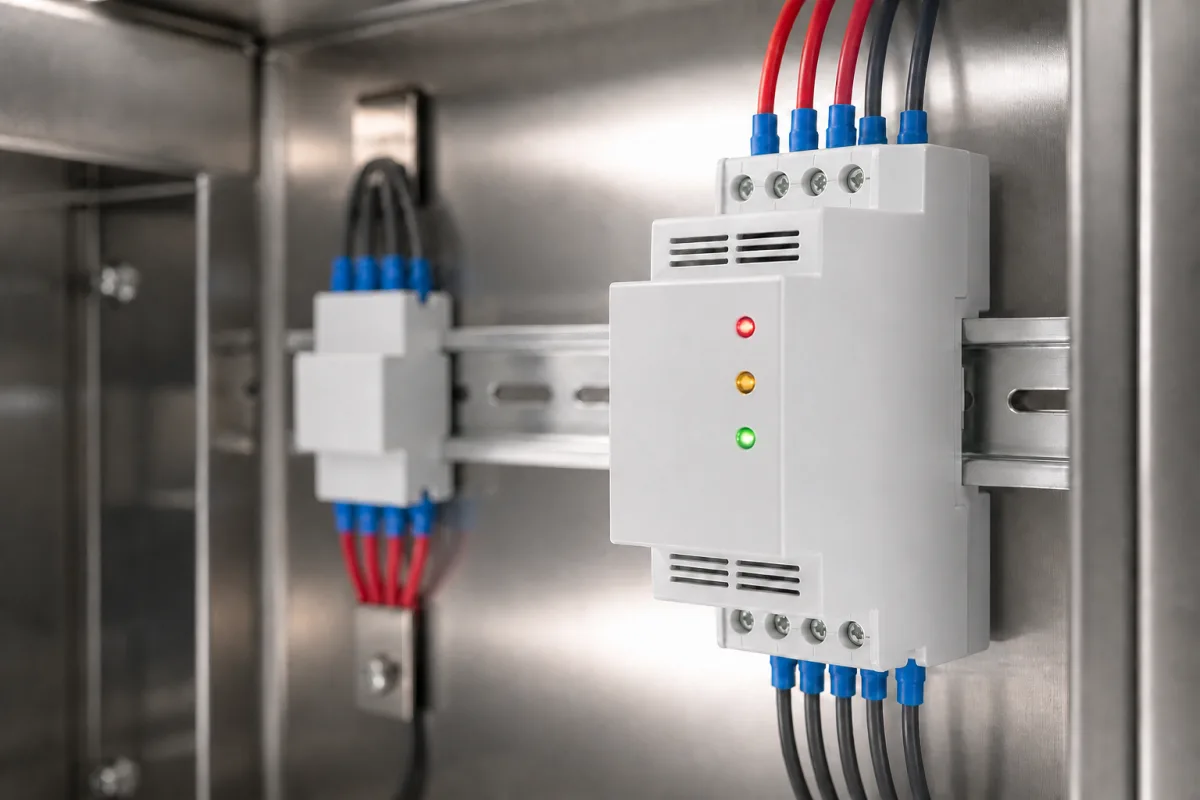
Temperature alarm module: DIN-rail trip unit that switches a relay when an RTD or thermocouple reading crosses a limit
DIN-rail temperature alarm (trip) modules · RTD or thermocouple in, relay contacts out, with trip point, hysteresis, delay, latching and a sensor-break relay
A temperature alarm module, also called a trip amplifier or process limit alarm, is a DIN-rail unit that takes a temperature sensor signal and drives one or more relay contacts when the reading passes a set limit. Its relays feed a horn, beacon, PLC input or shutdown circuit; the module itself has no heating or cooling output. When choosing one, decide what the relay should do at the limit, how far the temperature must fall back before it resets, how long the limit must be exceeded before it trips, and what happens if the sensor breaks.
DIN-rail temperature alarm and trip modules with RTD or thermocouple inputs and relay outputs, including programmable process limit alarms and safety-certified trip alarms. Panel and DIN-rail temperature controllers that switch heaters under PID or on/off control, with their own limit controllers, are covered on the Temperature controller page; sound-and-light annunciators that are triggered by a PLC or digital input are a separate product.
CNFX editorial research · Sources checked October 12, 2026 · 3 sources
Set the trip point, hysteresis and delay that decide when the relay switches
Three published trip modules show how differently the same functions are set: Datexel's DAT5024-P by front potentiometers and DIP switches (or a PC cable), PR electronics' 4116 by a plug-on display/programming front, and Moore Industries' STA by front-panel pushbuttons with password protection. [3][2][1]
On the DAT5024-P the trip level is adjustable from 2% to 98% of full scale with a setting accuracy of 0.3% of full scale when set by potentiometer. [3] Editorial calculation for a Pt100 input configured 0 to 200 °C (a 200 °C span): the hysteresis can be set from 1 °C to 20 °C, the potentiometer setting accuracy is about ±0.6 °C, and the input accuracy is ±0.2 °C, since 0.1% of the span and the 0.2 °C floor are equal.
Moore states a trip response time of 256 ms maximum from a step change on the input to a change of alarm state, for an alarm set at the mid-point of the step, and a reference-junction compensation accuracy of ±0.45 °C for thermocouple inputs. [1] PR's 4116 can be set to switch on rising or falling input, and its window function holds the relay in one state between a low and a high setpoint and in the other state outside it. [2]
State the sensor type and range, each trip point, whether it is a high, low or window alarm, the reset band, the delay, and what the contacts switch (voltage, current, AC or DC).
02
Decide what the relay does when the sensor breaks and whether the alarm latches
A temperature alarm that stays silent with a broken RTD gives false reassurance, so the three modules treat sensor faults explicitly. PR's 4116 offers sensor error detection with the relay set to break, make or hold, and a separate relay function that is activated by sensor error; its front LED flashes green at 13 Hz in normal operation and at 1 Hz on a sensor error. [2]
Moore's STA dedicates its third relay to input and instrument faults such as loss of sensor or bad-quality input; unit faults always latch, input faults can be set to latch or not, and the process alarms can be set latching or non-latching and normally open or closed. [1] PR's latch function holds a relay in the alarm state until an operator resets it from the front, and only once the input no longer meets the trip condition; a relay set to the error function latches on sensor error and does not reset by itself when the fault clears. [2]
On Datexel's DAT5024-P each threshold is configured by DIP switch as a maximum or a minimum, and the module provides an auxiliary supply of more than 18 V at 20 mA for a two-wire transmitter on its current input. [3]
03
Use a SIL-certified trip alarm where the relay is part of a shutdown function
Moore's STA is exida-certified to IEC 61508:2010 for systematic integrity up to SIL 3 and random integrity up to SIL 2, which Moore states means approval for single use in a safety instrumented system up to SIL 2 and in redundant architectures such as 1oo2 or 2oo3 up to SIL 3; FMEDA data are provided on request. [1]
PR describes its 4116 as designed as a SIL 2 device that provides SFF and PFDavg failure data for SIL 2 applications under IEC 61508 and IEC 61511, with failure rates corresponding to Performance Level d under ISO 13849. If its optional output monitoring finds the 4–20 mA output differing from the calculated value or at 0 mA, it lights the red LED and disables the relays until power is cycled. [2] Datexel's DAT5024-P datasheet lists EMC and UKCA conformity but no SIL rating. [3]
For a shutdown duty, ask for the SIL certificate, the FMEDA report and the proof-test procedure for the exact model and firmware.
04
Data for a temperature alarm module enquiry
Paste it into your enquiry below or into an email to a maker, then replace every bracket.
Sensor: [Pt100, Pt1000, thermocouple type; 2-, 3- or 4-wire]
Range: [measuring span in °C]
Alarms: [number; high, low or window; trip points]
Reset: [hysteresis in °C; latching or self-resetting]
Delay: [seconds before trip and before reset]
Sensor fault: [relay action on break or short; separate fault relay]
Contacts: [load voltage and current; AC or DC; NO or NC]
Supply and space: [supply voltage; module width; ambient temperature]
Safety: [SIL level required; certificate]
Explore company information and manufacturing capabilities, then discuss the scope of your project with a relevant supplier.
Share this page
Compiled and source-reviewed by the CNFX editorial team.
Each manufacturer above links to the page on that company's own website where the product is listed, with the date we checked it. How we source and review
· Page last updated 13 October 2026
Buyer questions
What is the difference between a temperature alarm module and a temperature controller?
The alarm module only switches relay contacts when the reading crosses a set limit; it has no control output for a heater or cooler. Moore describes its STA as warning of unwanted conditions, providing emergency shutdown or simple on/off control. [1]
How long can the trip be delayed?
1 to 25 s on Datexel's DAT5024-P, 0 to 120 s on Moore's STA, and 0 to 3,600 s for both ON and OFF delay on PR's 4116. [3][1][2]
What happens if the RTD breaks?
Depending on the model, a dedicated fault relay trips (Moore STA) or the alarm relays can be set to break, make or hold on sensor error (PR 4116). [1][2]
Sources and what still needs a direct check
Sources checked 2026-10-12. Specifications come from three makers' own documents: Moore Industries' STA datasheet (August 2025), PR electronics' 4116 product manual (V106) and Datexel's DAT5024-P datasheet. Values apply to the models named.