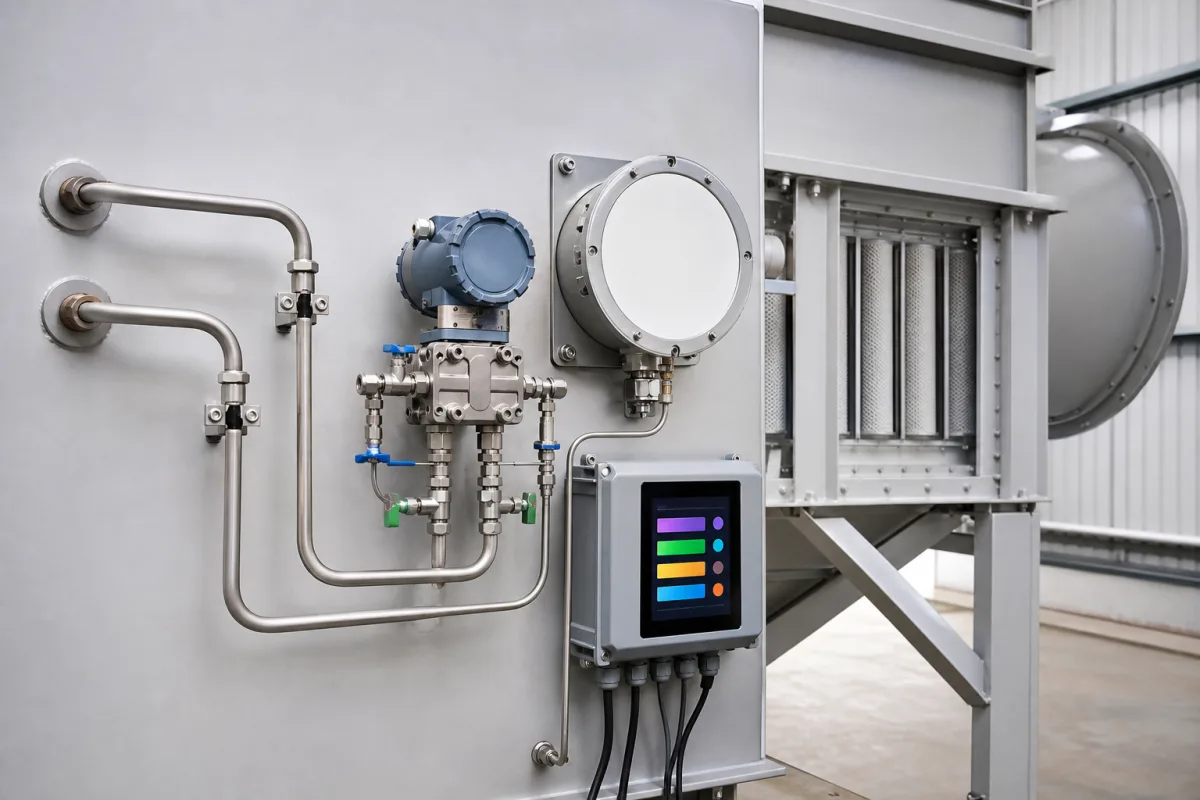
Pressure monitoring system for a dust collector (differential pressure across the filters, and the limits that start and stop pulse cleaning)
Reading the pressure drop across the filters of a pulse-jet dust collector · inches of water column, high and low limits that start and stop cleaning, high and low alarms, 4-20 mA to the plant system, sensing tubing that keeps condensate out, and where pressure drop sits among compliance indicators
As dust builds up on bags or cartridges, the pressure drop across them rises. A pressure monitoring system reads that difference between the dirty-air and clean-air sides, shows it, raises alarms, and on an on-demand collector tells the pulse timer when to start and stop cleaning. The buyer decides the range, the limit and alarm points, the output to the plant control system, and how the sensing lines are run.
Differential pressure measurement, display, alarms and cleaning limits on bag and cartridge dust collectors. General-purpose pressure transmitters are covered on the Industrial pressure sensors and transmitters page; sensor cores on the Pressure transducer sensing element: oil-filled piezoresistive sensor core page; the collector itself on the Dust collector page; pulse valves, headers and timers on the Pulse-jet cleaning system for bag and cartridge filters (header, pulse valves, blowpipes and timer) page; bag cages on the Filter bag cage page.
CNFX editorial research · Sources checked October 13, 2026 · 2 sources
Dwyer's Bulletin E-97 for the DCT1000 dust collector timer controller describes two ways to clean on demand: plug-in pressure modules (DCP100A/200A), or "an external pressure switch (such as the Dwyer Photohelic®) can be used for High/Low limit control". With a module installed, the High Limit "sets the pressure at which the cleaning cycle will begin" and the Low Limit "sets the pressure where the cleaning cycle will end". [1]
If the High Limit is set below the Low Limit, the manual says cleaning begins when the High Limit is exceeded and stops when pressure falls below it, and "The Low Limit in this case will have no effect." High and low alarm set points are separate from the cleaning limits, and an auto alarm reset (0 to 255 s, default 5 s) clears an alarm once pressure has returned to the normal range. A down time clean input forces cleaning for 0 to 255 minutes (default one minute). [1]
On the sensing lines, the manual warns: "Care should be observed when routing the air hoses to ensure that any potential condensation or moisture will not drain into the sensor. Where heavy condensation is present, a drip loop or an in-line filter should be installed". It adds that "periodic calibration may be desirable", with the module returned to the factory. [1]
State the collector's normal operating pressure drop from its maker, choose a range that covers it with margin, and give the cleaning limits, alarm points and auto-reset time to the supplier.
02
What pressure drop can and cannot show
EPA's Air Emissions Monitoring Knowledge Base says that "As dust builds up on the filter surface, the pressure drop across the filter increases", and that the filter material is cleaned periodically to avoid excessive pressure drops. [2]
For performance, EPA names particulate matter outlet concentration, measured by a PM CEMS or a bag leak detection system, as the best indicator, with opacity also an indicator. Pressure differential is listed among "Other indicators of performance", with inlet temperature, temperature differential, exhaust gas flow rate, cleaning mechanism operation and fan current. EPA also notes that condensation can cause bag blinding, which blocks air flow through the bag. [2]
If the collector is under an air permit, check whether the permit names pressure drop, bag leak detection or opacity as the monitored parameter, and what range and averaging it sets, before choosing the instrument and logging.
03
Dust collector pressure monitoring details
Paste it into your enquiry below or into an email to a maker, then replace every bracket.
Collector: [bag; cartridge; pulse-jet; air volume]
Normal pressure drop: [maker's value]
Range: [10 in. w.c.; 20 in. w.c.; other]
Cleaning: [continuous; on-demand high/low limits]
Alarms: [high; low; auto reset]
Output: [4-20 mA; relay; logging]
Sensing lines: [tubing I.D.; drip loop; filter]
Permit: [monitored parameter; range]
Explore company information and manufacturing capabilities, then discuss the scope of your project with a relevant supplier.
Share this page
Compiled and source-reviewed by the CNFX editorial team.
Each manufacturer above links to the page on that company's own website where the product is listed, with the date we checked it. How we source and review
· Page last updated 13 October 2026
Buyer questions
What starts and stops on-demand cleaning?
In Dwyer's DCT1000, the High Limit pressure starts the cleaning cycle and the Low Limit pressure ends it. [1]
What range do the pressure modules cover?
The DCP modules come in 10 in. w.c. or 20 in. w.c. ranges, with a 4-20 mA output. [1]
How should the sensing tubing be run?
So condensation cannot drain into the sensor; with heavy condensation, Dwyer calls for a drip loop or in-line filter. [1]
Is pressure drop the best measure of filter performance?
EPA names PM outlet concentration or bag leak detection as the best indicators; pressure differential is among the others. [2]
Sources and what still needs a direct check
Sources checked 2026-10-13. Dwyer Instruments publishes Bulletin E-97 for the DCT1000 controller (hosted by Omega); EPA publishes the fabric filter page of its Air Emissions Monitoring Knowledge Base.