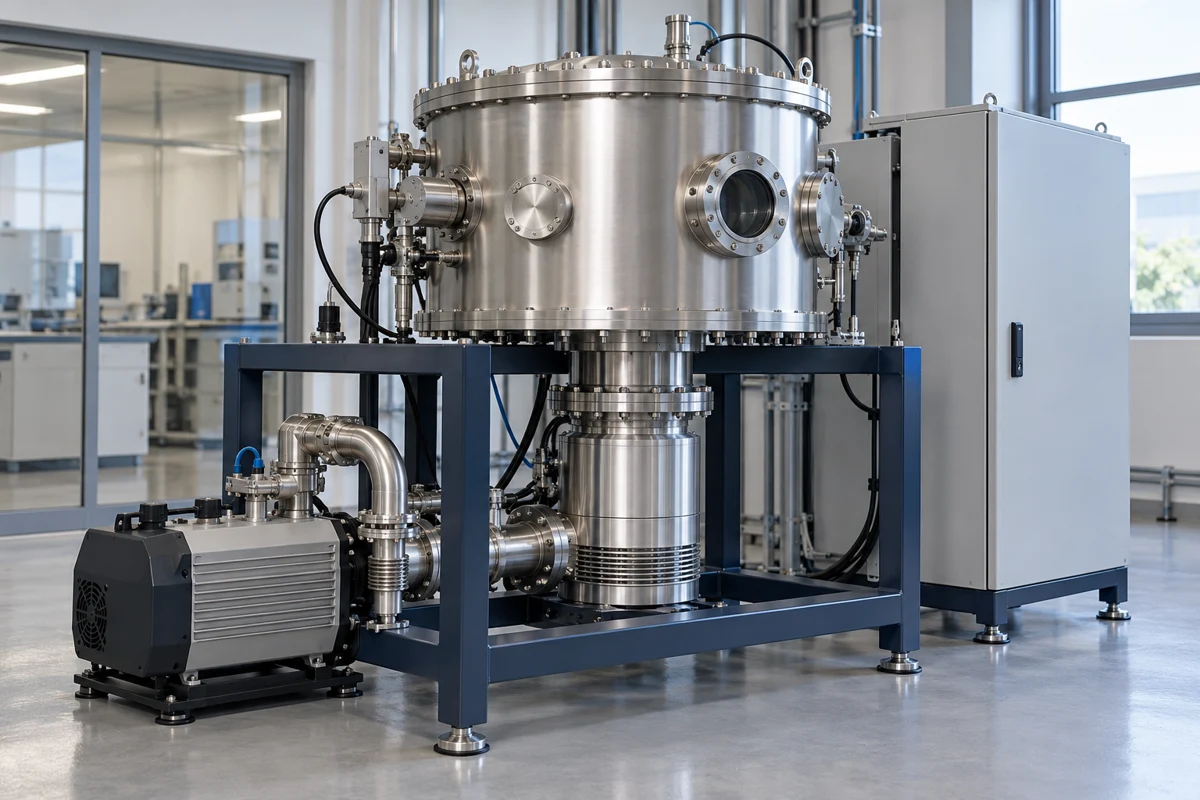
Follow the gas from the vacuum chamber through a turbomolecular pump to its backing pump. Compare gas-specific performance, understand the components, and check the flange and cooling details before specifying the system.
CNFX editorial research · Sources checked October 12, 2026 · 8 sources
The component list depends on how the pump removes gas
High vacuum describes a pressure range, not one machine design. This guide concentrates on turbomolecular systems; cryopumps and sputter-ion pumps use different gas-capture mechanisms. The table is a functional component reference, not a manufacturing BOM for the Baosi model. [3][6][7]
Component / pump family
Function
Material and configuration boundary
Rotor · turbomolecular
Moving blades transfer momentum to gas molecules. [3]
The Baosi page does not identify rotor alloy, coating or replacement part number. [5]
Stator · turbomolecular
Stationary blades alternate with the rotor stages; Holweck designs use helical stator channels. [3]
No stator material or drag-stage configuration is stated for FFZ250/2000PM-W. [5]
Bearing system · turbomolecular
Supports the rotating assembly. ISO 21360-4 covers both mechanical- and magnetic-bearing designs. [2]
Baosi states grease lubrication, but does not specify bearing material or service interval. Do not infer magnetic levitation from the category name. [5]
Cold surface / cryopanel · cryopump
Retains gas by condensation or adsorption; regeneration releases the accumulated gas. [6]
Leybold describes activated charcoal on inner cryosorption panels. This is a cryopump construction example, not a Baosi turbopump material specification. [6]
Cathode · sputter-ion pump
Ion bombardment sputters getter material; ions can also be implanted in the cathode. [7]
Leybold describes titanium cathodes and stainless-steel anodes. These belong to an ion-pump electrode system. [7]
In a turbomolecular pump, fast-moving rotor blades transfer momentum to gas molecules. Stationary blades alternate with the rotor stages; the combined stages move gas toward the foreline, where the backing pump takes over. Molecular flow is essential to this pumping action. A Holweck stage, where fitted, adds a rotating sleeve and helical stator channels downstream. Its presence must be checked for the offered model. [3]
A cryopump instead holds gas on cold panels, including adsorbent-coated surfaces for gases that are difficult to condense. A sputter-ion pump uses ion bombardment, sputtered getter material and implantation to retain gas. A cryopanel or cathode therefore is not an optional component of the rotor assembly in the turbopump described below. [6][7]
For a replacement-parts order, request the manufacturer’s exploded drawing, part numbers and material list for the exact pump serial number. The component functions above do not establish interchangeable parts.
02
State the target pressure, not just "high vacuum"
Range names are conventions. One leading supplier divides the scale as below and notes that the division is somewhat arbitrary [1].
Bakeout, all-metal sealing and hydrogen performance become deciding factors
Give pressures with units. Datasheets mix Pa, hPa and mbar: 1 hPa equals 1 mbar, and 1 Pa is 0.01 mbar.
03
A turbopump is half a system: choose the backing pump with it
ISO 21360-4:2018 says a turbomolecular pump's performance cannot be fully defined by its pumping-speed curve, because it is backed by a primary pump; backing pressure and the drive also matter [2]. ISO lists the 2018 edition as current, confirmed in 2024, with a replacement under development; confirm the contractual edition when ordering. [2]
Classic turbopumps need a low backing pressure
Pure rotor–stator turbopumps need a fore-vacuum of about 10⁻² hPa to keep molecular flow. Designs with added Holweck (drag) stages can discharge against 0.5 to 5 hPa, which lets a diaphragm pump do the backing [3]. Ask which type you are being offered and its maximum backing pressure.
Oil-sealed backing pumps carry a backflow risk
Pfeiffer identifies an oil-backflow risk when a turbopump backed by an oil-sealed rotary vane pump is switched off, especially with incorrect operation. Its comparison discusses dry alternatives, but is not a current price quotation. Specify your contamination limit before choosing the backing pump. [3]
The supplier should state the backing pump it assumes
A Chinese turbomolecular pump page specifies a backing pump of 15 L/s for its 2000 L/s model, without naming a pump type [5]. Ask for the backing pump type, pumping speed and the backing pressure behind every quoted ultimate pressure.
Pfeiffer measured these results with its HiPace 300 H (February 2022 publication, Table 1, p. 10). They are not FFZ250/2000PM-W test results. The same publication notes the gas-load limitation of compression-optimized pumps. [3]
04
Nitrogen figures do not tell you about hydrogen
A turbopump's compression ratio rises with the molecular mass of the gas, so it is much higher for nitrogen than for hydrogen [3].
Compression ratio by gas
Pfeiffer’s discussion of low-ultimate-pressure designs uses about 10⁹ for nitrogen and 1,000 for hydrogen as design context, not a universal acceptance requirement. Baosi publishes 1 × 10⁸ for N₂ and 6 × 10³ for H₂ for FFZ250/2000PM-W. Compare the specified gases and test conditions rather than applying a category-wide minimum. [3][5]
Pumping speed by gas
The Chinese model page gives 2000 L/s for N₂ only [5]. Ask for helium and hydrogen speeds if those gases are in your process or used for leak testing.
Measurement basis
ISO 21360-4 adds throughput, backing pressure and a curve of compression ratio against backing pressure to the performance data [2]. Ask whether quoted figures were measured to it.
Ultimate pressure
Baosi’s summary states CF: 5 × 10⁻⁷ Pa and LF: 6 × 10⁻⁶ Pa. In its two-column parameter table, the CF250 column instead shows 6 × 10⁻⁶ Pa and the LF250 column 6 × 10⁻⁷ Pa. The discrepancy includes the flange mapping and a changed coefficient. Neither pair is accepted here as the confirmed rating. Request a corrected, flange-specific data sheet and its backing-pump/test conditions. [5]
05
Match the flange, seal and bakeout limits separately
Pfeiffer’s connection guide gives the pressure capabilities below for particular flange and seal arrangements. They are connection capabilities, not a guarantee of the pressure a complete chamber will reach. [4]
Down to 1 × 10⁻⁸ hPa with O-rings; below 1 × 10⁻⁹ hPa with metal seals and special clamps [4]
ISO-K / ISO-F (clamped or bolted)
DIN 28404 and ISO 1609; ISO-K DN 10 to DN 630, ISO-F up to DN 1000 [4]
Down to 1 × 10⁻⁸ hPa with O-rings; below 1 × 10⁻⁹ hPa with metal seals [4]
CF (copper gasket)
ISO 3669:2026 is the current knife-edge flange dimensional standard. Pfeiffer’s older size discussion cites ISO/TS 3669-2; compare the actual mating dimensions rather than relying on that superseded reference. [8][4]
Pfeiffer describes CF connections for below 1 × 10⁻¹² hPa and bakeout up to 450°C. This does not authorize baking the pump, controller or every gasket to 450°C. Used copper gaskets must be replaced. [4]
Baosi offers CF250 or LF250 inlet and KF40 outlet. Its “LF250” designation needs a mating drawing; do not silently convert it to an ISO-K or ISO-F specification. Request bolt/clamp details, seal type and the pump’s own inlet bakeout limit. [5]
06
Read the FFZ250/2000PM-W record with its missing conditions
This is one Baosi water-cooled turbomolecular model, not a specification range for all high-vacuum pumps. Values are manufacturer claims from the linked page. Unpublished fields remain questions for the quotation. [5]
Parameter
Published value or evidence gap
What the quotation needs to resolve
Ultimate pressure · Pa
Summary and parameter table disagree; exact values are compared above. [5]
One corrected value for each flange, with backing pump, gas and measurement conditions.
Mating dimensions, seal and hardware—not just a nominal diameter.
The published rotational speed is 24,000 rpm. This is rotor speed, not the incoming supply frequency. Baosi does not identify the associated controller model. [5]
07
Utilities and installation the supplier must confirm
Values below are from one Chinese turbopump page and show what to ask for, not a general rule.
Cooling
The page states water cooling, water temperature ≤25 without a unit and flow ≥1 L/s. Do not silently change the flow to L/min. Ask for a corrected utility schedule with inlet pressure, water quality and loss-of-flow protection. [5]
Power and run-up
Maximum power ≤750 W at 220 V, run-up time under 7 minutes [5]. Confirm whether the controller and cables are in the scope of supply.
Mounting and bearings
The feature list says grease lubricated and installation at any angle; the table gives 40 kg and vibration ≤0.15 μm. A later generic application paragraph calls these pumps oil-lubricated. Request the model’s own lubrication and mounting instructions to resolve that wording. [5]
Venting
Not stated on the page [5]; ask how the pump is vented after shutdown and with what gas.
08
Maintenance instructions must match the pumping mechanism
For FFZ250/2000PM-W, obtain the manufacturer’s shutdown, venting and bearing-service procedure before commissioning. The public product page gives neither a venting sequence nor a grease specification or replacement interval. Its run-up time is not a rotor-stop time. Request the conditions for safe access, power-loss behavior and cooling-failure response in the operating manual. [5]
For removable CF joints, Pfeiffer requires a new copper gasket after disassembly and controlled, even heating and cooling during bakeout. Keep flange maintenance separate from servicing the rotating pump; the flange’s temperature capability is not the pump’s allowable temperature. [4]
For a cryopump, a service plan must include regeneration: retained gases are released when the cryopanels are warmed. Leybold distinguishes full and partial regeneration. That process is specific to gas-capture pumps and is not a turbopump bearing-maintenance instruction. [6]
09
Copy this RFQ and fill in the brackets
Paste it into your enquiry below or into an email to a maker, then replace every bracket.
Product: high-vacuum pump, type [turbomolecular / turbodrag; other capture-pump requirement separately], quantity [units]
Chamber: volume [L], target base pressure [value] mbar, working pressure [value] mbar
Gases pumped: [N2 / H2 / He / process gases], gas load [mbar·L/s]
Required data: pumping speed for [N2/He/H2], compression ratio for [N2/H2], compression ratio vs backing pressure curve (ISO 21360-4 if available)
Inlet flange: [ISO-KF / ISO-K / ISO-F / CF] DN [size]; outlet flange: [type, size]
Backing pump: [existing model and speed / please propose: rotary vane / diaphragm / Roots], maximum backing pressure accepted
Cooling: [water / air], available water [°C, L/min]; power supply [AC/DC, V, Hz]; pump/controller enclosure [IP requirement]
Controller, cables and venting valve: [included / not needed]
Orientation: [vertical / horizontal / any]; bakeout required: [yes °C / no]
Documents: data sheet tying ultimate pressure to flange and backing pump, test report for the supplied unit, dimensioned installation drawing, gas-contact materials, venting/power-loss instructions and bearing service interval
Delivery to [country], target date [date]
1 company lists this product among what they make. Company figures are quoted from each
company's own website; every card states where the relationship came from.
Ningbo Baosi Energy Equipment Co., Ltd.
Fenghua, Ningbo, Zhejiang (contact address), CN
Baosi lists FFZ250/2000PM-W with water cooling, 2000 L/s N₂ pumping speed and CF250/LF250 inlet options. Its pressure and lubrication conflicts are explained in this guide. The public listing supports the model offering; it does not independently verify unit performance or model certification.
Product scope checked 2026-10-09
Listed on the company's own website · profile compiled by CNFX from public sources
Explore company information and manufacturing capabilities, then discuss the scope of your project with a relevant supplier.
Share this page
Compiled and source-reviewed by the CNFX editorial team.
Each manufacturer above links to the page on that company's own website where the product is listed, with the date we checked it. How we source and review
· Page last updated 13 October 2026
Buyer questions
Can a diaphragm pump back a turbopump?
Yes, for a compatible turbodrag design and gas load. Pfeiffer reports 0.5–5 hPa for diaphragm-backed arrangements with Holweck stages, while classic rotor–stator designs need about 10⁻² hPa. Its HiPace 300 H test with an MVP 015-2 backing pump reached 2.75 × 10⁻¹¹ hPa at 3 hPa fore-vacuum; that result does not establish compatibility with a different pump. [3]
Why is hydrogen hard to pump to low pressure?
A turbopump's compression ratio grows with the gas's molecular mass, so it is much lower for hydrogen than for nitrogen. Ask for hydrogen compression and pumping speed separately. [3][5]
Which flange do I need for ultra-high vacuum?
Pfeiffer describes CF metal-sealed connections for below 1 × 10⁻¹² hPa, whereas its O-ring ISO-KF and ISO-K/F examples extend to 1 × 10⁻⁸ hPa. Confirm the complete system and seal selection. The guide’s 450°C CF bakeout figure applies to the connection, not to every attached pump or controller. [4]
What pressure counts as high vacuum?
One convention is 10⁻³ to 10⁻⁷ mbar, with ultra-high vacuum below that; the boundaries are a convention, so state your target pressure in numbers. [1]
Can CF copper gaskets be reused?
Pfeiffer says used CF copper gaskets must be replaced. Its guide separately allows repeated use of suitable FKM seals around 1 × 10⁻⁸ hPa; that is a different seal arrangement and pressure capability, not permission to reuse a copper gasket. [4]
Sources and what still needs a direct check
Sources checked 2026-10-12. Standards bodies and regulations define the requirements; manufacturer pages show published ranges for those models only. CNFX does not certify products or suppliers.
Baosi’s CF/LF ultimate-pressure values and flange mapping conflict between the summary and table. No corrected model data sheet has been obtained.
Cooling temperature lacks a unit; the printed water flow is ≥1 L/s. Neither has been normalized or treated as a confirmed site-utility requirement.
Baosi’s feature list says grease lubrication, while its application paragraph says oil lubrication. Bearing material, service interval and shutdown/venting procedure remain unconfirmed.
The ISO sources used here are public catalogue abstracts, not the full paid standards. ISO 21360-4:2018 remains listed as current with a replacement under development; ISO 3669:2026 is published.
Pfeiffer’s backing-pump results belong to its HiPace 300 H and the named backing pumps. They are not a test of the Chinese model.
The manufacturer relationship below is supported by its public product listing. That does not establish a supplied unit’s performance, product certification or inspection status.
Buyer enquiry
Request manufacturing insight
for High-Vacuum Pump
Ask for use case, specification boundaries, supplier type, and RFQ preparation
information for this product.
Where it goes
Straight to the CNFX editorial desk, and to the manufacturer if this product is
linked to a claimed profile. Nothing is broadcast to a supplier list.
Your details stay here
We do not sell or rent enquiry data, and we do not add you to a mailing list.
Used only to answer this request.
No commission, no middleman
CNFX is a directory. We take no cut of any order and never negotiate on a
supplier's behalf.
What to include
Share your product specifications, quantity, destination and target delivery date.
Need to Manufacture High-Vacuum Pump?
Compare manufacturer profiles with relevant product and process capability.