Industry-Verified Manufacturing Data (2026)

Cap Hopper & Elevator

Based on aggregated insights from multiple verified factory profiles within the CNFX directory, the standard Cap Hopper & Elevator used in the Machinery and Equipment Manufacturing sector typically supports operational capacities ranging from standard industrial configurations to heavy-duty production requirements.

Technical Definition & Core Assembly

A canonical Cap Hopper & Elevator is characterized by the integration of Bulk Storage Hopper and Elevator Conveyor/Mechanism. In industrial production environments, manufacturers listed on CNFX commonly emphasize Stainless Steel (AISI 304/316) construction to support stable, high-cycle operation across diverse manufacturing scenarios.

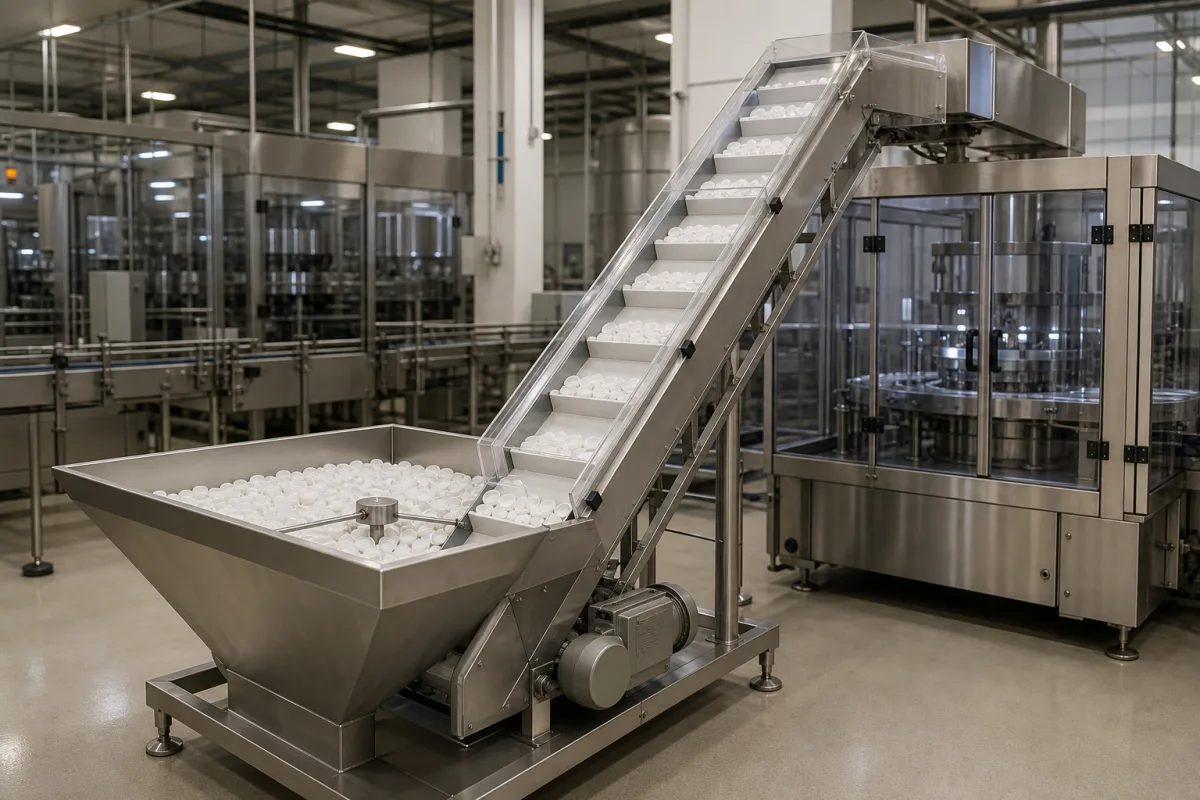
A feeding and transport subsystem within an aseptic capping unit that stores and elevates caps to the capping mechanism.
Product Specifications

Technical details and manufacturing context for Cap Hopper & Elevator

Definition
The Cap Hopper & Elevator is a critical component of an Aseptic Capping Unit, responsible for the bulk storage, orientation, and controlled elevation of caps from a hopper to the precise height required by the capping mechanism. It ensures a continuous, aseptic supply of caps to maintain high-speed production lines while preventing contamination.
Working Principle
Caps are loaded in bulk into the hopper. An integrated elevator mechanism, often a vertical conveyor belt with pockets or a screw elevator, gently lifts the caps from the bottom of the hopper. The system orients the caps correctly during ascent and delivers them singularly or in batches to the discharge chute at the top, which feeds directly into the capping head or placement station.
Common Materials
Stainless Steel (AISI 304/316), Food-Grade Plastics (e.g., Acetal, UHMW-PE)
Technical Parameters
  • Maximum cap feed/elevation rate (caps/min) Customizable
Components / BOM
  • Bulk Storage Hopper
    Holds a large volume of caps, often with vibratory or agitator mechanisms to prevent bridging and ensure consistent flow to the elevator intake.
    Material: Stainless Steel
  • Elevator Conveyor/Mechanism
    The core lifting device (e.g., belt with cleats, vertical screw) that transports caps from the hopper base to the discharge point.
    Material: Stainless Steel / Food-Grade Plastic
  • Orientation Guide/Rails
    Guides or channels within the elevator path that ensure caps are presented in the correct orientation (e.g., rim-down) for the capping process.
    Material: Stainless Steel / Engineering Plastic
  • Discharge Chute
    Directs the elevated and oriented caps from the elevator exit into the capping head or placement mechanism.
    Material: Stainless Steel / Transparent Plastic
Engineering Reasoning
0.5-2.0 m/s vertical transport velocity, 20-100 caps/minute feed rate, 0.1-0.3 MPa pneumatic pressure
Cap jam occurs at >0.5 mm cap misalignment, elevator chain slippage at >15% tension loss, motor overload at >120% rated torque for >30 seconds
Design Rationale: Cap misalignment exceeding hopper guide clearance causes mechanical interference; insufficient chain tension reduces frictional grip below 0.4 coefficient; motor thermal overload from sustained current >115% FLA
Risk Mitigation (FMEA)
Trigger Cap orientation sensor calibration drift exceeding ±0.2°
Mode: Misaligned cap entry causing mechanical jam at elevator inlet
Strategy: Install redundant optical sensors with 0.1° resolution and automatic calibration every 1000 cycles
Trigger Elevator chain wear reducing pitch diameter by >0.8 mm
Mode: Chain-sprocket tooth skipping causing intermittent cap transport failure
Strategy: Implement chain elongation monitoring with 0.1 mm resolution and automatic tension adjustment

Industry Taxonomies & Aliases

Commonly used trade names and technical identifiers for Cap Hopper & Elevator.

Applied To / Applications

This component is essential for the following industrial systems and equipment:

Industrial Ecosystem & Supply Chain DNA

Complementary Systems
Downstream Applications
Specialized Tooling

Application Fit & Sizing Matrix

Operational Limits
pressure: Atmospheric (non-pressurized)
other spec: Cap feed rate: 50-500 caps/min, Cap size range: 15-50mm diameter, Elevation height: 0.5-3m
temperature: Ambient to 60°C (140°F)
Media Compatibility
✓ Polypropylene caps ✓ HDPE caps ✓ Aluminum caps with plastic liners
Unsuitable: High-viscosity adhesive or lubricant-coated caps
Sizing Data Required
  • Cap dimensions (diameter, height, weight)
  • Required feed rate (caps per minute)
  • Elevation height from hopper to capping mechanism

Reliability & Engineering Risk Analysis

Failure Mode & Root Cause
Bearing seizure
Cause: Inadequate lubrication leading to overheating and metal-to-metal contact, often due to contamination or improper lubrication intervals.
Chain/belt wear and elongation
Cause: Excessive tension, misalignment, or abrasive material buildup causing accelerated wear and loss of proper engagement with sprockets/pulleys.
Maintenance Indicators
  • Unusual grinding or squealing noises from the elevator drive mechanism
  • Visible material spillage or leakage around hopper seals or elevator casing joints
Engineering Tips
  • Implement condition-based lubrication using vibration analysis and infrared thermography to optimize intervals and detect early bearing degradation.
  • Install wear-resistant liners in high-impact areas of the hopper and use alignment lasers during installation/rebuilds to ensure precise chain/belt tracking.

Compliance & Manufacturing Standards

Reference Standards
ISO 9001:2015 Quality Management Systems ANSI B20.1 Safety Standard for Conveyors and Related Equipment CE Machinery Directive 2006/42/EC
Manufacturing Precision
  • Shaft Alignment: +/-0.05mm
  • Hopper Welding Seam: 0.2mm maximum deviation
Quality Inspection
  • Non-Destructive Testing (NDT) for weld integrity
  • Load Capacity Verification Test

Factories Producing Cap Hopper & Elevator

Verified manufacturers with capability to produce this product in China

✓ 96% Supplier Capability Match Found

P Procurement Specialist from Australia Jan 03, 2026
★★★★★
"As a professional in the Machinery and Equipment Manufacturing sector, I confirm this Cap Hopper & Elevator meets all ISO standards."
Technical Specifications Verified
T Technical Director from Singapore Dec 31, 2025
★★★★★
"Standard OEM quality for Machinery and Equipment Manufacturing applications. The Cap Hopper & Elevator arrived with full certification."
Technical Specifications Verified
P Project Engineer from Germany Dec 28, 2025
★★★★★
"Great transparency on the Cap Hopper & Elevator components. Essential for our Machinery and Equipment Manufacturing supply chain."
Technical Specifications Verified
Verification Protocol

“Feedback is collected from verified sourcing managers during RFQ (Request for Quote) and factory evaluation processes on CNFX. These reports represent historical performance data and technical audit summaries from our B2B manufacturing network.”

6 sourcing managers are analyzing this specification now. Last inquiry for Cap Hopper & Elevator from Turkey (1h ago).

Supply Chain Compatible Machinery & Devices

Hydraulic Press

Industrial machine using hydraulic pressure to compress, form, or assemble materials

Explore Specs →
Heavy-Duty CNC Plasma Cutting Machine

Industrial machine for precision metal cutting using plasma arc technology

Explore Specs →
Automated Assembly Line System

Integrated production system for sequential component assembly operations

Explore Specs →
Automated Powder Coating System

Integrated industrial system for applying dry powder coatings to metal substrates.

Explore Specs →

Frequently Asked Questions

What materials are used in the cap hopper and elevator for food safety compliance?

Constructed with AISI 304/316 stainless steel and food-grade plastics like Acetal and UHMW-PE, ensuring corrosion resistance and meeting stringent food safety standards for aseptic environments.

How does the cap elevator maintain proper cap orientation during transport?

The system uses orientation guides and rails within the elevator conveyor mechanism to consistently align caps, preventing jams and ensuring smooth delivery to the capping mechanism.

What maintenance is required for the cap hopper and elevator subsystem?

Regular cleaning of the hopper, discharge chute, and conveyor components is recommended, along with periodic inspection of wear parts like plastic guides, to ensure optimal performance and hygiene in aseptic operations.

Can I contact factories directly on CNFX?

CNFX is an open directory, not a transaction platform. Each factory profile provides direct contact information and production details to help you initiate direct inquiries with Chinese suppliers.

Get Quote for Cap Hopper & Elevator

Request technical pricing, lead times, or customized specifications for Cap Hopper & Elevator directly from verified manufacturing units.

Your business information is encrypted and only shared with verified Cap Hopper & Elevator suppliers.

Thank you! Your message has been sent. We'll respond within 1–3 business days.

Need to Manufacture Cap Hopper & Elevator?

Connect with verified factories specializing in this product category

Add Your Factory Contact Us
Previous Product
Cap Hopper
Next Product
Cap Sorter/Elevator