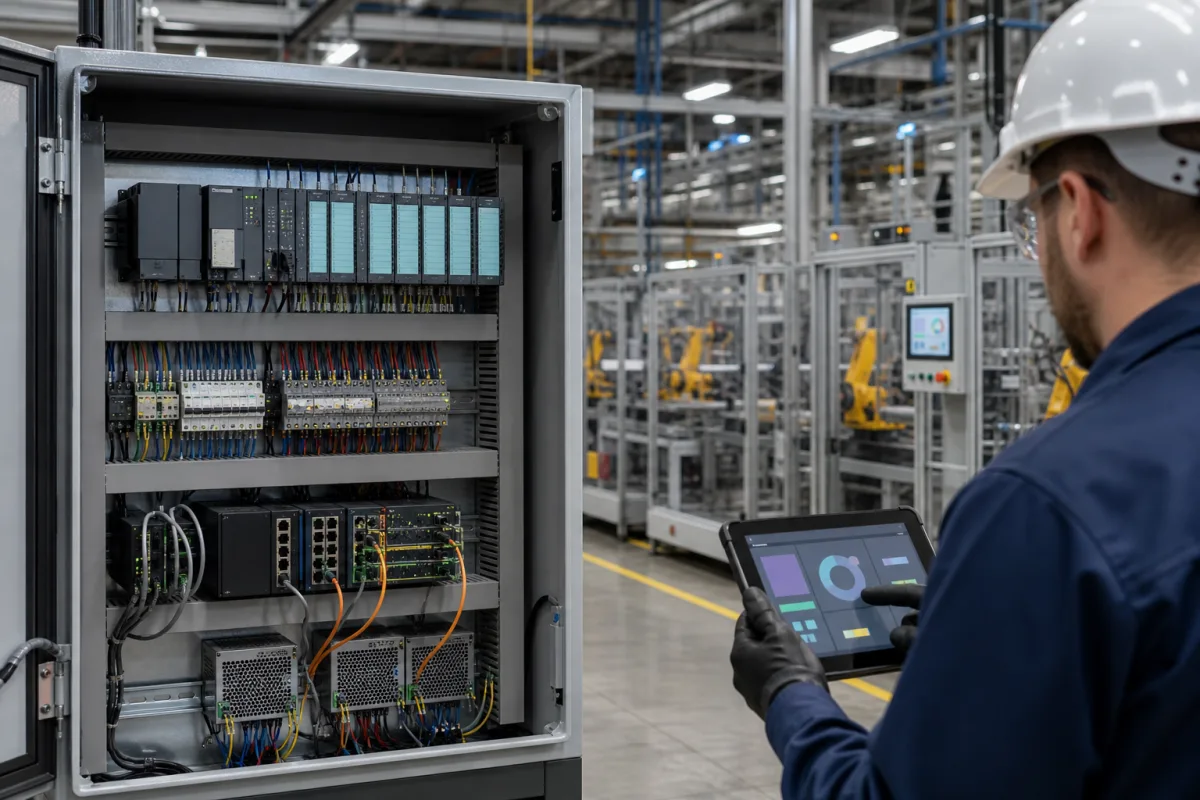
Central PLC controller: EtherCAT bus master that coordinates distributed I/O, servos and drives
Central PLCs as EtherCAT bus masters · One controller coordinating distributed I/O, servos and drives, cycle time and jitter, segment size, interpolation and electronic cams
This page covers the central controller of a machine or line when its I/O and drives are distributed on an EtherCAT network: one PLC acts as the bus master, runs the motion and logic, and exchanges process data with every device each cycle. Ask three things first: what cycle time and synchronisation the controller holds with your device count, which drives and I/O it supports on the bus, and which motion functions (interpolation, cams) it provides.
Central PLCs and bus controllers that act as EtherCAT masters for distributed I/O, servo drives, steppers and inverters on machines and lines. Compact PLCs with local and expansion I/O are covered on the Programmable logic controller (PLC) page. Industrial PCs, safety controllers and building or lighting controllers are outside this page.
CNFX editorial research · Sources checked October 12, 2026 · 3 sources
Check bus performance: cycle time, jitter and device count
The EtherCAT Technology Group states that EtherCAT, standardised in IEC 61158, was developed for short cycle times of 100 µs or less, low jitter for synchronisation of 1 µs or less and low hardware cost; up to 65,535 devices can be connected to one segment in line, tree or star topology, copper links run up to 100 m between nodes with fibre such as 100BASE-FX beyond that, and the effective data rate of a telegram exceeds 90%. Only the EtherCAT MainDevice may actively send frames; other nodes forward them, and distributed clocks synchronise the nodes in hardware with compensation for propagation delays. [1]
The ETG also states that the master can refresh drives at a short cycle time while sampling I/O at a longer one, that EtherCAT can assign addresses automatically, and that the architecture reduces CPU load by 25–30% compared with other bus systems at the same cycle time. [1][2]
Editorial calculation: at a 100 µs cycle the master exchanges process data 10,000 times per second; at 1 ms, 1,000 times. Ask the supplier for the cycle time it guarantees with your actual number of axes and I/O modules, not the protocol's lower limit. [1]
Give the supplier the number of servo axes, steppers, inverters and I/O points, required cycle time and synchronisation, cam or interpolation needs, programming standard (for example CODESYS), and the HMI and higher-level networks to connect.
02
Check motion functions and supported devices
Xinje describes its XDH series EtherCAT bus controller as integrating EtherCAT, communicating with its own distributed I/O, DS5C2 servo drives, DP3C steppers and VH6 inverters as well as other standard EtherCAT devices, and offering larger program capacity and faster processing. It lists three-axis linear, circular-arc and spiral interpolation and an electronic cam function in which up to 32 cam tables can be loaded, each storing up to 1,000 key points, used on capping, pillow packaging and blow moulding machines, plus look-ahead to protect accuracy where parts of the system lag. [3]
Xinje's download list for the series includes a CODESYS native platform device package, an XD/XL/XG series software manual and a flying shear process library. [3] Editorial calculation: 32 cam tables × 1,000 key points is up to 32,000 stored cam points. [3]
Editorial note: confirm which non-Xinje EtherCAT devices have been tested with the controller, and whether cam and interpolation run in the same cycle as the bus or in a slower task.
03
Central EtherCAT master, mixed cycle times and bus controllers with motion libraries
The choice is where I/O sits and how it is synchronised.
Architecture
What the source states
Ask for
Central EtherCAT master with distributed devices
≤100 µs cycles; ≤1 µs jitter; up to 65,535 devices per segment. [1]
1 company lists this product among what they make. Company figures are quoted from each
company's own website; every card states where the relationship came from.
Wuxi Xinje Electric Co., Ltd.
Manufacturing site to be confirmed for the order
Lists the XDH series EtherCAT bus controller with interpolation and electronic cam functions.
Explore company information and manufacturing capabilities, then discuss the scope of your project with a relevant supplier.
Share this page
Compiled and source-reviewed by the CNFX editorial team.
Each manufacturer above links to the page on that company's own website where the product is listed, with the date we checked it. How we source and review
· Page last updated 13 October 2026
Buyer questions
How fast is an EtherCAT bus?
The EtherCAT Technology Group states it was designed for cycle times of 100 µs or less with synchronisation jitter of 1 µs or less. [1]
How many devices can one EtherCAT controller address?
Up to 65,535 devices can be connected to one EtherCAT segment, according to the EtherCAT Technology Group. [1]
What motion functions does an EtherCAT bus controller offer?
Xinje lists three-axis linear, circular and spiral interpolation and electronic cams with up to 32 tables of 1,000 key points for its XDH series. [3]
Sources and what still needs a direct check
Sources checked 2026-10-12. The EtherCAT Technology Group describes its own technology; Xinje describes its own controller.