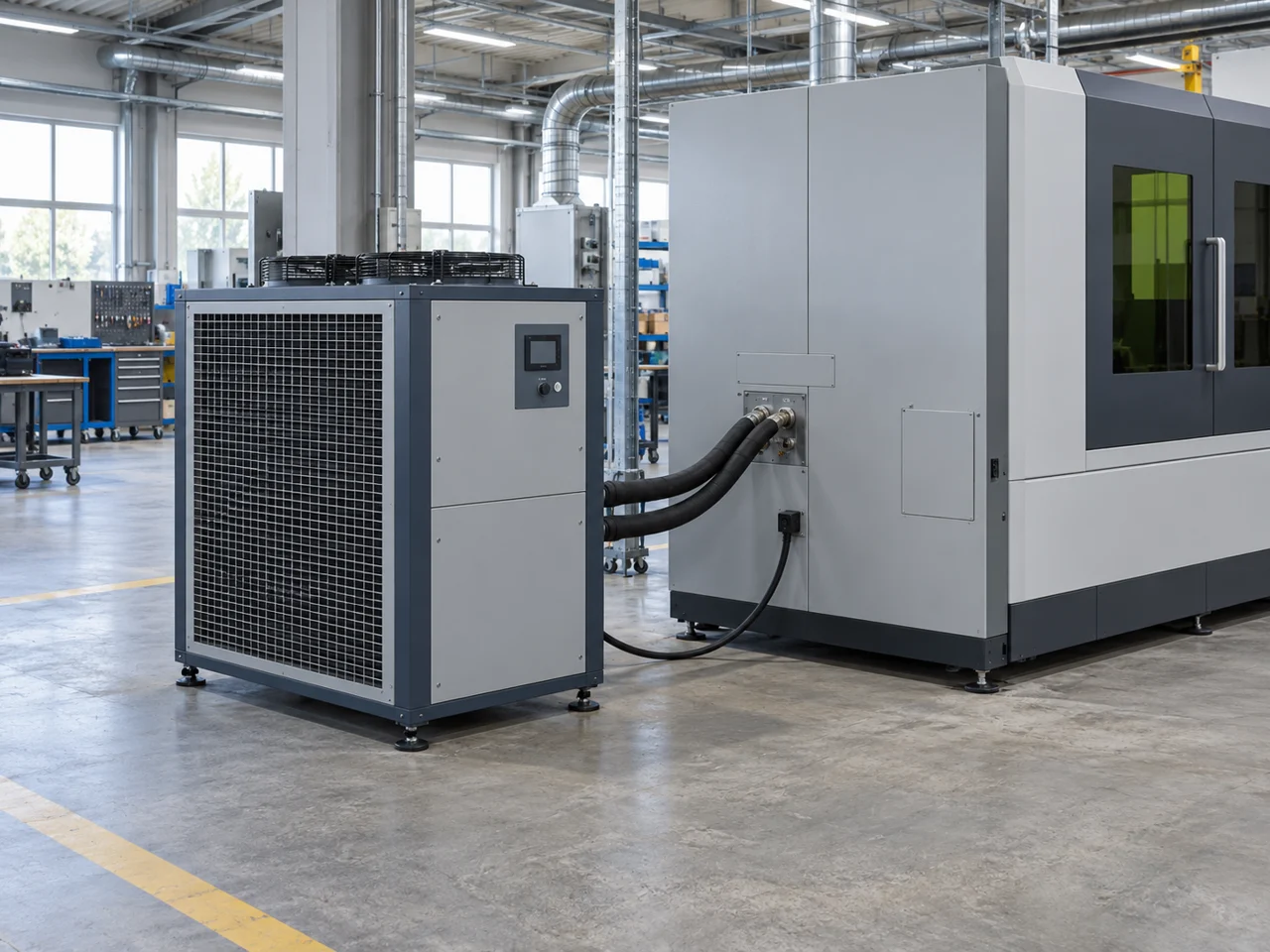
Process chiller: capacity, circulation and condensation
Process cooling · Buyer's guide
The refrigeration circuit removes heat from the circulating water; the water circuit carries heat away from the machine. A useful chiller specification ties both together: heat load at the required water temperature, flow through the actual hoses and equipment, and a temperature window that avoids condensation inside the machine.
CNFX editorial research · Sources checked October 12, 2026 · 10 sources
Follow the heat through two separate fluid circuits
In the refrigeration loop, the compressor raises the refrigerant pressure; the condenser rejects heat and condenses the refrigerant; an expansion device reduces pressure before the evaporator absorbs heat. The process-water pump circulates a different fluid between the machine and that evaporator. Danfoss explains the refrigeration mechanism; TopChiller’s AC table identifies the corresponding chiller components. [5][1]
Component structure / BOM reference
Role in this air-cooled arrangement
Construction supported by the source
Compressor
Circulate and compress refrigerant so heat can be rejected at the condenser. [5]
The AC catalogue lists hermetic compressor configurations. It does not provide housing material grades or service part numbers for each quoted unit. [1]
Air-cooled condenser
Transfer refrigerant heat to the surrounding air and condense the refrigerant. [5]
The AC table specifies finned copper tube with aluminium; this material statement belongs to the condenser, not every wetted surface in the water circuit. [1]
Condenser fans
Move air across the condenser; their intake and discharge are part of the installation layout.
External-rotor fans are listed with separate air-flow and motor-power figures. “Low noise” in the description is not a measured sound rating. [1]
Expansion device
Reduce refrigerant pressure before the evaporator. [5]
TopChiller lists capillary / thermostatic expansion valve alternatives. A valve is not established as fitted to every AC model, and its body material is not stated. [1]
Evaporator / process heat exchanger
Transfer heat from the returning process coolant into evaporating refrigerant. [5]
The AC table lists tank-coil, shell-and-tube and plate variants. Obtain the selected exchanger and all coolant-contact materials; the alternatives are not a single combined assembly. [1]
Water reservoir and circulating pump
Hold the process coolant and circulate it through the equipment circuit.
Tank volumes, pump motor powers and maximum lifts are listed. The table does not identify the pump housing, seals and all reservoir wetted grades for the quoted assembly; obtain its configuration drawing. [1]
Temperature control and protective devices
Control cooling and respond to abnormal temperature, level, pressure or flow.
TopChiller lists protections, but the catalogue does not establish each trip setting, sensor location or machine interlock. Obtain the supplied wiring and alarm schedule. [1]
Functional assembly reference, not a manufacturing BOM with quantities, certified material grades or interchangeable spare-part numbers. The water circuit and refrigerant circuit require separate fluid specifications; an air-cooled condenser still belongs to a refrigerant system.
02
Read cooling capacity at its rating conditions
TopChiller publishes the following selected AC-series rows at chilled-water inlet/outlet temperatures of 12/7 °C and cooling-air inlet/outlet temperatures of 33/38 °C. These are manufacturer catalogue values, not CNFX measurements. [1]
The rating outlet is 7 °C; the application may need another temperature
Obtain a capacity selection at the required leaving-water temperature, entering condenser-air temperature and specified coolant. The published rating point alone does not establish capacity across the application’s operating envelope. TopChiller’s page also gives different general water-temperature ranges in its prose; use a dated model-specific selection rather than combining them. [1]
Keep the cooling and electrical columns separate
For AC-3A, the arithmetic ratio 8.35 ÷ 3.27 is about 2.55. It compares the table’s 50 Hz cooling figure with its single input-power figure; it is not a seasonal efficiency rating or a part-load curve. For supply design obtain the actual voltage, phase, frequency, current and protection requirements from the supplied unit’s electrical schedule. [1]
Model
Capacity 50 / 60 Hz
Input power
Chilled water flow 50 / 60 Hz
Pump
Tank
AC-1A
2.85 / 3.42 kW
1.35 kW
0.49 / 0.59 m³/h
0.37 kW, 22 m max. lift
18.3 L
AC-3A
8.35 / 10.02 kW
3.27 kW
1.44 / 1.72 m³/h
0.37 kW, 22 m max. lift
50 L
AC-6A
16.9 / 20.28 kW
6.45 kW
2.91 / 3.49 m³/h
0.75 kW, 30 m max. lift
110 L
AC-10AD
27.9 / 33.48 kW
11.5 kW
4.8 / 5.76 m³/h
1.5 kW, 25 m max. lift
200 L
The selected 60 Hz capacity figures are 20% above the 50 Hz figures. This is a comparison within this table, not permission to connect a 50 Hz machine to a different supply. The table does not provide separate frequency-specific electrical-input values. [1]
03
Select a pump at the required flow, not at its maximum lift
For a steady sensible-heat balance, heat removal P = mass flow × specific heat × temperature rise. Using water density approximately 1 kg/L and specific heat 4.19 kJ/(kg·K), AC-3A’s 8.35 kW and 5 K rise give 8.35 ÷ (4.19 × 5) ≈ 0.399 kg/s ≈ 1.43 m³/h. That is close to the catalogue’s rounded 1.44 m³/h. This is an illustrative calculation, not a pump test; use the actual fluid properties for a glycol mixture. [7][1]
Start at the machine connections
Obtain the laser/source/head cooling requirements separately: heat load, allowed supply and return temperatures, minimum flow, pressure limits and coolant quality. Raycus monitors laser and output-cable flow separately; a single total flow reading may not establish both branch conditions. [3]
Match the circuit resistance to the pump curve
Grundfos describes the Q–H curve as the relationship between flow and head, used with the system characteristics. Evaluate the total circuit pressure loss at the required flow and obtain the pump head available there, with the supplied speed and coolant. [6]
Treat maximum lift as a limit, not a duty point
AC-3A’s listed 22 m maximum lift does not prove that 22 m remains available at 1.44 m³/h. TopChiller also labels a separate maximum-flow row “m³”, without a time denominator. Do not turn that row into an operating-flow guarantee or pair two maxima as one duty point. [1]
Investigate a falling branch flow
Raycus identifies scale or blockage as possible waterway problems and describes alarms when flow falls to a risk threshold. Low flow is a symptom to investigate; the article does not establish that every low-flow event is caused by scaling. [3]
04
Measure the dew point where the cold surfaces are exposed
Vaisala explains condensation through a cold pipe: it forms when the surface reaches the surrounding air’s dew point. For a laser, Raycus monitors internal air temperature, humidity and dew point. A room-air reading alone may miss the conditions inside the enclosure. [4][3]
Do not solve condensation by exceeding the equipment’s cooling limit
Specify a compatible operating window for both cooling and condensation protection. If there is no overlap, resolve the enclosure environment and cooling arrangement with the equipment maker. Raycus specifically describes adjusting the on-board air conditioner and water chiller using internal temperature, humidity and dew-point monitoring. [3]
Fixed-temperature control
TEYU’s control article describes a selected water setpoint, with a typical adjustment range of 5–35 °C. This is TEYU guidance, not an AC-series operating specification. [2]
Ambient-tracking control
The same article describes a default target 2 °C below ambient, limited to 20–30 °C: 15 °C ambient gives 20 °C water, and 33 °C ambient gives 30 °C water. It does not establish humidity-based dew-point sensing on every controller. [2]
The missing condition
An ambient offset does not by itself prove that exposed cold surfaces stay above the local dew point. Compare the equipment’s allowable cooling-temperature range with measured enclosure conditions; this is the application check derived from the condensation mechanism. [4][3]
05
Tie the protection list to the installed wiring and water circuit
TopChiller lists compressor, over-current, high/low refrigerant-pressure, over-temperature, discharge-overheat, flow, low-level, anti-freezing and phase-related protections. A catalogue list does not specify how a fault stops the connected machine. [1]
Identify flow-sensor locations and branch coverage, trip thresholds, alarm outputs and the equipment shutdown interface. Verify those functions during commissioning with the supplier’s approved test procedure. [1][3]
Request the actual voltage / phase / frequency configuration and electrical protection schedule. The AC table includes alternative power supplies; these are not an assurance that one unit accepts them all. [1]
State the exact refrigerant on the order and nameplate. The web table lists alternative refrigerants, but does not establish the configuration or destination compliance of a particular unit. [1]
For a deionized-water application, obtain a water-circuit drawing, wetted materials and the equipment maker’s water-quality limits. TopChiller advertises secondary-loop arrangements; their presence and construction must be identified on the selected configuration. [1]
06
Put measurement conditions beside each specification
Use these fields to specify the cooling duty and installation. Values below belong only to the identified AC-3A example; an unreported field remains an item to obtain, not an assumed capability. [1]
Field
Published example or unit
How to read it
Cooling capacity
AC-3A: 8.35 / 10.02 kW at 50 / 60 Hz
Keep the stated 12/7 °C water and 33/38 °C air conditions attached; obtain the application selection. [1]
Temperature control accuracy
°C; model-specific result required
Specify the measurement point, load, ambient and test duration. A setpoint range does not state stability or measurement error.
Water flow
AC-3A: 1.44 / 1.72 m³/h
Catalogue water-flow rows at 50 / 60 Hz; verify delivered branch flow against the installed Q–H duty. [1][6]
Operating pressure
kPa or bar; circuit identified
Separate water-side working pressure, pump differential pressure and refrigerant-side limits. Maximum pump lift is not a pressure rating for every hose or component. [6]
Refrigerant
Exact designation and charge required
The catalogue offers alternatives. Do not copy one refrigerant into every model specification. [1]
Power supply
V / phase / Hz
Use the ordered electrical configuration and nameplate, not a list of all available voltages. [1]
Electrical input
AC-3A: 3.27 kW in the web table
Separate from heat-removal capacity. Frequency-specific input, current and protection data need the unit schedule. [1]
Ambient operating range
°C; model-specific envelope required
The rating air temperatures do not define the minimum and maximum permissible ambient. [1]
Water-temperature range
°C; operating range and setpoint
Specify coolant and equipment limits; do not transfer TEYU’s controller range to TopChiller’s AC model. [2][1]
Enclosure protection
IP designation required
No verified AC-3A IP value is given in the specification table. Obtain the enclosure rating for the intended installation.
Noise
dB(A), test quantity and conditions required
The table’s low-noise fan wording does not give sound pressure/power, distance or load conditions. [1]
Weight
AC-3A: 152 kg net
Net catalogue mass; shipping mass and operating mass with coolant are separate installation inputs. [1]
Dimensions
AC-3A: 980 × 520 × 1170 mm, L × W × H
Cabinet dimensions from the table; obtain the drawing with hose connections, service access and air clearances. [1]
07
Use flow and coolant condition to guide maintenance
Raycus’s 2021 monitoring note calls for checking water level and cleaning the chiller air-inlet filter, watching changes in coolant colour or smell, and checking water filters for blockage. Those tasks address different parts of the heat path: air-side contamination and water-side restriction should not be treated as the same fault. [3]
Keep the maintenance schedule attached to the equipment manual
The Raycus article gives periodic checks and replacement limits for its guidance context. For the supplied machine, record the approved coolant, filter element, cleaning procedure and service intervals from its current manual. Do not replace coolant chemistry or open the refrigerant circuit based on a generic product page. [3]
08
Copy a specification for the cooling circuit
Paste it into your enquiry below or into an email to a maker, then replace every bracket.
Equipment / laser model and duty cycle: [ ]
Heat to remove per circuit: [kW]; cooling requirement source: [ ]
Coolant supply / maximum return temperature: [°C]; allowable stability at measurement point: [ ]
Required flow per branch: [L/min]; pressure loss at that flow: [kPa]
Equipment / hose pressure limits: [ ]; hose and coupling layout: [ ]
Coolant composition and water-quality limits: [ ]; wetted-material requirements: [ ]
Ambient min / max: [°C]; enclosure humidity or measured dew point: [ ]; indoor/outdoor: [ ]
Electrical supply: [V / phase / Hz]; refrigerant / destination requirements: [ ]
Alarm / interlock interface and commissioning test: [ ]
Required documents: capacity selection, pump curve, circuit drawing, electrical schedule, service manual
Installation space, ventilation and delivery location: [ ]
Quantity and required delivery date: [ ]
TopChiller’s AC table supplies the model examples above. GESON publishes process-cooling ranges; ECOAIR presents modular and screw chillers with a central-air-conditioning focus. Chillerone describes a group marketing and service role. Match the application and contracting entity before treating these records as independent factory quotations.
TopChiller
Shenzhen, Guangdong, China (published contact address)
Publishes AC-series laser/process chiller specifications, including cooling, flow, pump and tank data. Request a dated selection and circuit drawing for the actual laser or machine; dual circuits and deionized-water compatibility are configuration questions.
Dezhou, Shandong, China (published contact address)
Lists packaged, scroll, screw and modular chillers; describes itself as the group’s global marketing and service operation. The contact email is also used by TopChiller. These records do not establish two independent manufacturing companies; confirm the quotation issuer and build location.
Nanjing, Jiangsu, China (published contact address)
Publishes air-cooled and water-cooled process chillers, including scroll and screw configurations, with laser cooling among its applications. Its range-level catalogue does not establish the water quality, stability or branch arrangement required by a particular laser.
Ningbo, Zhejiang, China (published contact address)
Lists air-cooled modular and screw chillers, including cooling/heating and heat-recovery applications. This supports a chiller supply role; it does not by itself establish a dedicated precision laser-cooling configuration or a model’s certification status.
Explore company information and manufacturing capabilities, then discuss the scope of your project with a relevant supplier.
Share this page
Compiled and source-reviewed by the CNFX editorial team.
Sources support the stated product range and company role. They are not proof of independent ownership, a factory audit, model certification or suitability for a specific cooling circuit. How we source and review
· Page last updated 13 October 2026
Buyer questions
Why does a chiller’s stated capacity need test conditions?
The AC-series example is rated at 12/7 °C water and 33/38 °C air. That single point does not establish capacity at your coolant, leaving-water temperature and maximum ambient. Ask for that application selection. [1]
How much water flow does the AC-3A example require?
The 50 Hz table lists 1.44 m³/h. A simplified water heat balance for 8.35 kW and a 5 K rise gives about 1.43 m³/h, using density 1 kg/L and specific heat 4.19 kJ/(kg·K). The actual equipment’s branch-flow requirements and the pump curve still have to be met. [1][7][6]
Will setting water 2 °C below ambient prevent laser condensation?
That is the default ambient-tracking offset described in TEYU’s article, within its stated limits. It is not a universal condensation guarantee: cold surfaces must be assessed against the local dew point, while cooling stays within the laser’s permitted temperature range. Raycus monitors internal temperature, humidity and dew point. [2][4][3]
Is 60 Hz capacity higher than 50 Hz?
The four selected TopChiller rows list 60 Hz cooling capacities 20% above their 50 Hz figures. This is catalogue data for those configurations, not a universal rule or approval to change the frequency of a supplied unit. [1]
Sources and what still needs a direct check
Sources checked 2026-10-12. Standards bodies and regulations define the requirements; manufacturer pages show published ranges for those models only. CNFX does not certify products or suppliers.
Capacity at the selected coolant, water setpoint and site ambient; the published AC table gives only one temperature rating point.
An actual Q–H curve and available external head; the web table’s maximum-flow row omits a time unit.
Model-specific wetted materials, water-quality limits, control stability, enclosure protection, sound data and interlock settings.
Chillerone and TopChiller use the same contact email; legal contracting entity and manufacturing site need confirmation. Supplier model certifications have not been independently checked.
Buyer enquiry
Request manufacturing insight
for Chiller Unit
Ask for use case, specification boundaries, supplier type, and RFQ preparation
information for this product.
Where it goes
Straight to the CNFX editorial desk, and to the manufacturer if this product is
linked to a claimed profile. Nothing is broadcast to a supplier list.
Your details stay here
We do not sell or rent enquiry data, and we do not add you to a mailing list.
Used only to answer this request.
No commission, no middleman
CNFX is a directory. We take no cut of any order and never negotiate on a
supplier's behalf.
What to include
Share your product specifications, quantity, destination and target delivery date.
Need to Manufacture Chiller Unit?
Compare manufacturer profiles with relevant product and process capability.