Industry-Verified Manufacturing Data (2026)

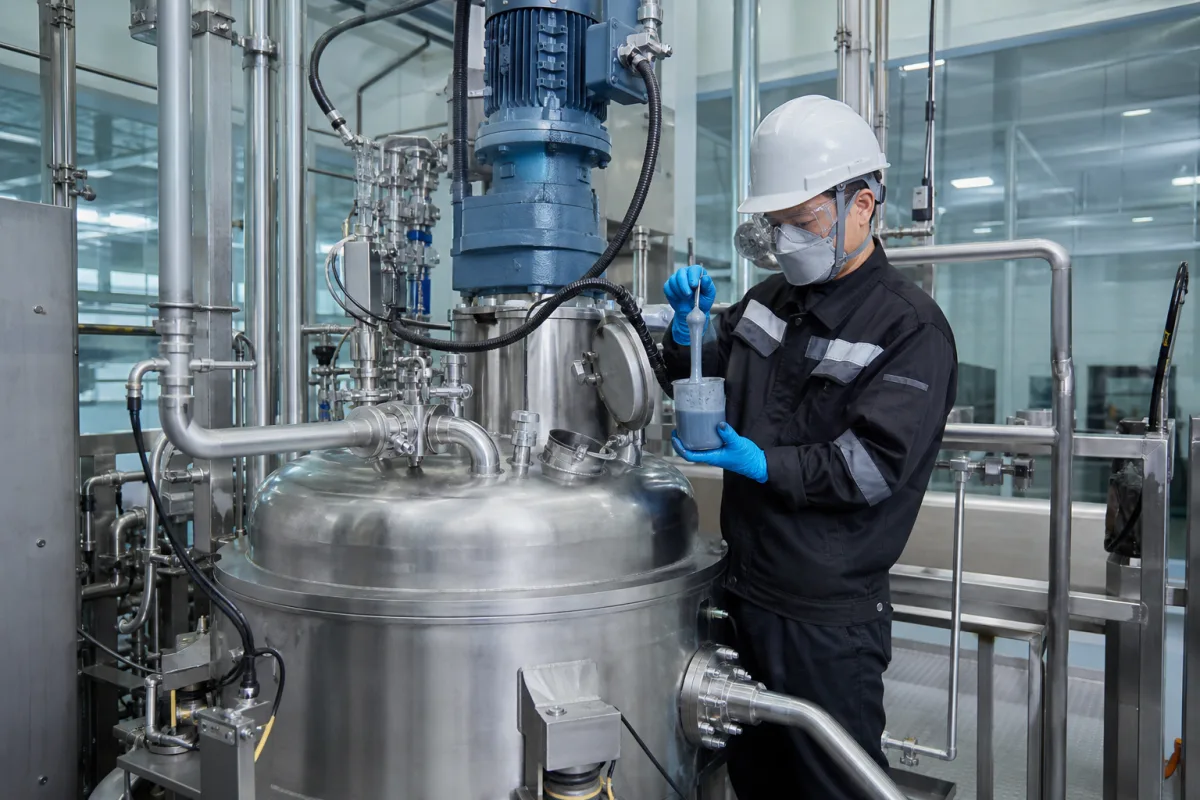
Coating Slurry Mixing Tank

Based on aggregated insights from multiple verified factory profiles within the CNFX directory, the standard Coating Slurry Mixing Tank used in the Machinery and Equipment Manufacturing sector typically supports operational capacities ranging from standard industrial configurations to heavy-duty production requirements.

Technical Definition & Core Assembly

A canonical Coating Slurry Mixing Tank is characterized by the integration of Mixing Impeller and Tank Body. In industrial production environments, manufacturers listed on CNFX commonly emphasize Stainless Steel 304/316 construction to support stable, high-cycle operation across diverse manufacturing scenarios.

A specialized tank designed for mixing coating slurry to ensure uniform consistency and proper suspension of particles before application in mold coating processes.

Product Specifications

Technical details and manufacturing context for Coating Slurry Mixing Tank

Definition
The Coating Slurry Mixing Tank is a critical component within the Automated Mold Preheating and Coating System, responsible for preparing the coating slurry by thoroughly mixing raw materials such as refractory powders, binders, and additives. It ensures the slurry achieves the required viscosity, homogeneity, and particle suspension to provide consistent coating quality on molds, which is essential for preventing metal adhesion and extending mold lifespan in casting operations.
Working Principle
The tank typically employs mechanical agitation through rotating impellers or paddles to blend slurry components. It may include features like heating elements to maintain optimal slurry temperature, baffles to prevent vortex formation, and sensors to monitor viscosity and temperature. The mixing process ensures even distribution of solids in the liquid medium, creating a stable slurry ready for automated application onto preheated molds.
Common Materials
Stainless Steel 304/316, Carbon Steel with Protective Lining
Technical Parameters
  • Capacity of the mixing tank, typically ranging from 50L to 1000L depending on system requirements (L) Customizable
Components / BOM
  • Mixing Impeller
    Provides mechanical agitation to blend slurry components uniformly
  • Tank Body
    Contains the slurry during mixing process
  • Baffles
    Prevents vortex formation and ensures efficient mixing
Engineering Reasoning
0.5-3.0 bar mixing pressure, 20-80 rpm impeller speed, 15-60°C temperature range
Impeller tip speed exceeding 5.2 m/s causing particle degradation, slurry viscosity dropping below 150 cP leading to sedimentation, tank wall stress exceeding 25 MPa at 4.0 bar internal pressure
Design Rationale: Reynolds number exceeding 10^4 causing turbulent flow transition and particle segregation, Bingham plastic behavior breakdown at shear rates below 10 s^-1, von Mises stress concentration at weld seams exceeding yield strength of 316L stainless steel (205 MPa)
Risk Mitigation (FMEA)
Trigger Impeller shaft misalignment exceeding 0.05 mm/m causing dynamic imbalance
Mode: Bearing fatigue failure at 10^7 cycles with 150 N radial load, resulting in 0.5 mm shaft displacement
Strategy: Laser alignment during installation with 0.01 mm/m tolerance, dual angular contact bearings with C=15 kN dynamic load rating
Trigger Slurry pH dropping below 4.0 due to acidic additive miscalculation
Mode: Intergranular corrosion at heat-affected zones of 316L welds, reducing wall thickness by 0.1 mm/year
Strategy: Titanium cladding (3 mm thickness) on internal surfaces, real-time pH monitoring with 0.1 resolution and automatic neutralization injection

Industry Taxonomies & Aliases

Commonly used trade names and technical identifiers for Coating Slurry Mixing Tank.

Applied To / Applications

This component is essential for the following industrial systems and equipment:

Industrial Ecosystem & Supply Chain DNA

Complementary Systems
Downstream Applications
Specialized Tooling

Application Fit & Sizing Matrix

Operational Limits
pressure: Atmospheric to 2 bar (29 psi)
flow rate: 0-500 L/min (0-132 gal/min)
temperature: Ambient to 80°C (176°F)
slurry concentration: Up to 70% solids by weight
Media Compatibility
✓ Ceramic-based slurries ✓ Refractory coating mixtures ✓ Water-based polymer suspensions
Unsuitable: Highly corrosive acidic or halogenated chemical slurries
Sizing Data Required
  • Required batch volume (L or gal)
  • Desired mixing time per batch (minutes)
  • Maximum particle size in slurry (microns)

Reliability & Engineering Risk Analysis

Failure Mode & Root Cause
Abrasive erosion
Cause: High concentration of solid particles in the slurry causing wear on tank walls, agitator blades, and internal components due to constant friction and impact.
Corrosion and pitting
Cause: Chemical attack from slurry components or cleaning agents, especially at weld seams, crevices, or areas with coating defects, leading to material degradation and potential leaks.
Maintenance Indicators
  • Unusual vibration or noise from the agitator drive, indicating imbalance, bearing wear, or blade damage.
  • Visible slurry leakage or weeping from tank seams, welds, or fittings, suggesting material failure or seal degradation.
Engineering Tips
  • Implement regular slurry particle size and concentration monitoring to adjust mixing parameters and reduce abrasive wear on components.
  • Use corrosion-resistant lining materials (e.g., rubber, polyurethane) and conduct periodic non-destructive testing (e.g., ultrasonic thickness gauging) to detect early wall thinning or defects.

Compliance & Manufacturing Standards

Reference Standards
ISO 14644-1:2015 (Cleanrooms and associated controlled environments) ASTM D3278-96(2021) (Standard Test Methods for Flash Point of Liquids by Small Scale Closed-Cup Apparatus) CE Marking (EU Machinery Directive 2006/42/EC)
Manufacturing Precision
  • Tank Cylindricity: +/- 0.5 mm per meter of height
  • Agitator Shaft Runout: 0.05 mm maximum
Quality Inspection
  • Liquid Penetrant Testing (PT) for weld integrity
  • Material Certification Verification (e.g., ASTM A240 for stainless steel)

Factories Producing Coating Slurry Mixing Tank

Verified manufacturers with capability to produce this product in China

✓ 94% Supplier Capability Match Found

P Procurement Specialist from United Arab Emirates Jan 27, 2026
★★★★★
"As a professional in the Machinery and Equipment Manufacturing sector, I confirm this Coating Slurry Mixing Tank meets all ISO standards."
Technical Specifications Verified
T Technical Director from Australia Jan 24, 2026
★★★★★
"Standard OEM quality for Machinery and Equipment Manufacturing applications. The Coating Slurry Mixing Tank arrived with full certification."
Technical Specifications Verified
P Project Engineer from Singapore Jan 21, 2026
★★★★★
"Great transparency on the Coating Slurry Mixing Tank components. Essential for our Machinery and Equipment Manufacturing supply chain."
Technical Specifications Verified
Verification Protocol

“Feedback is collected from verified sourcing managers during RFQ (Request for Quote) and factory evaluation processes on CNFX. These reports represent historical performance data and technical audit summaries from our B2B manufacturing network.”

11 sourcing managers are analyzing this specification now. Last inquiry for Coating Slurry Mixing Tank from UAE (58m ago).

Supply Chain Compatible Machinery & Devices

Hydraulic Press

Industrial machine using hydraulic pressure to compress, form, or assemble materials

Explore Specs →
Heavy-Duty CNC Plasma Cutting Machine

Industrial machine for precision metal cutting using plasma arc technology

Explore Specs →
Automated Assembly Line System

Integrated production system for sequential component assembly operations

Explore Specs →
Automated Powder Coating System

Integrated industrial system for applying dry powder coatings to metal substrates.

Explore Specs →

Frequently Asked Questions

What materials are available for the coating slurry mixing tank?

Our coating slurry mixing tanks are available in Stainless Steel 304/316 for corrosion resistance or Carbon Steel with protective lining for cost-effective durability in industrial environments.

How does the tank ensure uniform slurry consistency?

The tank features strategically placed baffles and a precision mixing impeller that work together to prevent particle settling and ensure homogeneous slurry consistency throughout the mixing process.

What are the key components of the mixing tank?

The main components include the tank body (available in various materials), mixing impeller for agitation, and baffles that prevent vortex formation and improve mixing efficiency for coating slurries.

Can I contact factories directly on CNFX?

CNFX is an open directory, not a transaction platform. Each factory profile provides direct contact information and production details to help you initiate direct inquiries with Chinese suppliers.

Get Quote for Coating Slurry Mixing Tank

Request technical pricing, lead times, or customized specifications for Coating Slurry Mixing Tank directly from verified manufacturing units.

Your business information is encrypted and only shared with verified Coating Slurry Mixing Tank suppliers.

Thank you! Your message has been sent. We'll respond within 1–3 business days.

Need to Manufacture Coating Slurry Mixing Tank?

Connect with verified factories specializing in this product category

Add Your Factory Contact Us
Previous Product
Coating Pan
Next Product
Coefficient Multiplier