Industry-Verified Manufacturing Data (2026)

Collection Hopper

Based on aggregated insights from multiple verified factory profiles within the CNFX directory, the standard Collection Hopper used in the Machinery and Equipment Manufacturing sector typically supports operational capacities ranging from standard industrial configurations to heavy-duty production requirements.

Technical Definition & Core Assembly

A canonical Collection Hopper is characterized by the integration of Hopper Body and Discharge Valve. In industrial production environments, manufacturers listed on CNFX commonly emphasize Stainless Steel construction to support stable, high-cycle operation across diverse manufacturing scenarios.

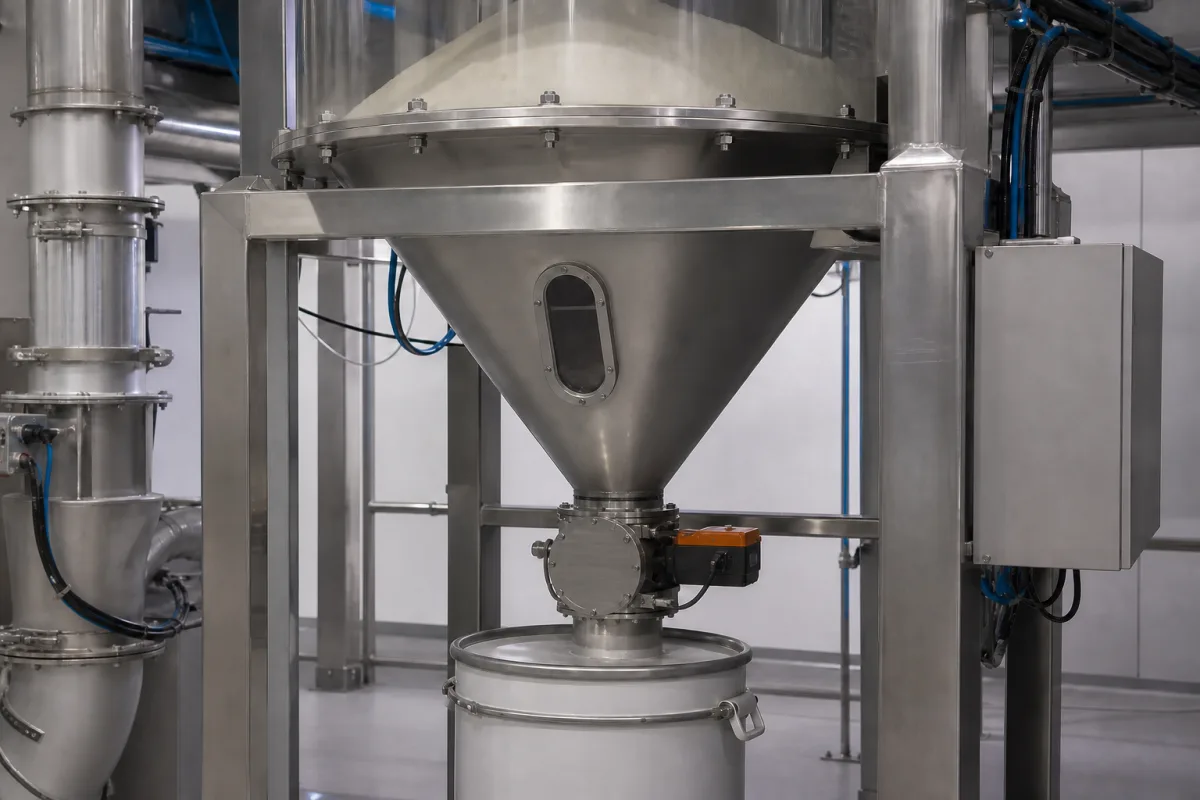
A funnel-shaped container that collects recovered powder from the Powder Recovery Unit for temporary storage and controlled discharge.
Product Specifications

Technical details and manufacturing context for Collection Hopper

Definition
The Collection Hopper is a critical component of the Powder Recovery Unit, designed to receive and temporarily store powder particles recovered from the system's filtration or separation processes. It typically features a conical or pyramidal shape to facilitate material flow toward the discharge outlet, often equipped with level sensors, vibrators, or agitators to prevent material bridging or compaction. Its primary function is to ensure efficient material handling between recovery and subsequent processing stages.
Working Principle
Powder-laden air or material from the recovery system enters the hopper, where particles settle due to gravity or are directed by internal baffles. The hopper's sloped walls guide the accumulated powder toward the discharge point, which may be controlled by valves, gates, or rotary feeders to regulate outflow. Level indicators monitor fill status to prevent overfilling or empty conditions.
Common Materials
Stainless Steel, Carbon Steel, Food-Grade Plastic
Technical Parameters
  • Hopper dimensions (diameter/width, height, discharge outlet size) (mm) Per Request
Components / BOM
  • Hopper Body
    Main container that collects and stores recovered powder
    Material: Stainless Steel
  • Discharge Valve
    Controls the release of powder from the hopper
    Material: Stainless Steel
  • Level Sensor
    Monitors powder level to prevent overfilling or empty conditions
    Material: Stainless Steel/Electronic Components
Engineering Reasoning
0-150 kg powder capacity, 0-0.5 bar internal pressure, -20°C to 80°C temperature
Material yield strength of 235 MPa (S235JR steel) exceeded, wall thickness reduction below 2.5 mm, powder accumulation exceeding 180 kg
Design Rationale: Hopper wall fatigue failure due to cyclic powder impact loading at 0.5-2.0 Hz frequency, exceeding material endurance limit of 150 MPa
Risk Mitigation (FMEA)
Trigger Powder bridging due to moisture content exceeding 3% by weight
Mode: Flow obstruction causing asymmetric loading and hopper wall deformation
Strategy: Installation of pneumatic vibrators with 50 Hz frequency and 100 N force rating at 45° hopper wall angle
Trigger Electrostatic charge accumulation exceeding 5 kV/m in powder stream
Mode: Powder adhesion to hopper walls reducing effective capacity by 40%
Strategy: Grounding system with resistance <1 Ω and ionization bars at discharge point

Industry Taxonomies & Aliases

Commonly used trade names and technical identifiers for Collection Hopper.

Applied To / Applications

This component is essential for the following industrial systems and equipment:

Industrial Ecosystem & Supply Chain DNA

Complementary Systems
Downstream Applications
Specialized Tooling

Application Fit & Sizing Matrix

Operational Limits
pressure: Atmospheric to 0.5 bar gauge (max)
flow rate: 0.1 to 5 m³/hr (discharge rate)
temperature: -20°C to 80°C (standard), up to 120°C with special materials
slurry concentration: Up to 70% solids by weight
Media Compatibility
✓ Polymer powders (e.g., PVC, polyethylene) ✓ Metal powders (e.g., aluminum, steel) ✓ Ceramic powders (e.g., alumina, silica)
Unsuitable: Highly hygroscopic or caking powders without agitation/aeration
Sizing Data Required
  • Maximum batch volume (m³)
  • Required discharge rate (kg/hr or m³/hr)
  • Material angle of repose (degrees)

Reliability & Engineering Risk Analysis

Failure Mode & Root Cause
Abrasive wear and erosion
Cause: Continuous flow of abrasive materials (e.g., sand, minerals, metal chips) causing gradual thinning of hopper walls, especially at impact zones and flow transition points.
Corrosion and material degradation
Cause: Exposure to moisture, chemicals, or corrosive materials leading to pitting, rust, or material breakdown, particularly in seams, welds, and areas with material buildup.
Maintenance Indicators
  • Visible thinning, bulging, or deformation of hopper walls indicating structural weakness
  • Unusual vibrations, rattling noises, or material leakage from seams/welds during operation
Engineering Tips
  • Install wear liners or abrasion-resistant plating at high-impact areas and implement regular thickness monitoring with ultrasonic testing
  • Apply protective coatings suitable for handled materials, ensure proper drainage to prevent moisture accumulation, and maintain consistent material flow to prevent corrosive buildup

Compliance & Manufacturing Standards

Reference Standards
ISO 14122-3:2016 - Safety of machinery - Permanent means of access to machinery - Part 3: Stairs, stepladders and guard-rails ASME B31.3:2022 - Process Piping EN 1090-2:2018 - Execution of steel structures and aluminium structures - Part 2: Technical requirements for steel structures
Manufacturing Precision
  • Flatness of mounting flange: +/- 0.5 mm
  • Concentricity of inlet/outlet connections: +/- 1.0 mm
Quality Inspection
  • Visual Inspection for weld quality and surface defects
  • Pressure Test (hydrostatic or pneumatic) for leak tightness

Factories Producing Collection Hopper

Verified manufacturers with capability to produce this product in China

✓ 93% Supplier Capability Match Found

T Technical Director from Germany Jan 10, 2026
★★★★★
"Testing the Collection Hopper now; the technical reliability results are within 1% of the laboratory datasheet."
Technical Specifications Verified
P Project Engineer from Brazil Jan 07, 2026
★★★★☆
"Impressive build quality. Especially the technical reliability is very stable during long-term operation. (Delivery took slightly longer than expected, but technical support was excellent.)"
Technical Specifications Verified
S Sourcing Manager from Canada Jan 04, 2026
★★★★★
"As a professional in the Machinery and Equipment Manufacturing sector, I confirm this Collection Hopper meets all ISO standards."
Technical Specifications Verified
Verification Protocol

“Feedback is collected from verified sourcing managers during RFQ (Request for Quote) and factory evaluation processes on CNFX. These reports represent historical performance data and technical audit summaries from our B2B manufacturing network.”

14 sourcing managers are analyzing this specification now. Last inquiry for Collection Hopper from Poland (1h ago).

Supply Chain Compatible Machinery & Devices

Automated Assembly Line System

Integrated production system for sequential component assembly operations

Explore Specs →
Automated Powder Coating System

Integrated industrial system for applying dry powder coatings to metal substrates.

Explore Specs →
Centrifugal Pump Impeller

Rotating component that transfers energy to fluid in centrifugal pumps.

Explore Specs →
High-Precision CNC Laser Cutting Machine

Computer-controlled industrial machine using focused laser beams to cut sheet metal with micron-level accuracy.

Explore Specs →

Frequently Asked Questions

What materials are available for the Collection Hopper?

The Collection Hopper is available in Stainless Steel for corrosion resistance, Carbon Steel for durability, and Food-Grade Plastic for sanitary applications in food or pharmaceutical industries.

How does the discharge valve work in the Collection Hopper?

The discharge valve allows controlled release of collected powder from the hopper, preventing spillage and enabling precise material transfer to downstream processes or packaging systems.

What is the purpose of the level sensor in the Collection Hopper?

The level sensor monitors powder volume in the hopper, preventing overfilling, optimizing discharge cycles, and enabling automated operation when integrated with powder recovery systems.

Can I contact factories directly on CNFX?

CNFX is an open directory, not a transaction platform. Each factory profile provides direct contact information and production details to help you initiate direct inquiries with Chinese suppliers.

Get Quote for Collection Hopper

Request technical pricing, lead times, or customized specifications for Collection Hopper directly from verified manufacturing units.

Your business information is encrypted and only shared with verified Collection Hopper suppliers.

Thank you! Your message has been sent. We'll respond within 1–3 business days.

Need to Manufacture Collection Hopper?

Connect with verified factories specializing in this product category

Add Your Factory Contact Us
Previous Product
Collection Hood
Next Product
Collection Hoppers